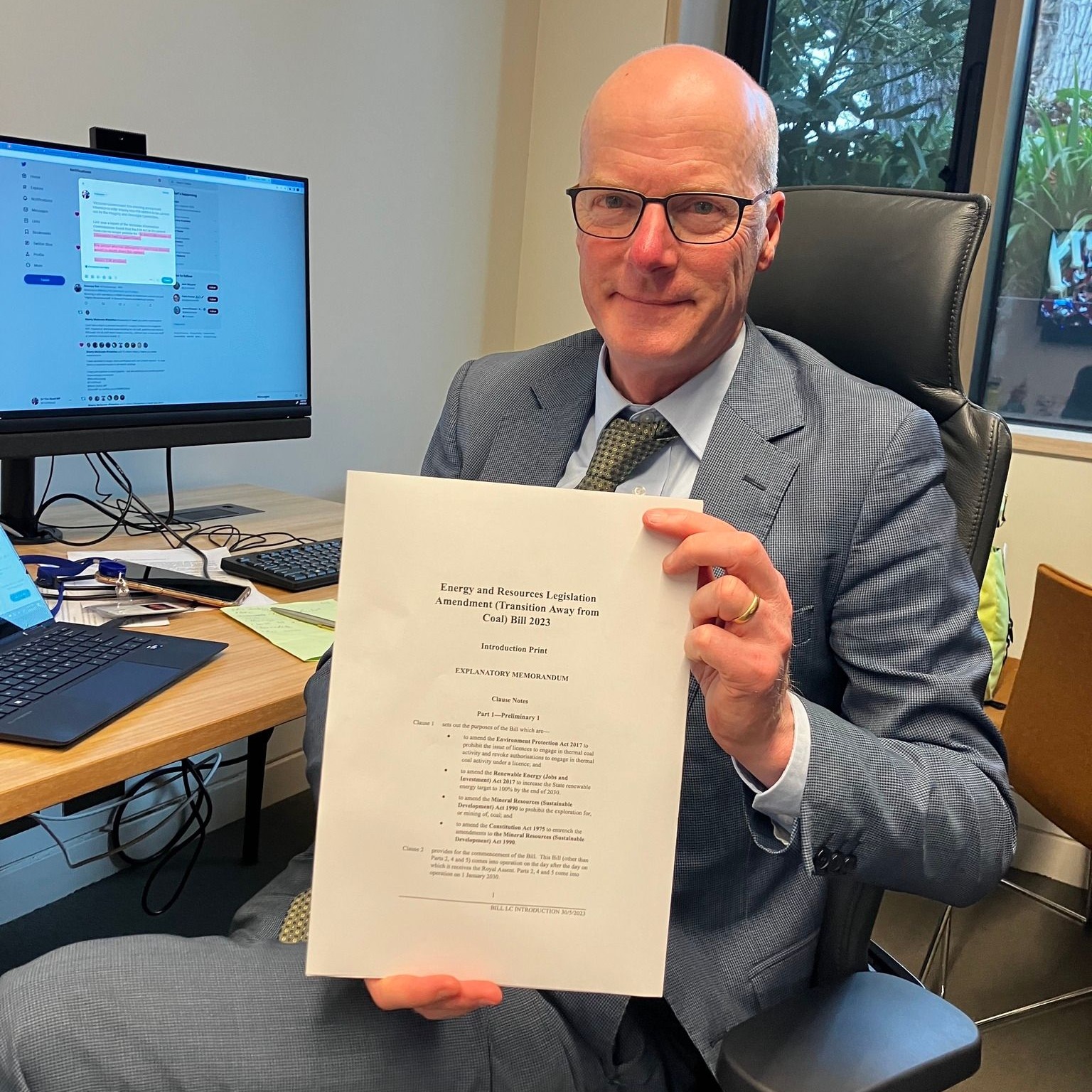
The Greens in the Legislative Council have presented legislation to a second reading to end coal mining, coal burning, and coal to hydrogen processing in Victoria by the end of 2030.
Greens Western Region MP Sarah Mansfield moved the second reading motion of the Energy and Resources Legislation Amendment (Transition Away from Coal) Bill 2023. It will come back for discussion in about 2 weeks time.
In her speech Mansfield acknowledges the Victorian Governments more ambitious climate targets for 2035, which will probably see coal power disappear by that date.
But Mansfield also takes note that brown coal mining could continue as part of coal to hydrogen for export to Japan, with the Government to attempt to sequester emissions in the depleted oil and gas wells in Bass Strait.
There are a number of huge problems with this. Carbon Capture and Storage (CCS) projects seldom achieve there stated emissions sequestration rates. And there are always fugitive emissions in burning and processing the coal to hydrogen and transporting the carbon dioxide by pipeline to the old wells.
Labor will likely vote against this Bill, highlighting their continued support for coal at all costs.
On 16th May the Labor Government locked in new climate targets for 2035, tabling them in parliament. These 2035 climate targets had been announced by the Premier in October 2022, prior to the State Election
- 75-80% emissions reduction target for 2035,
- Net zero by 2045,
- New Renewables Targets VRET of 65% by 2030, 95% by 2035.
Local Brunswick Greens MP Tim Read said on Facebook regarding the Transition Away from Coal Bill:
“the Victorian Labor Government continues to support opening new coal and gas projects – including a disastrous brown-coal-to-hydrogen project, that would expand coal mining in Victoria.
“Our Transition Away from Coal Bill 2023 would ban destructive new coal projects and, in a world first, cement that ban in Victoria’s Constitution.
“By getting this ban in the Victorian Constitution, there’s a very high bar to overturn it. This means no future Government could continue this threat to our climate and environment.
“There is so much potential for Victoria beyond coal. There are huge opportunities for new jobs in offshore wind, clean manufacturing and mine rehabilitation.”
Tim Read MP Facebook post
.
It is worth reading Sarah Mansfield’s speech in full:
Speech by Sarah Mansfield (Greens – Western Region)
Just this year, we have seen record bushfires in Chile, cyclones in south-eastern Africa, and heatwaves across China, India, and other parts of Asia.
Now, the World Meteorological Organization announced the earth will exceed our make-or-break 1.5- degree limit within just five years. Breaching this limit will be catastrophic, and every fraction of a degree beyond it will cost more lives.
And credit where it is due, Labor is taking action, announcing last year a 95 per cent renewable electricity target for 2035 – not as soon as the science demands, but a far cry better than many of our other state and federal colleagues.
But unfortunately, that promise very well may mean nothing in terms of emissions, because while the Andrews government may not want our energy coming from brown coal – the dirtiest in Australia – it is apparently happy to continue mining and burning brown coal to export to the world in the form of hydrogen, as part of the so-called Hydrogen Energy Supply Chain, or HESC, project.
Back in 2018, Labor threw $50 million of Victorian taxpayer money to this brown-coal-to-hydrogen project as a pilot. Along with co-funding from the then coalition federal government, Victorian Labor supported the plan to turn our dirtiest fossil fuel, brown coal, into hydrogen for export to Japan.
Now the Labor Treasurer tells us that the project – which will expand our coal industry – won’t add to Victoria’s emissions because we’ll capture the emissions through ‘carbon capture and storage’ in disused offshore gas wells in the Gippsland basin. Labor is planning to do this through the CarbonNet project, which was also given $150 million in taxpayer funding.
There’s just one problem with this plan: carbon capture and storage has failed to actually capture anywhere near the emissions it has promised, anywhere in the world. For example, Chevron’s Gorgon gas development facility in WA saw emissions increase 50 per cent last year. That project was delayed by more than three years and has actually gotten less efficient every year since coming online in 2019 – falling from 2.7 million tonnes captured in 2019–20 to just 1.6 million tonnes last financial year.
But despite all of this – and despite the fact that the pilot HESC project produced just 1 tonne of hydrogen in its maiden shipment, instead, embarrassingly, having to purchase more than half of its minimum total requirement – the pilot was declared a success.
In March this year the Victorian Labor Treasurer Tim Pallas announced that he had secured a $2.35 billion deal through the Japanese government’s misleadingly named Green Innovation Fund – delivered to a consortium of energy providers led by Kawasaki Heavy Industries – to expand this coa-lto-hydrogen project to a commercial-sized operation. Even with CCS, carbon capture and storage, working at full capacity, the Australia Institute found the project will likely still increase emissions by up to 3.8 million tonnes per year.
I’ll repeat that: in a climate emergency, the Labor government thinks it’s a good idea to expand our brown coal industry. It’s almost too ludicrous to say aloud.
What’s more, they have kept crucial details of this hidden from the public.
On 22 March, the Legislative Council passed the Greens’ resolution requiring that the government provide briefings, assessments, analyses, examinations, modelling and consultancy reports on the HESC. Unsurprisingly, Labor did not meet this requirement, citing time constraints, but told us they were preparing a response in mid-April.
The Greens continue to wait, with bated breath, for the government to eventually provide transparency over this hugely significant project. But amid obvious state capture of the fossil fuel industry during a climate crisis, there is hope.
The sheer idiocy of the Hydrogen Energy Supply Chain project has at least not escaped the energy minister, who is reportedly against it. We suspect there are others in Labor who appreciate what a bad idea this is.
This bill is their chance to prove it.
On behalf of the Greens, I’m proud to introduce a bill today to phase out coal for good in Victoria and replace it with clean, renewable energy. The Energy and Resources Legislation Amendment (Transition Away from Coal) Bill 2023 would ban destructive new coal projects like the HESC and, in a world first, cement that ban in Victoria’s constitution.
This bill sets a certain end date for coal burning in Victoria of 2030. It amends the Environment Protection Act 2017 such that all existing thermal coal activity will cease by 2030, and no new thermal coal activity can occur after this point.
It would then prohibit the exploration for, and mining of, coal after 2030, and would enshrine that ban on coal mining in the constitution. Labor has already put a ban on gas fracking in the constitution.
Given that coal is similarly devastating for our climate and our health, we hope that Labor will, similarly, support this bill.
The bill defines ‘thermal coal activity’ as establishing, expanding, operating or modifying a coalmine or coal-fired power station. Handling, stockpiling, processing or transporting coal is also captured by the definition, as is using coal for making hydrogen – no matter how ‘clean’ the industry wants to mislabel it.
The bill provides that where the Environment Protection Authority has given a licence for thermal coal activity past 2030, such a licence will be revoked. From an abundance of caution the bill also provides no compensation is payable to anyone as a result of a licence not being given or extended or revoked.
This bill would amend the Renewable Energy (Jobs and Investment) Act 2017 to increase Victoria’s renewable energy target to 100 per cent by 2030. To ensure coal is not mined here only to be burned somewhere else, the bill also amends the Mineral Resources (Sustainable Development) Act 1990 to prohibit the exploration for and mining of coal. And by putting this ban in the Victorian constitution, it ensures that there is a very high bar to overturn it so that no future government, be they Labor, Liberal, National or otherwise, could continue mining this existential threat to life on earth.
This massive expansion would sit alongside a comprehensive policy plan from the Greens that outlines, in detail, how Victoria can transition away from coal to renewables by 2030 and importantly, how workers and communities can be supported through this transition and given certainty about their futures.
The Greens want to see a job-for-job guarantee for coal workers and secure funding to 2035 for an independent Latrobe Valley Authority, which has so far received piecemeal funding and needs a bigger remit. The authority would be tasked with the closure of Victoria’s coal plants and the development of new industries for the region such as offshore wind, clean manufacturing and mine site rehabilitation.
While the bill sets an end date for coal of 2030, our plan spells out closure dates for Victoria’s remaining coal plants: Yallourn, 2024; Loy Yang A, 2027; and Loy Yang B, 2030. This will give certainty to the industry, workers and communities while also recognising that the science demands we cannot continue using or burning coal, especially not after 2030, if we have any hope of a safe future for ourselves, our children and their children.
There is so much potential for the Latrobe Valley beyond coal. There are huge opportunities for new jobs in offshore wind, clean manufacturing and mine rehabilitation, but only if governments are honest about the transition that’s needed, give certainty, and plan ahead to support the transition – unlike what happened with Hazelwood when the Labor government assured this Parliament and communities that Hazelwood would stay open when they knew it was about to close.
When it comes to replacing coal with 100 per cent renewable energy, the great news is that it’s absolutely achievable.
With the announcement of 95 per cent renewables by 2035, the Andrews government faced the fact that we must shut down all coal plants over the next decade – and, if they are being honest with themselves, likely much sooner than those coal giants forecast. But it would mean nothing if Victoria continues to mine and burn coal, including for hydrogen for export.
So let’s see Labor put its money where its mouth is. Let’s phase out coal for good, get to 100 per cent renewables and support workers and communities along the way. I look forward to support from all representatives here when we debate this bill in June. I commend this bill to the house.
 Climate Action Merribek