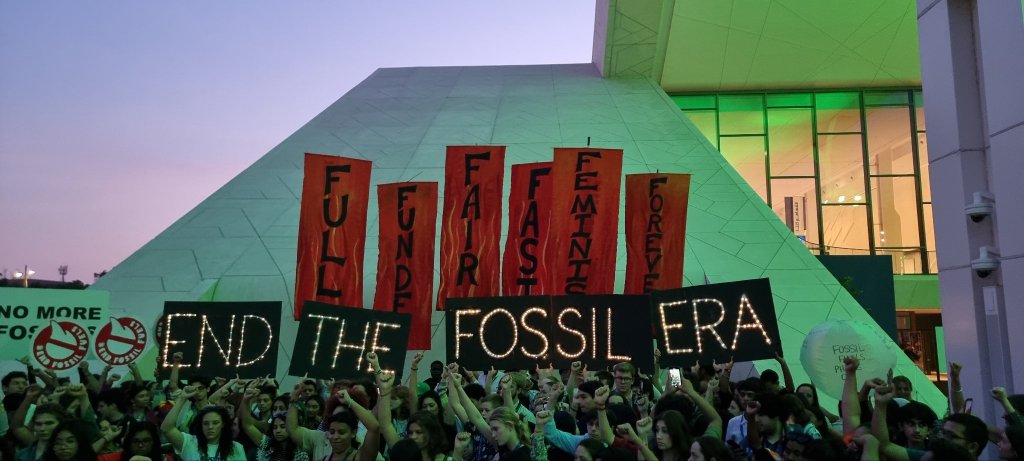
For the first time in 28 yearly meetings of the United Nations Framework Convention on Climate Change (UNFCCC) the elephant in the room was debated and named: the burning of fossil fuels causing 90 percent of greenhouse gas emissions and global warming.
At COP28 in Dubai the big debate was on phaseout of all fossil fuels: coal, oil and gas. It is ironic that the turning point for Fossil Fuels came at a climate conference held in a Petro state (UAE), presided over by the CEO of UAE’s National oil company (ADNOC), and with a record number of fossil fuel lobbyists in attendance. Many thought Sultan Al Jaber would not be able to pull together an agreement, but he achieved a decision to be known as the UAE Consensus.
While there were positive elements in the decision , there were also major compromises in the deal. And the decision was gavelled through despite the absence at the time of representation by AOSIS representing 39 island nations, who would have raised concerns with the text..
Despite the debate in COP on Fossil Fuel Phaseout, the phrase ‘Fossil Fuels’ is only mentioned once in the Global Stock Take Document that was adopted, as part of the three paragraphs of the Energy package. Paragragh 28 (d):
“Transitioning away from fossil fuels in energy systems, in a just, orderly and equitable manner, accelerating action in this critical decade, so as to achieve net zero by 2050 in keeping with the science;”
In 2021 at COP26 the final decision specified the phasedown of coal was needed, the first time that either coal, oil or gas was ever mentioned in decision text.
There is no doubt that this signals the start of the end for Fossil fuel production and use. It should send a market signal to Banks and Superannuation Funds regarding loans and investment.
The pledge to triple renewable energy and double energy efficiency was incorporated in Paragraph 28(a). As renewables ramp up this will displace coal, oil and gas use in energy systems.
The November announcement by Australia to ramp up investment in renewables via the Capacity Investment Scheme provides a plan to meet the 82 percent renewables target by 2030 which is in line with the COP28 decision to triple renewables.
Paragraph 28 (h) addresses the need to phase out Fossil Fuel subsidies. Even with the weasel word use of ‘inefficient’ and the qualifying phrase on ‘energy poverty or just transition’, Australia should be already planning the phase out of these subsidies. Current tax subsidies alone are estimated at about $11 billion per annum. Reuters reports that a Dutch-led coalition has moved to phase out fossil fuel subsidies at COP28. The Netherlands plan is backed by Antigua and Barbuda, Austria, Belgium, Canada, Costa Rica, Denmark, Finland, France, Ireland, Luxembourg and Spain. Australia is missing!
28 (h) Phasing out inefficient fossil fuel subsidies that do not address energy poverty or just transitions, as soon as possible;
The UNEP Production Gap report produced shortly before the conference started clearly shows we have more fossil fuels currently in production than we need to meet the Paris Agreement 1.5C temperature target. It singled out Australia as a major fossil fuel producer highlighting that Ministers had rejected calls to ban new fossil fuel projects, that some 69 coal projects and 49 new oil and gas projects are in the pipeline which represent nearly 5 GtCO2eq of potential emissions. Fossil fuel production is also a major source of Australia’s domestic emissions, accounting for 19% of the total in 2021, reports Climate Action Merribek convenor John Englart at his Climate Citizen blog.
The Federal Labor Government has approved 10 new or extended coal or gas projects since coming to power in May 2022.
Loopholes for Fossil Gas
This was a compromise deal, however. There are substantial loopholes in the text to allow continuation of fossil fuel use, particularly Fossil Gas.
Paragraph 28 (d) specifies it only applies to energy systems has let the Petrochemicals, Plastics and synthetic fertiliser and other industrial processing completely off. For some years the Fossil fuel sector have seen these areas for expansion and profitability. Specifying ‘energy systems’ has applied a silo approach and fails to recognise the huge threat from plastics production, pollution and microplastics creating the Plastics Crisis.
Paragraph 29 which only came in at the last draft will be used by Fossil Gas to maintain they are needed to continue to produce fossil gas, and even open up new gas fields. But Gas is no longer a Transition Fuel, and in total lifecycle emissions is often worse than coal.
29. Recognizes that transitional fuels can play a role in facilitating the energy transition while ensuring energy security;
Paragraph 28(e) specifies some solutions which are a distraction and way to delay the exit of fossil fuels. Nuclear is hugely expensive and comes with substantial opportunity cost as well as potential disaster risks. Carbon Capture Utilisation and Storage has limited effectiveness, needs constant monitoring and needs to be site specific. The IEA has warned not to rely on CCS except for hard to abate processes. We should not be applying the technology to justify openning new gas fields. While there is a future for green hydrogen, the risk is that this will justify producing Blue hydrogen made from Fossil Gas with CCS.
28 (e) Accelerating zero- and low-emission technologies, including, inter alia, renewables, nuclear, abatement and removal technologies such as carbon capture and utilization and storage, particularly in hard-to-abate sectors, and low-carbon hydrogen production;
Science and some target milestones recognised
The Science is recognized and clearly stated that we need to sustain reductions in global greenhouse gas emissions of 43 per cent by 2030 and 60 per cent by 2035 relative to the 2019 level. We need to peak global emissions before 2025.
Paragraph 26 and 27 clearly states the science
26.Recognizes the finding in the Synthesis Report of the Sixth Assessment Report of the Intergovernmental Panel on Climate Change,2 based on global modelled pathways and assumptions, that global greenhouse gas emissions are projected to peak between 2020 and at the latest before 2025 in global modelled pathways that limit warming to 1.5 °C with no or limited overshoot and in those that limit warming to 2 °C and assume immediate action, and notes that this does not imply peaking in all countries within this time frame, and that time frames for peaking may be shaped by sustainable development, poverty eradication needs and equity and be in line with different national circumstances, and recognizes that technology development and transfer on voluntary and mutually agreed terms, as well as capacity-building and financing, can support countries in this regard;
27. Also recognizes that limiting global warming to 1.5 °C with no or limited overshoot requires deep, rapid and sustained reductions in global greenhouse gas emissions of 43 per cent by 2030 and 60 per cent by 2035 relative to the 2019 level and reaching net zero carbon dioxide emissions by 2050;
Export Fossil Fuels
Australia is the 3rd largest exporter of Fossil fuels globally. But the Paris Agreement only looks and measures emissions where they occurr. While Scope i and 2 emissions in the export of fossil fuels Australia has to take responsibility for, the Scope 3 emissions caused when fossil fuels are burnt are nominally the reponsibility of the country where that happens.
So Australia get a free ticket pass to continue to expand and export fossil fuels while the demand is there. None of the negotiations address that issue. Despite the UNEP Production Gap highlighting the excess in supply of fossil fuels for a global carbon budget.
This means Climate Minister Chris Bowen can be ambitious regarding domestic Australian emissions and push for ambitious Fossil Fuel phaseout in the negotiating texts.
It won’t affect Australia’s fossil fuel exports until demand declines in importing countries. But that time will come Both Japan and South Korea have set net-zero by 2050 targets, which means they won’t be able to burn fossil fuels unless fully abated through carbon capture and storage. And the technology to ramp up successful capacity of CCS is limited.
Australia pushes for ambition and Fossil Fuel Phaseout
Climate Finance
Australia made two announcements on Climate Finance at COP28. $50 million contribution to the Green Climate Fund which Australia has recently rejoined. Australia also contributed $100 million to the newly established Pacific Climate Resilience Fund. Australia was on the transitional Committee for the Loss and Damage Fund that was established and operationalised on day one of COP28. Australia has been silent on contributing to this fund. NGOs have called in an open letter for $100 million initial contribution to the Loss and Damage Fund.
Speaking on ambition and fossil Fuel phaseout
Here is Chris Bowen articulating ambition off the cuff at the Majlis event on 9 December. It is a powerful speech. But keep in mind any Fossil Fuel phaseout won’t immediately impact Fossil fuel exporters and their plans for expansion of production.
Final Plenary comments by Chris Bowen
Here is Chris Bowen at the Final Plenary speaking on behalf of the Umbrella group of nations:
Here is an excerpt of his speech on behalf of the Umbrella Group:
The outcome does not go as far as many of us have asked for, starting with some of the most vulnerable countries, but the message it sends is clear.
That all nations of the world have acknowledged the reality that our future is in clean energy, and the age of fossil fuels will end.
The Global Stocktake also shows that the nations of the world have come a long way under the Paris Agreement.
Eighty-seven percent of the global economy is now covered by a climate neutrality target and almost all countries have commitments to cut emissions.
But the Stocktake also shows that we have a long way to go – that we need a step change to keep 1.5 degrees within reach.
The Stocktake affirms the latest science – that we will need to cut global emissions by 43% by 2030 and 60% by 2035.
We stand behind its call for future NDCs to be aligned with 1.5 degrees. This is the guiding “North Star” as countries prepare most ambitious NDCs.
We stand behind its calls for NDCs to have economy-wide emission reduction targets, covering all sectors, gases, and categories.
We stand behind its call for a tripling of renewable energy, doubling of energy efficiency and substantially reducing non-CO2 emissions.
DCCEEW transcript
He concluded his speech addressing Pacific Countries in particular: “The Pacific has long called for the highest possible ambition to keep 1.5 alive, and while this outcome today may not have fully met their calls, their voices are being heard. The message from this COP on the urgency of the energy transition is loud and clear; we must now deliver.”
Time will tell whether the Ministers rhetoric is backed up with action, particularly in addressing new fossil fuel export projects and fossil fuel subsidies, which Australia is being criticised for by the UNEP 2023 Production Gap Report, 2024 Climate Change Performance Report, and others,
The IEA report on The Oil and Gas Industry in Net Zero Transitions stresses the importance of that the problem with fossil fuels needs to be tackled at both the demand end and the supply side. Both actions are needed, and transitions work best when change is collaborative and cooperative.
The Climate Action Tracker also singles out Australia’s expansion of the fossil fuel industry as problematic.
Climate Action Tracker assessment
The Climate Action Tracker rates Australia overall as Insufficient (which is a slight improvement). For Fossil Fuels it says:
“The government continues to endorse the expansion of the fossil fuel industry by supporting new carbon-intensive offshore gas field developments, permitting fracking, approving new coal mines, and creating regulations for CO2 sequestration beyond its borders, in contradiction with its stated climate goals.”
Policies and action against modelled domestic pathways: INSUFFICIENT, < 3°C WORLD
NDC target against modelled domestic pathways: ALMOST SUFFICIENT, < 2°C WORLD
NDC target against fair share: INSUFFICIENT, < 3°C WORLD
Climate finance: CRITICALLY INSUFFICIENT

References
UNFCCC, 13 December 2023, Matters relating to the global stocktake under the Paris Agreement (unedited version of Decision) https://unfccc.int/documents/636584
DCCEEW Minister Speech to COP28 Final Plenary, 13 December 2023, https://minister.dcceew.gov.au/bowen/speeches/cop28-umbrella-group-closing-statement
UNEP, 8 November 2023, Production Gap Report 2023, https://www.unep.org/resources/production-gap-report-2023
IEA, 23 November 2023, Oil and gas industry faces moment of truth – and opportunity to adapt – as clean energy transitions advance https://www.iea.org/news/oil-and-gas-industry-faces-moment-of-truth-and-opportunity-to-adapt-as-clean-energy-transitions-advance
Climate Action Tracker, Assessment for Australia, 11 December 2023, https://climateactiontracker.org/countries/australia/
 Climate Action Merribek