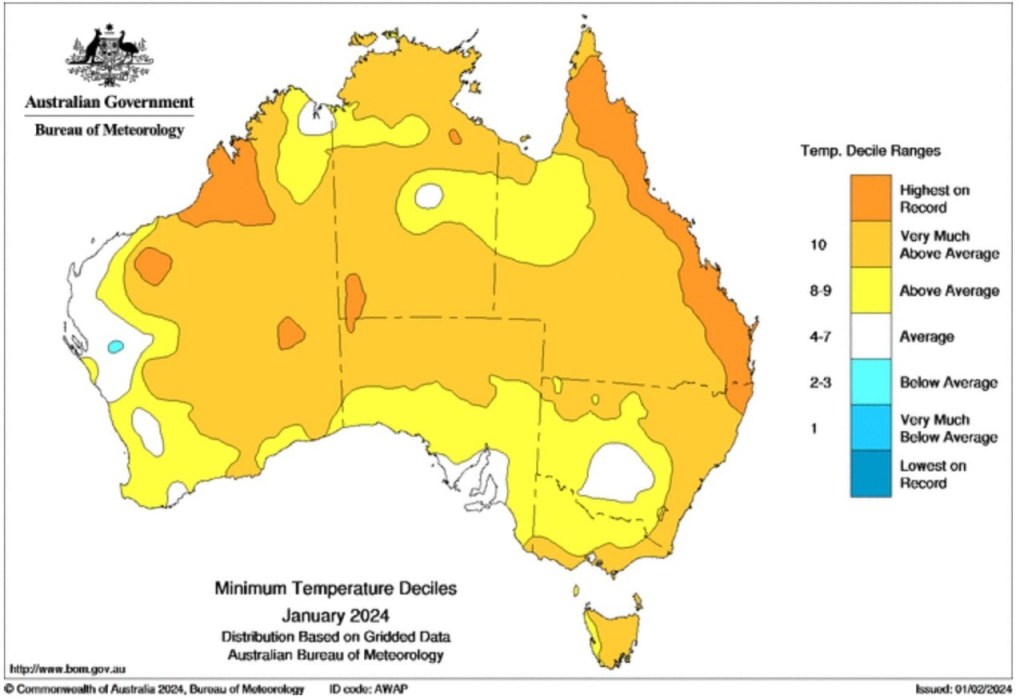
If you thought the nights were warmer in January, for nearly all Australia, you would be right. Much of east coast was highest Area Average Tmin on record for January 2024. Averaged over Australia it was third highest for the month in records going back to 1910.

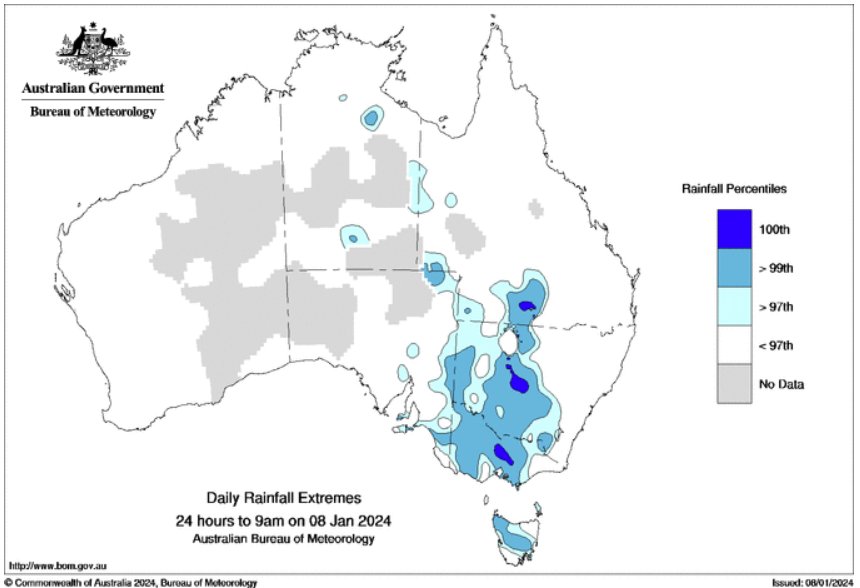
Wettest on record start to the year for Victoria
The Bureau of Meteorology identified the first nine days of 2024 were Victoria’s wettest since records began in 1900, with an average of 62mm falling across the state since 1 January. The area-average of 62mm of rain from 1 January to 9 January beat the previous opening nine-day record of 50mm set in 1970. New Rainfall records were set.
For Victoria, it was the fifth-wettest January on record and the highest January rainfall total since 2011. The mean minimum temperature was above average across the state and very much above average (in the highest 10% of historical observations) for southern parts of the state.
To her credit Premier Jacinta Allan acknowledged Climate Change driving more extreme Weather and said it justifies energy Transition being undertaken by Victoria.
Interviewed by Richard Willingham on ABC Melbourne, Premier Jacinta Allan said;
“There is clearly a change in our climate. Growing up in this part of the world, these summer storm events, it is troubling that it is becoming more common and the ferocity of these events. It does speak to the fact we need to recognise that the climate is changing. It does go to those broader measures we need to take as a government, as a community, as a society for action to transition to renewable energy, transition to how we can take stronger climate action.”
“Separate to that, what also needs to be considered obviously as we plan for new houses, new communities, or how we build projects, these weather events and the impact of these weather events do need to be factored in. Indeed, legislation that went through the Victorian Parliament last year, our climate legislation, did require that the impact of the climate be factored into the planning initiatives at the earliest Opportunity.”
“…. What used to be a 1 in 100 year event for communities like Rochester have had 3 big flooding events in 10-11 years. The impact of climate does need to be considered in terms of future planning and decisions.”
The Federal Government has now come on board with emergency and hardship payments to individuals, businesses and Councils as announced by Prime Minister Anthony Albanese on Wednesday 10 January, at the State Disaster Control Centre.

The Victorian city of Bendigo had 91.8mm in the 24 hours to 9am on Monday: its wettest day in records dating back to 1863. Bendigo Prison rainfall record was 87.6mm on 28 Mar 1914. (Records 1862-1992) Bendigo Airport record was 66.4mm on 05 Feb 2011 (Records back to 1991)
Redesdale new daily rainfall record of 117.2mm. Previous January record was 78.6mm 14 Jan 2011, Previous all time record was 92.7 on 17 Feb 1972. (Records back to 1903)
Seymour Shire Depot new January daily rainfall record of 98mm. Highest previous January record was 57.2mm 18 Jan 1945. Highest record of 100.3 on 18 Mar 1950. (Records back to 1880)
Wallan (Kilmore Gap) new January daily rainfall record of 95.6mm. Previous record was 60mm on 29 Jan 1995. Highest on record is 111mm on 03 Feb 2005. (Records back to 1993)
Heathcote also set a new rainfall record of 154.4mm.
Puckapanyal at 121.2mm.
Yea at 88.4mm.
Daily Sea Surface Temperatures
A quick check of global daily SeaSurfaceTemperatures …
Yep, still at record levels as at 31 Jan 2024
Ocean Heat is a climate factor driving intensity and frequency of extreme weather events.


Australia’s Climate in 2023
The Bureau of Meteorology has released its assessment and analysis of 2023. Here are the key points:
- Australia’s equal eighth-warmest year on record with the national mean temperature 0.98 °C warmer than the 1961–1990 average.
- Both the mean annual maximum and minimum temperatures were above average for all States and the Northern Territory.
- Winter was Australia’s warmest on record, with the national mean temperature 1.53 °C above the 1961–1990 average.
- Widespread warmth throughout the second half of the year. The mean national temperature for June, July, August, September, November and December were among the ten warmest on record.
- Between October to December parts of northern and central Australia were affected by frequent low-to-severe intensity heatwave conditions.
- Nationally-averaged rainfall was 1.6% above the 1961–1990 average at 473.70 mm.
- Rainfall was above the 1961–1990 average for much of northern Australia, but below the 1961–1990 average for Tasmania, much of the south-eastern quarter of Queensland, parts of northern New South Wales, western and southern Western Australia, and parts of southern Victoria, eastern and south-western South Australia.
- In the first quarter, Australia experienced multiple major flood events, mostly across inland and northern regions.
- The August to October period was Australia’s driest three month period on record since 1900.
- Surface water storages declined, including those in the Murray–Darling Basin. However, Australia’s total surface water storage volume remained high at the end of the year (at 74.1% of its accessible capacity).
- Major global-scale climate influences on Australian climate in 2023 were La Niña at the start of the year, an El Niño and a strong positive Indian Ocean Dipole which were established in early spring, and a positive phase of the Southern Annular Mode towards the end of the year.
- Globally, it was the warmest year on record, with record warm oceans since April and record low Antarctic sea ice extent for much of the year.
References
Bureau of Meteorology, 8 February 2024, Annual Climate Statement, http://www.bom.gov.au/climate/current/annual/aus/
 Climate Action Merribek