
On Sunday it was observed that soccer was being played at CB Smith Reserve in Fawkner during the first true heatwave of the 2024 summer. This was in a girls competition. The girls were playing in 35.8C ambient temperature, 22% humidity at 2.20pm. That places them into moderate heat health risk, and approaching high risk, according to Sports Medicine Australia Extreme Heat policy published February 2021
Maybe the soccer club had organised more frequent breaks, or drink stoppages implemented which are risk mitigation measures at moderate level.
I am only glad this wasn’t on synthetic turf which would amplify the heat health risks. Synthetic Turf can reach spot temperatures up to 80C in direct sunlight posing a direct health stress risk to playing on the surface.
This highlights that as well as professional sport, community sport needs to take the risks of climate change seriously, especially heat health risks to people participating in community sport.
It is unknown whether there is an elevated heat health risk to children or young people playing in these heat conditions. The Sports Medicine Australia document says near the end : “currently unclear if heat stress risk is truly elevated in children”
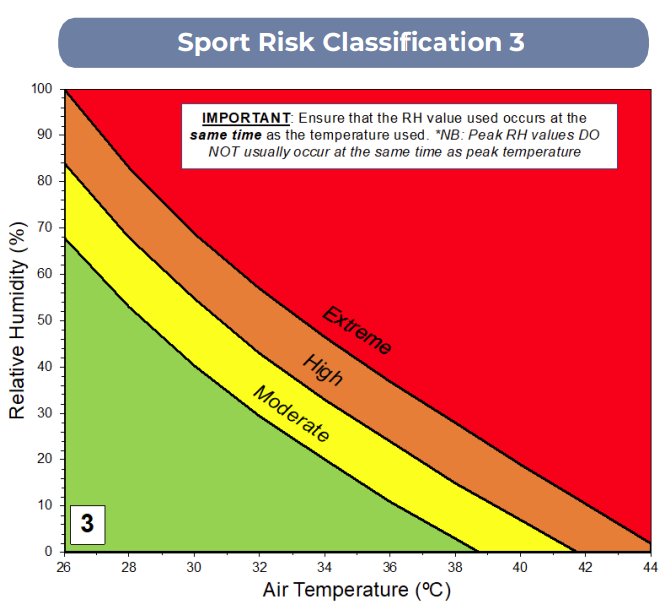
Sports Medicine Australia recommends at the moderate risk level:
“When the heat stress risk is moderate, increasing the frequency and/or duration of your rest
breaks during exercise or sporting activities is an effective way of reducing your risk for heat
illness even if minimal resources are available.
- During training sessions, provide a minimum of 15 minutes of rest for every 45 minutes
of practice. - Extend scheduled rest breaks that naturally occur during match-play of a particular
sport (e.g. half-time) by ~10 mins. This is effective for sports such as soccer/football and
rugby and can be implemented across other sports such as field hockey. - Implement additional rest breaks that are not normally scheduled to occur. For example,
3 to 5-min “quarter-time” breaks can be introduced mid-way through each half of a
football or rugby match, or an extended 10-min drinks break can be introduced every
hour of a cricket match or after the second set of a tennis match. - For sports with continuous play without any scheduled breaks, courses or play duration
can be shortened - During all breaks in play or practice, everyone should seek shade – if natural shade is not
available, portable sun shelters should be provided, and water freely available.
NOTE: While hats provide UV protection, they provide minimal protection against the heat.”
See the Sports Medicine Australia Extreme Heat Policy (below in References) for mitigation action at other heat health risk levels
In 2023 in late January/ early February an A-League Women’s match in Canberra went ahead in extreme heat conditions with temperature over 35C. The match commissioner, in consultation with the two team doctors, implemented two drinks breaks per each 45-minute half, as well as the provision of ice towels and extra water. But multiple players reportedly experienced symptoms of heat strain afterwards, with one player from Western United having to be attended to by ambulance officers at McKellar Park.
Cancelling or Pushing back play has its own problems, as explained in the ABC Story of that 2023 game.
But the heat health of players needs to be considered, and mitigation against heat injury needs to be planned for, even at community levels of sport.
The recent example of the death of Manly Sea Eagles player Keith Titmuss from exertional heat stroke should carry warnings. Titmuss was a fit young man and the exertional heat stroke ocurred at practice in relatively mild temperatures.
Community sport needs to take the issue of heat health seriously.

References
Sports Medicine Australia, February 2021, Extreme Heat Policy, https://sma.org.au/wp-content/uploads/2023/03/SMA-Extreme-Heat-Policy-2021-Final.pdf
Samantha Lewis, ABC News, Sat 4 Feb 2023, A-Leagues to revise heat policy after Canberra v Western women’s game goes ahead in extreme conditions https://www.abc.net.au/news/2023-02-04/a-leagues-revise-heat-policy-womens-game-goes-ahead-extreme/101905740
Helena Burke, ABC News, 11 Feb 2024, The dangers of exertional heat stroke which killed Manly Sea Eagles player Keith Titmuss https://www.abc.net.au/news/2024-02-11/nsw-what-is-exertional-heat-stroke-keith-titmuss-death/103447718
Photo of soccer game at CB Smith Reserve by John Englart.
 Climate Action Merribek