The Federal budget has provided a range of measures to address cost of living and also add to the energy transformation and address environmental reform. Some important initiatives include substantial funding for the Future Made in Australia Program which continues the transition and transformation of Australia on the path to becoming an energy super power.
But its measures in emissions reduction don’t match the scale needed to address the climate and biodiversity emergency. Tim Neal from UNSW asks: “Nothing is in the budget to tackle our biodiversity and extinction crisis.”
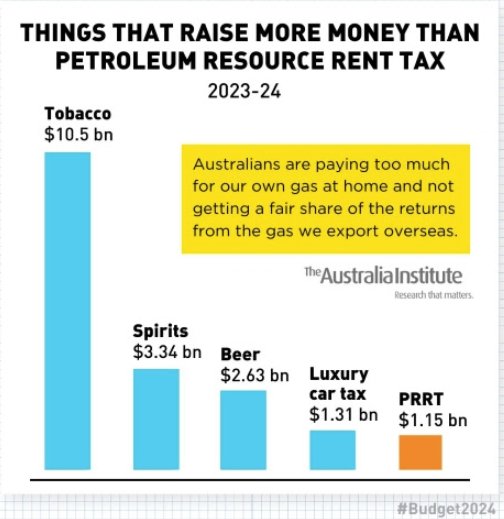
While putting money into the energy transition, it also continues fossil fuel subsidies with $54bn over five years for the fuel tax credits, and $32.6m over four years to establish regulatory frameworks for Carbon Capture and Storage. The Petroleum Resource Rental Tax (PRRT), recently revised, languishes at $2.4 billion collected over 4 financial years.
The budget was framed at Cost of Living while trying to avoid being too inflationary. The centre point of this is the provision of $3.5 billion over three years from 2023–24 to extend and expand the Energy Bill Relief Fund to provide a $300 rebate to all Australian households and a $325 rebate to eligible small businesses on 2024–25 bills to provide cost of living relief.
Some of the items of note identified by the Australian Conservation Foundation statement include:
Energy transition
- $22.7bn over a decade for the Future Made in Australia plan to underpin private investor and business confidence in building a renewable manufacturing and export industry, including
- Funding for renewable hydrogen, green metals clean energy technology manufacturing, including $8bn over 10 years to supp$154.5 million over six years from 2023–24 (and $12.6 million per year ongoing) to implement a New Vehicle Efficiency Standardort the production of renewable hydrogen and $835m to boost solar manufacturing in Australia.
- $3.2bn over a decade to the Australian Renewable Energy Agency to support commercialisation of technologies that are critical to the net zero transition, including renewable hydrogen, green metals and battery manufacturing.
- $182.7m over eight years to strengthen approval processes to support the delivery of the Future Made in Australia agenda and transition to a net zero economy, including
- $96.6m over four years to strengthen environmental approvals for renewable energy, transmission and critical minerals projects and to improve environmental data used in decision-making
- $20m to improve engagement with communities involved in the energy transition.
- $91m over next five years for the development of clean energy workforce through expanded access to New Energy Apprenticeship Program and clean energy courses.
- $399.1m over five years in additional resourcing for the Net Zero Economy Authority and Fair Work Commission to promote orderly and positive economic transformation for workers and regions affected by net zero transition.
- $47.7m over four years to maximise consumer and community benefits of the energy transition, including $27.7m to better integrate consumer energy resources, such as rooftop solar, home batteries and electric vehicles into the grid.
International climate policy
- $2m over five years to support Australia’s continued engagement in international climate change and energy transition issues, including climate diplomacy and bid to co-host the COP31
- $150m over four years in international climate finance, including $100m over three years to fund small scale climate and disaster resilience projects in the Pacific and $50m over 2 years to the UN Green Climate Fund.
Nature
- $40.9m over two years to continue implementing the Nature Positive Plan, including $5.3m additional funding to progress legislative reforms and $4.1m to drive voluntary update of the Nature Repair Market and nature-related reporting by businesses.
- $50m in 2024-25 for the Great Barrier Reef Marine Park Authority to engage tourism operators to conduct reef monitoring, protection and other stewardship activities.
Greenwashing
- $17.3m over four years to take action against greenwashing and enhance the sustainable finance framework
Funding fossil fuels
- $32.6m over four years to establish regulatory frameworks and bilateral instruments to enable industry to move carbon dioxide to geological storage sites (carbon capture and storage).
- $54bn over five years for the fuel tax credits
Nuclear and uranium
- $43m over six years to continue activities around identifying alternative pathways for disposal of Australia’s radioactive waste, including remediation of former national Radioactive Waste Management Facility.
Money for Fossil Gas
Tom Swann on X notes gas is still being funded in the budget:
- Geoscience half billion for exploration, open to gas
- CCS money, for benefit of gas industry
- $1.5bn Middle Arm fracked gas funding still there
Petroleum Resource Rental Tax (PRRT)
The Australia Institute highlights the expected revenue from the Petroleum Resource Rent Tax has been revised down in the Federal Budget, so much so that those purchasing luxury cars are contributing more than is raised by the PRRT.
PRRT “revised down by $750.0 million over the five years from 2023–24 to 2027–28” …. For 4 years the “total expected receipts from this measure of $2.4 billion from 2023–24 to 2026–27” Budget Paper 1.
Insights on transport infrastructure and reducing transport emissions
$4.1 billion over seven years from 2024–25 for 65 new priority infrastructure projects. Much of this is for road improvements but there are a few targeting public transport and active transport, tackling transport emission reduction as below:.
- $115.0 million for Zero Emission Buses Tranche 1 Infrastructure in NSW
- $50.0 million to plan for Stage 2B of the Canberra Light Rail in the ACT
- $540.0 million for the Australian Rail Track Corporation to invest in the interstate rail
network, including $150.0 million for the Maroona to Portland Line Upgrade (for freight) - $100.0 million over four years from 2025–26 for an Active Transport Fund to support the
construction and upgrade of bicycle and walking paths across Australia. - $154.5 million over six years from 2023–24 (and $12.6 million per year ongoing) to implement a New Vehicle Efficiency Standard
- $78.8 million over three years from 2023–24 for the High Speed Rail Authority to undertake the development of a business case for the Sydney to Newcastle high speed rail corridor
Treasurer’s Speech
In the Treasurer’s speech, climate was only mentioned once, in Support for small business, and in particular for farming: “And investing $625 million to help farmers and rural communities reduce emissions and better prepare for climate change and drought.”
In comparison, there was a whole section on enhancing renewable energy:
Making Australia a renewable energy superpower
We know the global energy transformation represents a golden opportunity for Australia.
The world is changing, the pace of that change is accelerating, and our approach to growth and investment needs to change as well.
If we hang back, the chance for a new generation of jobs and prosperity will pass us by – and we’ll be poorer and more vulnerable as a consequence.
This Budget invests in our renewable energy superpower ambitions –
Including $13.7 billion in production tax incentives for green hydrogen and processed critical minerals, so industries are rewarded for scale and success –
The $1.7 billion Future Made in Australia Innovation Fund, to develop new industries like green metals and low carbon fuels –
And $520 million to deepen net zero trade and engagement with our region.
We’re also allocating $566 million to map the geological potential of our entire country.
To get a comprehensive picture of our critical minerals and groundwater.
Commentary
David McEwen at Michael West Media, 13 May 2024, writing on The Other Budget: Labor staring down the barrel of a climate deficit
Australian Conservation Foundation
“There are two sides to this budget coin,” said Australian Conservation Foundation CEO Kelly O’Shanassy.
“On one side the budget allocates significant funding to the ambitious Future Made in Australia plan which, if well-executed, will help build a manufacturing and export industry powered by clean renewable energy. This is crucial to solving the climate crisis.
“But on the other side of the budget coin, serious public money is still flowing to coal and gas, especially via the Fuel Tax Credit scheme and through funding for carbon capture and storage – technology designed to extend the use-by date of climate-damaging fossil fuels.
“It makes sense to fund the industries that help us solve climate change, not the industries that got us into this mess. Propping up fossil fuel industries with public money is bad for the climate and isn’t doing anything to relieve cost of living pressures for Australians either.
“The establishment of the Environment Protection Australia and Environment Information Australia is welcome, as is the crackdown on illegal land clearing.
“But there is much more the budget has not addressed on nature law reform and threatened species recovery. Experts say $2bn a year – less than a quarter of what is splashed annually in fuel tax credits – is needed to help Australian threatened species recover.
“We welcome the money to accelerate renewable energy approvals and map threatened species habitat to make sure projects are not approved in important habitat.
“The $20m to improve engagement with communities involved in the energy transition is crucial given the rise in misinformation and disinformation.
“This is the third Albanese government budget in which less than a cent out of every dollar the Commonwealth plans to spend is allocated to climate action and nature protection.
“There is a long way to go before funding for the environment is at a scale needed to protect and restore nature and secure the services nature provides and on which we all depend.”
Climate Council
The Climate Council was more positive saying this budget was a decisive turn towards Australia’s clean energy future.
Climate Council CEO Amanda McKenzie said: “Gas and coal are not part of the budget’s vision for a Future Made in Australia, underlining that our next era of prosperity can be built on cleaner foundations. This is an essential signal across our entire economy.
“Building a renewable future and clean industrial base will deliver good jobs and greater prospects for Australians. This is critical to slash climate pollution and protect our kids’ future.
“The budget makes an important and overdue opening bid to claim our place as one of the world’s clean energy market leaders.
“Both sides of politics should back this vision for Australia. It’s not political, it is for our kids.”
Climate Council Head of Policy and Advocacy Dr Jennifer Rayner said: “To make these budget investments work, we now need two things: stronger policies to get all parts of our economy pulling in the same pollution-free direction, and clear bipartisan commitment to seize Australia’s clean energy potential.
“The investments in this budget will need to ramp up in the next term of government and beyond. All political parties must now make clear that Australia is open for clean business with good new jobs, no matter who is in charge.”
WWF
WWF-Australia’s Head of Policy, Quinton Clements said the budget had provided positive commitments for renewable energy, but not enough new money to meet the challenges of biodiversity loss and climate change.
“Tonight’s budget has left nature shortchanged,” said Mr Clements.
“This government has made welcome pledges to prevent new extinctions and protect 30% of Australia’s land and sea areas, but has again failed to deliver the funding needed to meet these commitments.
In its budget submission, WWF-Australia estimated $5.8 billion per year would be required to reverse the decline of the 110 priority species identified in the government’s own threatened species action plan.
Yet the budget delivered no new funding for threatened species recovery or protected areas.
“Our long list of threatened species is a direct result of decades of inadequate spending on species recovery and conservation,” said Mr Clements.
“We can turn this around, but it will take a dramatic increase in action and investment.”
Solar Citizens
Solar Citizens CEO Heidi Douglas said, “This Federal Budget recognised energy bills are an important form of cost-of-living relief, yet missed the opportunity to provide households and small businesses with longer-term relief through greater support for rooftop solar and household batteries.
“While we acknowledge many Australians will be seeking immediate power bill relief, government support for solar panels and home batteries would continue to deliver savings for up to 20 years.”
Recent analysis commissioned by Solar Citizens and conducted by the Australian PV Institute at the University of NSW found:
- a massive $9.3 billion per year in potential cost savings for Australians if people living in apartments or houses with more space for solar panels were supported to install more rooftop solar; and
- Closing the solar potential gap would create 240,000 additional job-years of employment in the solar sales and installation industry, equivalent to employing 48,000 people for five years; and
- It would deliver an average annual household bill savings of $1,390 each year continuing for the operational lifetime of the solar PV systems, usually 20 years or more.
“A new burst of Federal Government investment in household solar will help bring cost of living relief, provide cheaper, cleaner energy for households and small businesses, and reinvigorate local manufacturing.
“Rooftop solar provides the most economical possible energy to customers and everyone in Australia should have access to the cost-saving benefits of solar, regardless of their postcode, or whether they rent or live in an apartment or social housing.”
“This budget also has focus and investment in making it local, and ensuring the growing demand for household solar and batteries is matched with making the technology here.
“Domestically manufactured solar panels provide more transparency of supply chains and product quality and safety. The development of local panel manufacturing will provide more consumer confidence and help fuel further increases in rooftop solar uptake across the country,” Ms Douglas said.
We Ride
We Ride cycling advocacy organisation welcomed The $100m National Active Transport Fund announced last week by Minister Catherine King and delivered by the Treasurer Jim Chalmers in the budget.
They also identified the important of $12.6 million over four years to ‘support the delivery of the Government’s Urban Agenda, supporting a national approach to sustainable urban development, oversight of urban renewal projects and the continued delivery of city and regional deal projects.’
Australia Institute
Primarily focussed on the lack of ambition in addressing social ineqality.
“The 2024-25 Federal Budget is a missed opportunity for the Government to solve the key underlying structural problems causing growing inequality, focusing instead on small announceables.”
“The emphasis on a surplus is a missed opportunity to invest in measures that would lift those on Jobseeker out of poverty,” said Matt Grudnoff, Senior Economist at the Australia Institute.
ACOSS
“This is a budget that has diagnosed the right problems but has failed to deliver the solutions we need.”
“There are some positive measures, including investments in Services Australia, the Remote Jobs Program, positive signals on employment services reform, a very modest rent assistance increase worth up to $9 a week for a single person, as well as additional investment in key services including homelessness, Family Violence Prevention Legal Services and emergency relief.”
However, there is a gaping hole at the heart of this budget.
“At a time when unemployment is being deliberately increased to curb inflation, the government is deliberately and cruelly denying people receiving unemployment payments decent income support.”
“This budget will deliver eyewatering tax cuts to the wealthiest people in the country and, at the same time, it cruelly denies the increase in income support that over one million people struggling to survive on JobSeeker and Youth Allowance desperately need.”
“The $300 energy rebate will be the only cash support the majority of people on JobSeeker and Youth Allowance will receive. Extending it to everyone – regardless of income – is extraordinarily wasteful. It does not target support to people most in need.”
“The budget’s investments in renewable energy are welcome and critical if we are to address the climate crisis. However, we also needed to see similar investment to support people on the lowest incomes to transition to renewables, including having rooftop solar on their homes. People on the lowest incomes are worst affected by the climate crisis but have the least resources to manage the transition.”
Where’s the “Conserved in Australia” policy?
Timothy Neal, Senior lecturer in Economics / Institute for Climate Risk and Response, UNSW Sydney, writing at The Conversation, 15 May 2024, Green industry yes, conservation no: a budget for people, not for nature
“Nothing is in the budget to tackle our biodiversity and extinction crisis.”
“This is another missed opportunity. The postponed environment laws aside, the government could have addressed the severe lack of funding for conservation.”
“What about the goal of protecting 30% of land and seas by 2030? This will take funding to expand protected areas – and to actually conserve species in existing protected areas. Invasive species from deer to blackberries run riot in many national parks.”
“How much should the government be spending and for what? To give some examples:
– $5 billion would fund the purchase of private land for conservation and long-term management. Australia previously had a fund like this, which is why our protected area estate has grown so much.
– $1.7 billion a year is the expert estimate for how much it would cost to bring all of Australia’s threatened species under active management and recover their numbers.
– $2 billion a year for 30 years would restore 13 million hectares of degraded land, without touching farms or urban areas – about twice the size of Tasmania.”
“Our natural environment affects our national identity, our mental health, and even our future economic prosperity.”
“Yes, conservation costs money. But the costs may turn out to be very small relative to the benefits, not only for the diverse species we share Australia with but for its people too. People don’t just need manufacturing jobs – they need nature, too.”
Fossil Fuel Subsidies
Fossil fuel subsidies cost Australians $14.5 billion in 2023-24, equivalent to $27,581 for every minute of every day – $540 for every person in Australia. That’s the estimate from the Australia Institute’s latest research on fossil fuel subsidies from Australian state, territory and federal governments. Key findings:
- Australia’s subsidies to fossil fuel producers and major users from all governments totalled $14.5 billion in 2023-24, the equivalent of $27,581 for every minute of every day, or $540 for every person in Australia.
- 2023-24 saw a 31% increase in fossil fuel subsidies to $14.5 billion, from the $11.1 billion recorded in 2022-23, driven by large increases to diesel and aviation fuel tax breaks.
- Total fossil fuel subsidies over the forward estimates from all governments has reached $65 billion, or 16 times the balance of Australia’s Disaster Ready Fund (as of December 2023).
- The OECD has recommended that Australia cut or reduce the largest subsidy, the Fuel Tax Credit Scheme, which alone cost the Federal Government $9.6 billion in 2023-24, more than Australia spends on the Royal Australian Air Force.
Federal and state fossil fuel highlights for the 2023-24 financial year:
- Federal – increase in the cost of the Fuel Tax Credit to $9.6 billion, more than the expenses of the Royal Australian Air Force. This comes as the OECD recommends Australia remove fuel tax exemptions.
- Federal – $1.6 billion in aviation fuel concessions, up 36%, as Australians expect to fly more.
- Federal – $113 million on upgrading coal railways to help “coal producers to…capitalise on global demand and high prices for thermal coal”.
- Queensland – a $520 million, six year program to “drive emissions reductions, with a focus on the state’s highest emitting metallurgical coal mines.”
- NT – $2.6 billion worth of gas purchase commitments and $674 million in pipeline commitments, this does not include recent announcement to buy fracked Beetaloo gas.
- WA – $141 million Investment Attraction Fund that assists “identified projects and sectors for strategic development including energy primary industries…”
- SA – Budgeting for “increased petroleum production”, with subsidies to the Santos-operated Port Bonython of $21 million this year, with the estimated total cost of $64 million.
- NSW – Recently announced Eraring coal-fired power subsidy will come on top of the NSW Coal Innovation Fund’s $45 million balance.

New climate spending measures in the Budget
There are 52 references to climate change in the Budget Papers No 1. Here are some of the details:
- $448.7 million to partner with the United States in the Landsat Next satellite program to provide access to critical data to monitor the earth’s climate, agricultural production, and natural disasters,
- $145.4 million for the National Measurement Institute to support its core scientific capabilities.
- $831.7 million to enhance water security and help farmers and rural communities prepare for future droughts and reduce agricultural emissions. This Budget provides $519.1 million over eight years to maintain and grow agricultural output and support the wellbeing of farmers and communities in a changing climate. This includes $235.0 million over eight years to build local drought and climate resilience solutions through greater collaboration and $137.4 million over five years to help farmers better plan for a changing climate and future droughts. An additional $120.3 million over six years will test and implement innovative farming and land management practices.
- $174.6 million over six years from the National Water Grid Fund. This funding will
assist to boost regional development, agricultural production and help secure Australia’s
water supplies. Another $32.0 million will support sustainable management of water
resources in the Great Artesian Basin, vital to many regional communities.
In addition, this Budget also invests $63.8 million over ten years to support the
Government’s Agriculture and Land Sector Plan, which will help farmers reduce their
agricultural emissions. These investments will help farmers implement the latest farming
practices and technologies, making them more sustainable and profitable. - $40.9 million over two years to continue implementation of the Nature Positive Plan and establishing the Nature Repair Market.
- $23.0 million to continue transitioning to a circular economy in Australia.
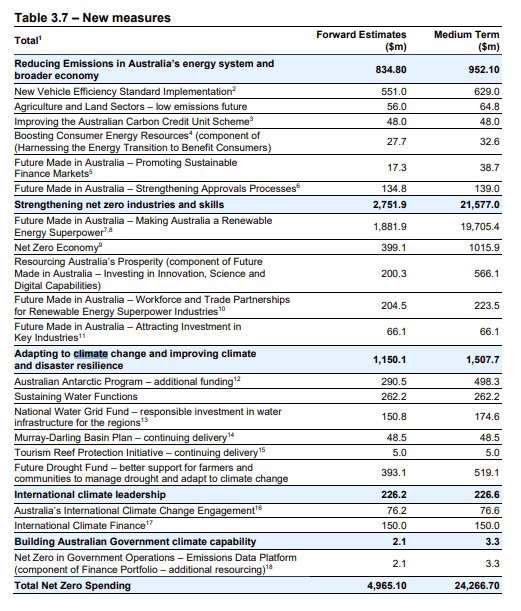
In the 2024–25 Budget there is $5.0 billion in net zero spending commitments over the forward estimates period and $24.3 billion over the medium term. This is in addition to the $4.6 billion in new climate-related spending announced in the May 2023–24 Budget and the historic $24.9 billion in new climate-related spending announced in the October 2022–23 Budget.
Measures in the 2024–25 Budget to reduce emissions in the Australian economy include the Hydrogen Production Tax Incentive and Critical Minerals Production Tax Incentive which align with the Government’s Future Made in Australia agenda. The uncertainty surrounding these measures could affect revenue forecasts.
Net zero climate new measures. From Budget Papers No 1:
Budget Paper No 2 – Payment measures related to climate/sustainability –
Climate Change, Energy, the Environment and Water


Australia’s International Climate Change Engagement
The Government will provide an additional $76.2 million over five years from 2023–24
(and an additional $0.3 million from 2028–29 to 2029–30) to support Australia’s continued
engagement in international climate change and energy transition issues, including
through the International Energy Agency, G20 and United Nations Framework Convention
on Climate Change, to bolster trade opportunities and enhance security relationships with
key partners, and bid to co-host the 31st Conference of the Parties (COP31) in partnership
with the Pacific and undertake initial planning in the event of a successful bid.
Australian Antarctic Program – additional funding
$290.5 million over five years from 2023–24 (and an additional $207.8 million from 2028–29 to 2032–33) to continue delivery of the Australian Antarctic Program and expand Australia’s international scientific activities.
Cost Recovery
The Government will provide $8.2 million in 2024–25 and increase revenue by $10.2 million
over four years from 2024–25 (and $2.6 million per year ongoing revenue from 2028–29), by
updating and improving cost recovery arrangements. Funding includes:
- $7.9 million in 2024–25 to continue administering the Waste Exports Licencing scheme
under the Recycling and Waste Reduction Act 2020. This funding will be offset by
introducing partial cost recovery for the scheme from 2024–25 - $0.2 million in 2024–25 to continue the Commonwealth’s contribution to the Water
Efficiency Labelling and Standards scheme.
The Government will not proceed with cost recovery for the Industrial Chemicals
Environmental Management Standard under the Industrial Chemicals Environmental
Management (Register) Act 2021. This will result in reduced revenue of $14.2 million over
four years from 2024–25 and $1.3 million per year ongoing from 2028–29.
Commonwealth Leadership for a Safe Circular Economy – continuing delivery
$23.0 million in 2024–25 to continue delivery of the Government’s circular economy policy, program and legislative functions. The Government will consider further funding for circular economy following the development of a new national circular economy framework.
Harnessing the Energy Transition to Benefit Consumers
$47.7 million over four years from 2024–25 (and $0.7 per year ongoing) to maximise consumer and community benefits of the energy transition. Funding includes:
- $27.7 million over four years from 2024–25 (and $0.7 million per year ongoing) to
implement priority consumer energy resources reforms that help consumers save on
bills by boosting the supply of renewable electricity to the grid from rooftop solar, home
batteries and other consumer energy resources - $16.6 million over four years from 2024–25 (including $1.7 million in capital funding in
2024–25) for the Australian Energy Regulator to help households get onto a better plan
by sustaining regulatory activities, upgrading data and digital systems to reduce
regulatory burden and cost, and delivering better outcomes for consumers through the
Energy Made Easy website - $1.8 million over four years from 2024–25 to implement a range of consumer-focused
energy retail reform measures to support consumers switching to a better deal with just
‘one click’, prevent contracts automatically rolling over to higher-cost deals, ensure
people receive the concessions and rebates they are entitled to and reduce excess fees
and charges - $1.6 million over two years from 2024–25 to undertake a statutory review of the Prohibited Energy Market Misconduct Act 2019 provisions in electricity retail, contract and wholesale markets.
Improving the Australian Carbon Credit Unit Scheme
$48.0 million over four years from 2024–25 to implement further reforms to the Australian Carbon Credit Unit scheme as part of the Government’s response to the Independent Review of Australian Carbon Credit Units.
These reforms will establish the Carbon Abatement Integrity Committee to oversee the new proponent led method development process and strengthen integrity, provide enhanced transparency measures, and support First Nations participation including in supporting consent processes for projects on Native Title land.
The Government will also forgo $9.7 million over two years from 2023–24 in receipts to trial on a pilot basis a partial delivery requirement as part of the fourth exit window for fixed delivery Carbon Abatement Contract exit arrangements to increase the supply of Australian Carbon Credit Units to the Safeguard Mechanism Cost Containment Measure. The trial will inform an enduring exit arrangement for fixed delivery Carbon Abatement Contracts.
Inspector-General of Water Compliance Legislative Functions
The Government will provide $28.6 million over four years from 2024–25 to the Inspector-General of Water Compliance to undertake inquiry, oversight and public engagement functions under the Water Act 2007 and to maintain its independence.
Murray-Darling Basin Plan – continuing delivery
The Government will provide funding over five years from 2023–24 to continue
implementation of the Murray-Darling Basin Plan (Basin Plan). Funding includes:
- $27.0 million in 2024–25 to expand the existing Resilient Rivers Water Infrastructure Program to enable the Commonwealth to work with private proponents on water recovery activities
- $17.0 million over three years from 2023–24 to enhance shorebird and wetland habitat in
the Coorong region - $4.0 million in 2024–25 for the hydrological modelling platform underpinning implementation of the Basin Plan and a business case for further development
- an additional $0.6 million in 2024–25 to deliver the Murray Reconnected Floodplains project
- funding for additional voluntary water purchases to contribute towards environmental outcomes under the Basin Plan
- funding for Basin states to minimise the socio-economic impacts of water purchases and continue implementing the Basin Plan reform activities.
The Government has already provided partial funding for this measure and the remainder
of the cost will be met from funding within the Water for the Environment Special Account
and Sustainable Rural Water Use and Infrastructure Program.
National Water Grid Fund – responsible investment in water infrastructure for the regions
The Government will provide $174.6 million over six years from 2024–25 to deliver new
water infrastructure projects, including:
- $119.6 million over six years from 2024–25 for five construction projects
- $26.1 million over three years from 2024–25 for 11 First Nations water infrastructure
projects, including ten construction projects and one business case - $18.1 million over four years from 2024–25 for nine business cases relating to potential
new projects - $10.7 million over three years from 2024–25 for 12 science projects.
- $592.3 million over five years from 2023–24 for the Paradise Dam Improvement project, the Big Rocks Weir project and the Hughenden Irrigation Scheme has been deferred, with an investment decision to be made upon completion of the business cases and planning works.
- The Government will also achieve savings of $200.0 million over four years from 2024–25
by redirecting uncommitted funding to support other Government priorities. - The cost of new water infrastructure projects in this measure will be met by reallocating
existing funding within the National Water Grid Fund and the $150.0 million allocated to
improve water security for remote First Nations communities under the 2023–24 Budget
measure titled Closing the Gap – further investment.
Nature Positive Plan – additional funding
The Government will provide a further $40.9 million over two years from 2024–25 to
continue implementing the Nature Positive Plan: better for the environment, better for business
(Nature Positive Plan). Building on the investment made in the 2023–24 Budget measure
titled Nature Positive Plan – better for the environment, better for business, which provided
$121.0 million over four years from 2023–24 to establish Environment Protection Australia
and $51.5 million over four years from 2023–24 ($4.5 million per year ongoing) to set up
Environment Information Australia, the additional funding in this measure includes:
- $17.6 million over two years from 2024–25 for the Department of Climate Change,
Energy, the Environment and Water to establish and commence operation of the Nature
Repair Market - $14.0 million over two years from 2024–25 for the Clean Energy Regulator to administer
the Nature Repair Market once open for participation - $5.3 million in 2024–25 additional funding to progress legislative reforms
- $4.1 million over two years from 2024–25 to drive voluntary uptake of the Nature Repair Market and nature related-reporting by businesses.
- The cost of this measure will be partially met from a reprioritisation of funding from the
2019–20 Budget measure ti
Reducing the Impact of Litter and Supporting On-ground Biodiversity Actions
The Government will provide $1.9 million over four years from 2024–25 to improve
environmental and biodiversity outcomes. Funding includes:
- $1.3 million over four years from 2024–25 to Clean Up Australia and Keep Australia
Beautiful to deliver conservation, and litter prevention and reduction activities to
protect Australia’s natural environment, ecosystems and biodiversity - $0.6 million over four years from 2024–25 to support actions that address threats
and pressures on biodiversity in the Alinytjara Wiluṟara natural resource
management region. - The cost of this measure will be met from a partial reversal of the 2022–23 October Budget measure titled Restoring Funding to the Environmental Defenders Office and Environmental Justice Australia. The Government will save an additional $0.3 million per year ongoing from 2028–29 from this partial reversal.
Regional cooperation initiative on carbon sequestration
The Government will provide $32.6 million over four years from 2024–25 to establish regulatory frameworks and bilateral instruments to better support heavy industry to reduce emissions to meet Paris Agreement commitments, both in Australia and overseas.
This will provide industry with the option of moving carbon dioxide to suitable and secure geological storage sites, where proven, to support energy security, meet obligations under Australian law and provide carbon management solutions for regional partners, consistent with our obligations under international law.
Sustaining Water Functions
The Government will provide $262.2 million over five years from 2023–24 to support the
Australian Government’s water policy functions, including;
- $217.3 million over four years from 2024–25 for the Department of Climate Change,
Energy, the Environment and Water to extend terminating funding for core water policy functions and to provide resourcing to enable the delivery of the Murray-Darling Basin Plan - $32.0 million over four years from 2024–25 to extend the terminating Improving Great Artesian Basin Drought Resilience program to deliver water saving projects and improve
water security in the region - $7.2 million over five years from 2023–24 for the Murray-Darling Basin Authority to deliver new statutory responsibilities under the Water Amendment (Restoring Our Rivers) Act 2023 (the Act)
- $5.7 million over two years from 2024–25 for the Australian Competition and Consumer Commission to implement water market integrity functions set out in the Act, including new compliance, enforcement and information-gathering powers.
Tourism Reef Protection Initiative – continuing delivery
The Government will provide $5.0 million in 2024–25 for the Great Barrier Reef Marine Park Authority to engage tourism operators to conduct reef monitoring, protection and other stewardship activities to protect the Great Barrier Reef.
The cost of this measure will be met from a reprioritisation of funding from the 2022–23 March Budget measure titled Strengthening the Great Barrier Reef through Stewardship and Leadership
Cross-Portfolio
Future Made in Australia – Attracting Investment in Key Industries
The Government will provide $68.0 million over four years from 2024–25 (and $3.1 million
per year ongoing) to attract investment in key industries to support a Future Made in
Australia. Funding includes:
- $54.7 million over two years from 2024–25 to administer, coordinate and promote the
Government’s Future Made in Australia agenda, including the development of
legislation that establishes a National Interest Framework and consultation with
industry, investors and major stakeholders on the development of a ‘single front door’
that improves the attraction and facilitation of major investment proposals - $11.4 million over four years from 2024–25 (and $3.1 million per year ongoing from
2028–29) to establish and manage a domestic National Interest Account with Export
Finance Australia, supporting domestic projects in the national interest, consistent with
the Future Made in Australia National Interest Framework - $1.9 million in 2024–25 to undertake an independent statutory review of the Northern
Australia Infrastructure Facility Act 2016.
Future Made in Australia – Investing in Innovation, Science and Digital Capabilities
The Government will provide $1.7 billion funding over ten years from 2024–25 for investments in innovation, science and digital capabilities to support a Future Made in Australia. Funding includes:
- $566.1 million over ten years from 2024–25 (and an average of $111.8 million per year from 2034–35 to 2058–59) for Geoscience Australia to map Australia’s national groundwater systems and resource endowments to increase industry investment and identify potential discoveries of all current critical minerals and strategic materials. This
extends the terminating Exploring for the Future program, reshaping it as the Resourcing
Australia’s Prosperity program - $466.4 million for a financing package of equity and loans provided by Export Finance Australia on the National Interest Account to PsiQuantum Pty Ltd to support the construction and operation of quantum computing capabilities and associated
investment in industry and research development in Brisbane, as part of a joint
investment with the Queensland Government. Additional funding of $27.7 million over
11 years from 2023–24 will also be provided for the Department of Finance, the
Department of Foreign Affairs and Trade, the Department of Industry, Science and
Resources and the Department of the Treasury to manage and provide oversight of this
investment. The financial implications of the financing package are not for publication
(nfp) due to commercial sensitivities - $448.7 million over 11 years from 2023–24 (and an average of $43.2 million per year
ongoing from 2034–35) establish Australia’s partnership with the United States on the
next generation of the Landsat satellite earth observation program (Landsat Next) - $145.4 million over two years from 2024–25 to maintain the National Measurement
Institute’s core scientific measurement and ICT capabilities and to support current site
operations and future planning.
Future Made in Australia – Making Australia a Renewable Energy Superpower
The Government will provide an estimated $19.7 billion over ten years from 2024–25 to
accelerate investment in Future Made in Australia priority industries, including renewable
hydrogen, green metals, low carbon liquid fuels, refining and processing of critical minerals
and manufacturing of clean energy technologies including in solar and battery supply
chains. Funding will catalyse clean energy supply chains and support Australia to become
a renewable energy superpower. Funding includes:
| Budget Paper No. 2
Page 68 | Part 2: Payment Measures
- An estimated $7.1 billion over 11 years from 2023–24 (and an average of $1.5 billion
per year from 2034–35 to 2040–41) to support refining and processing of critical
minerals, including:
– A Critical Minerals Production Tax Incentive from 2027–28 to 2040–41 to support
downstream refining and processing of Australia’s 31 critical minerals to improve
supply chain resilience, at an estimated cost to the budget of $7.0 billion over
11 years from 2023–24 (and an average of $1.5 billion per year from 2034–35 to
2040–41)
– $10.2 million in 2024–25 for pre-feasibility studies for critical mineral common-user
processing facilities in partnership with state and territory governments to enhance
Australia’s capacity to process critical minerals, sovereign capability and
economic resilience. - An estimated $8.0 billion over ten years from 2024–25 (and an average of $1.2 billion
per year from 2034–35 to 2040–41) to support the production of renewable
hydrogen, including:
– A Hydrogen Production Tax Incentive from 2027–28 to 2040–41 to producers of
renewable hydrogen to support the growth of a competitive hydrogen industry and
Australia’s decarbonisation, at an estimated cost to the budget of $6.7 billion over
ten years from 2024–25 (and an average of $1.1 billion per year from 2034–35 to
2040–41)
– $1.3 billion over ten years from 2024–25 (and an average of $151.6 million per year
from 2034–35 to 2038–39) for an additional round of the Hydrogen Headstart
program to bridge the green premium for early-mover renewable hydrogen projects
– $17.1 million over four years from 2024–25 (and an additional $2.5 million in
2028–29) to deliver the 2024 National Hydrogen Strategy, including hydrogen
infrastructure planning, social license and industry safety training and regulation. - $1.5 billion over seven years from 2027–28 (and an average of $125.0 million per year
from 2034–35 to 2036–37) to the Australian Renewable Energy Agency to supercharge
ARENA’s core investments in renewable energy and related technologies, including for
the development, demonstration, commercialisation, manufacture and deployment of
renewable energy technologies that will help make Australia a renewable energy
superpower. - $1.7 billion over ten years from 2024–25 for the Future Made in Australia Innovation
Fund, to be administered by the Australian Renewable Energy Agency, to support
innovation, commercialisation, pilot and demonstration projects and early stage
development in priority sectors, including renewable hydrogen, green metals, low
carbon liquid fuels and clean energy technology manufacturing such as batteries. - $1.4 billion over 11 years from 2023–24 (and $66.8 million per year from 2034–35 to
2036–37) to support manufacturing of clean energy technologies, including:
– $835.6 million over ten years from 2024–25 (and $66.8 million per year from 2034–35
to 2036–37) to establish the Solar Sunshot program administered by the Australian
Renewable Energy Agency to promote the development of solar manufacturing
capabilities, and improve the industry’s supply chain resilience through production
incentives and other forms of support
– $549.0 million over eight years from 2023–24 to support battery manufacturing,
including: - $523.2 million over seven years from 2024–25 to establish the Battery Breakthrough Initiative, administered by the Australian Renewable Energy Agency, to promote the development of battery manufacturing capabilities through production incentives targeted at the highest value opportunities in the supply chain
- $20.3 million over five years from 2023–24 for the Powering Australia Industry Growth Centre and the Future Battery Industries Cooperative Research Centre to enhance industry and research collaboration, including workforce training for battery research, manufacturing, transport and recycling
- $5.6 million in 2024–25 to support delivery of the Australian Made Battery Manufacturing Precinct to drive battery manufacturing in Australia.
– $2.0 million over two years from 2024–25 for a techno-economic feasibility study to explore solar value chain opportunities that could be generated from developing a green polysilicon industry in Australia, including through export and cooperative international opportunities. - $20.9 million over four years from 2024–25 (and $1.2 million per year ongoing) to undertake further consultation on incentives to support the production of, and demand for, low carbon liquid fuels, as well as the development of a low carbon liquid fuels certification scheme through the Guarantee of Origin Scheme.
- $18.1 million over six years from 2024–25 for foundational initiatives to expedite the emergence of Australia’s green metals industry, including through enhanced industry and research collaboration, exploration of opportunities to improve the use of Australian scrap metal and undertaking of further consultation on incentives to support the production of green iron, steel, alumina and aluminum.
- $11.4 million over four years from 2024–25 (and $1.1 million per year ongoing) to fast track the initial phase of the Guarantee of Origin Scheme for green hydrogen and bring forward work on green metals, including iron, steel and aluminium.
The Government will also make up to $1.2 billion in strategic investments in priority critical minerals projects including up to $655.0 million under the Critical Minerals Facility and up to $400.0 million through the Northern Australia Infrastructure Facility. This includes financing to support the Alpha HPA alumina project in Queensland and Arafura Rare Earth’s Nolans Rare Earth project in the Northern Territory.
Future Made in Australia – Promoting Sustainable Finance Markets
The Government will provide $17.3 million over four years from 2024–25 (and $3.1 million
per year ongoing) to promote the development of sustainable finance markets in Australia.
Funding includes:
- $10.0 million over four years from 2024–25 (and $1.9 million per year ongoing) for
additional resourcing for the Australian Securities and Investments Commission (ASIC)
to investigate and take enforcement action against market participants engaging in
greenwashing and other sustainability-related financial misconduct - $5.3 million over four years from 2024–25 (and $1.2 million per year ongoing) for the
Treasury, ASIC and the Australian Prudential Regulation Authority (APRA) to deliver
the sustainable finance framework, including issuing green bonds, improving data and
engaging in the development of international regulatory regimes related to sustainable
finance - $1.6 million over two years from 2024–25 for ASIC and the Treasury to consult on the
design of a labelling regime to regulate the use of sustainability labels on retail
investment products - $0.5 million in 2024–25 to continue the development of Australia’s sustainable finance
taxonomy, including expanding the taxonomy to cover the agricultural sector.
Future Made in Australia – Strengthening Approvals Processes
The Government will provide $182.7 million over eight years from 2023–24 (and
$4.5 million ongoing from 2031–32) to strengthen approval processes to support the
delivery of the Government’s Future Made in Australia agenda, including Australia’s
transition to a net zero economy. Funding includes:
- $96.6 million over four years from 2023–24 for the Department of Climate Change, Energy, the Environment and Water to strengthen environmental approvals for renewable energy, transmission, and critical minerals projects, deliver additional regional plans, and undertake targeted scientific studies to improve the environmental data used in decision-making
- $20.7 million over seven years from 2024–25 (and $0.4 million per year ongoing from 2031–32) to improve community engagement and social licence outcomes through permanent establishment of the Australian Energy Infrastructure Commissioner, development of voluntary national developer standards with the support of the Clean Energy Regulator, and the development of a regulatory reform package to realise community benefits in regional communities affected by the energy transition
- $19.9 million over four years from 2024–25 for the Department of Climate Change, Energy, the Environment and Water to develop, agree and maintain a national priority list of renewable energy related projects and process assessments for priority projects
- $17.7 million over three years from 2024–25 to reduce the backlog and support administration of complex cultural heritage applications under the Aboriginal and Torres Strait Islander Heritage Protection Act 1984 and progress the reform of Australia’s cultural
heritage laws - $15.7 million over four years from 2024–25 (and $4.1 million per year ongoing from 2028–29) for Treasury to strengthen and streamline Australia’s foreign investment framework, through more effective monitoring, enforcement of conditions and timely review of foreign investment applications. This includes refunding 75 per cent of fees for foreign investment applications that do not proceed because the applicant was unsuccessful in a competitive bid process.
Future Made in Australia – Workforce and Trade Partnerships for Renewable Energy Superpower Industries
The Government will provide $218.4 million over eight years from 2023–24 (and
$1.3 million per year ongoing) to support a Future Made in Australia through the
development of a skilled and diverse workforce and trade partnerships. Funding includes:
- $91.0 million over five years from 2023–24 (and an additional $0.6 million over three years from 2028–29) to support the development of the clean energy workforce, including through addressing vocational education and training sector trainer workforce shortages, and funding new and existing training facility upgrades across a range of clean energy occupations
- $55.6 million over four years from 2024–25 to establish the Building Women’s Careers program to drive structural and systemic change in work and training environments. The program will fund partnerships between training providers, community organisations, employers, and unions to improve women’s access to flexible, safe and inclusive work and training opportunities in traditionally male-dominated industries of national priority, including clean energy sectors
- $38.2 million over eight years from 2023–24 (and $1.3 million per year ongoing) to provide funding for a range of Science, Technology, Engineering and Mathematics (STEM) programs to increase diversity in STEM education and industries
- $14.3 million over four years from 2024–25 to improve the competitiveness of the Australian economy by working with trade partners to support global rules on unfair trade practices and to negotiate benchmarks for trade in high quality critical minerals
- $10.0 million in 2025–26 to establish a National Hydrogen Technology Skills Training Centre, in partnership with the Victorian Government, to promote hydrogen workforce development to support the skilled workforce needs of the growing domestic hydrogen industry
- $8.7 million in 2024–25 to continue to provide analysis, oversight and implementation support to deliver on Australia’s renewable energy superpower opportunities, and review Australia’s critical minerals trade policy settings.
Agriculture, Fisheries and Forestry
The Government will provide $63.8 million over ten years from 2024–25 (and $0.9 million
per year ongoing) to support initial emission reduction efforts in the agriculture and land
sectors as part of Australia’s transition to net zero by 2050.
The Government will allocate $519.1 million over eight years from 2024–25 from the Future
Drought Fund for initiatives that provide improved support to farmers and communities to
manage drought and adapt to climate change. Funding includes:
- $132.0 million over eight years from 2024–25 to continue the Drought Resilience Adoption
and Innovation Hubs model to support activities to address the challenges of drought and
climate variability in local areas - $83.2 million over five years from 2024–25 to continue the Farm Business Resilience
Program to provide farmers, farm workers and advisers with access to learning and
development opportunities and continue the scholarships program - $67.0 million over four years from 2025–26 for the next phase of the Regional Drought
Resilience Planning program, with a greater focus on implementation of activities
in plans - $60.3 million over six years from 2024–25 to continue and expand the Long Term Trials
program to test drought and climate resilience farming practices and support the
adoption of drought resilience innovations - $40.0 million over six years from 2024–25 for the Resilient Landscapes program to
support trials and demonstrate how natural resources management practices contribute
to drought and climate resilience - $37.0 million over three years from 2025–26 for the new Scaling Success program to
support previously funded Future Drought Fund projects that demonstrated successful
drought and climate resilience outcomes - $36.0 million over four years from 2024–25 for the Future Drought Fund Communities
Program to support social resilience and the mental wellbeing of farmers and
communities - $20.0 million over three years from 2025–26 for the Innovation Challenges Pilot program
to accelerate research and innovation in response to drought and climate challenges - $17.2 million over four years from 2024–25 to continue the Climate Services for Agriculture
program and the My Climate View online tool to provide accessible and tailored climate
information for farmers and regional communities - $15.0 million over four years from 2024–25 to partner with First Nations people and
communities to support connection to Country through the management of drought
and climate risks - $11.4 million over four years from 2024–25 to support enabling and evaluation activities
to deliver drought and climate resilience outcomes.
The Government will also provide $42.2 million over four years from 2024–25 for the
Department of Agriculture, Fisheries and Forestry to support the delivery of the Future
Drought Fund initiatives.
Finance
Snowy Hydro Limited
The Government will provide $7.1 billion over four years from 2024–25 to Snowy Hydro
Limited to support continued construction of Snowy 2.0. Funding includes:
- a $4.5 billion construction period loan over four years from 2024–25, provided on commercial terms and expected to be refinanced by Snowy Hydro Limited from 2029–30 onwards once Snowy 2.0 is operational
- $2.6 billion in equity over two years from 2024–25.
Foreign Affairs and Trade
International Climate Finance
The Government will provide $150.0 million over four years from 2024–25 in contributions
to international climate financing funds. Funding includes:
- $100.0 million over three years from 2024–25 as an investment in the Pacific Resilience
Facility, an initiative endorsed by the Pacific Islands Forum Leaders, to fund small scale
climate and disaster resilience projects in the Pacific - $50.0 million over two years from 2026–27 to the United Nations Framework
Convention on Climate Change Green Climate Fund to assist developing countries in
adaptation and mitigation practices to counter climate change. - The cost of this measure will be partially met from within the existing resourcing of the
Department of Foreign Affairs and Trade.
Health and Aged Care
Nothing on implementation of the Climate Health Strategy.
The Budget also fails to commit funding to the Australian Centre for Disease Control (ACDC), which the Public Health Association of Australia (PHAA) has strongly criticised, saying it suggests “pandemic amnesia four years after the lives of everyone in Australia was upended”.
See Croakey Health for A rolling wrap of reaction to the Federal Budget, and key health issues
Home Affairs
Disaster Support
The Government will provide $138.7 million over four years from 2024–25 (and $18.9 million per year ongoing) to improve Australia’s preparedness to respond to all-hazard disasters and resilience to natural hazards. Funding includes:
- $73.3 million over four years from 2024–25 (and $18.9 million per year ongoing) to
further uplift the National Emergency Management Agency’s capacity to support
Australians before, during and following a disaster - $35.0 million over two years from 2024–25 to support the National Aerial Firefighting
Centre to bolster the national aerial firefighting fleet and to undertake a review to
identify cost-effective options for long-term aerial capability - $26.8 million over three years from 2024–25 to maintain the national emergency
management stockpile of disaster response resources - $3.6 million in 2024–25 to provide targeted mental health support to emergency
service workers.
The support outlined in this measure is in addition to assistance provided under
Disaster Recovery Funding Arrangements through which the Australian Government
provides funding to states and territories to share the financial burden of responding to
a natural disaster, and supports the p
Industry, Science and Resources
Supporting Safety and Responsible Decommissioning in the Offshore Resources Sector
The Government will provide $29.7 million over three years from 2023–24 to improve
environmental and safety outcomes in the offshore resources sector. Funding includes:
- $20.0 million in 2024–25 for the National Offshore Petroleum Safety and Environmental Management Authority to assist its regulatory functions as the Commonwealth’s regulator of the offshore oil and gas industry and the emerging offshore energy industry
- $6.8 million over two years from 2024–25 to implement the Offshore Decommissioning Roadmap and grow Australia’s decommissioning industry by improving coordination and transparency and identifying opportunities for Australian businesses
- $2.9 million over two years from 2023–24 to continue reforms to protect the work health and safety of workers in the offshore resources sector
- Supplementary funding for decommissioning the Northern Endeavour floating oil production storage and offtake facility. The financial implications are not for publication (nfp) due to commercial sensitivities related to contract negotiations.
- The cost of this measure will be partially met from savings identified in the Department of
Industry Science and Resources, and funding already provided for by the Government.
Infrastructure, Transport, Regional Development, Communications and the Arts
Building a Better Future Through Considered Infrastructure Investment
The Government is committed to delivering the priority road and rail infrastructure
projects Australia needs via the over $120.0 billion infrastructure investment pipeline.
Building on the Independent Strategic Review of the Infrastructure Investment Program,
the Government is taking a more integrated, strategic and sustainable approach to
infrastructure investment this Budget. Funding includes:
- $4.1 billion over seven years from 2024–25 for 65 new priority infrastructure projects
across Australia under the Infrastructure Investment Program, including:
– $1.9 billion for projects in Western Sydney, including $500.0 million for the Mamre
Road Stage 2 Upgrade and $400.0 million for Elizabeth Drive – Priority Sections
Upgrade
– $300.0 million for the METRONET High-Capacity Signalling Program – Automatic
Train Control – Stage 1 in Western Australia
– $72.0 million for the Port Keats Road – Wadeye to Palumpa (Nganmarriyanga) in the
Northern Territory
– $134.5 million for the Mt Crosby Road Interchange Upgrade and $42.5 million for
Bremer River Bridge (Westbound) Strengthening on the Warrego Highway in
Queensland
– $115.0 million for Zero Emission Buses Tranche 1 Infrastructure – Macquarie Park
Depot in New South Wales
– $80.0 million for the Lyell Highway – Granton to New Norfolk in Tasmania
– $64.0 million for the Berrimah Road Duplication – Stuart Highway to Tiger Brennan
Drive in the Northern Territory
– $120.0 million for the Mount Barker and Verdun Interchange Upgrades in
South Australia
– $54.0 million for the Regional Road Safety Program – State Roads in Western Australia
– $53.6 million for the Great Northern Highway – Brooking Channel Bridge
Replacement in Western Australia
– $50.0 million to plan for Stage 2B of the Canberra Light Rail in the Australian
Capital Territory
– $17.6 million for projects in Victoria, including $12.0 million for the
Bridgewater Road and Portland Ring Road intersection upgrade - $10.1 billion over 11 years from 2023–24 for existing projects in the Infrastructure
Investment Program, including:
– $3.3 billion for North East Link in Victoria
– $1.2 billion for the Direct Sunshine Coast Rail Line in Queensland
– $1.4 billion for METRONET projects in Western Australia
– $578.6 million for projects in New South Wales, including $112.0 million for the
M1 Pacific Motorway Extension to Raymond Terrace
– $431.7 million for the Coomera Connector Stage 1 (Coomera to Nerang) in Queensland
– $133.6 million for projects in South Australia, including $100.0 million for the
South Eastern Freeway Upgrade
– $113.1 million for projects in Tasmania, including $50.0 million for the Mornington
Roundabout Upgrade
– $35.9 million for projects in the Northern Territory, including $25.0 million for the
Carpentaria Highway Upgrade
– $27.1 million for the William Hovell Drive Duplication in the Australian
Capital Territory - $1.7 billion in 2033–34 to continue existing road maintenance and safety programs,
including:
– $1.0 billion for the Roads to Recovery Program
– $200.0 million for the Safer Local Roads and Infrastructure Program
– $150.0 million for the Black Spot Program - $540.0 million for the Australian Rail Track Corporation to invest in the interstate rail
network, including $150.0 million for the Maroona to Portland Line Upgrade - $100.0 million over four years from 2025–26 for an Active Transport Fund to support the
construction and upgrade of bicycle and walking paths across Australia.
The Government will also reprofile $2.1 billion to beyond the forward estimates to better
align with construction market conditions and project delivery timeframes.
The Government will also provide $98.3 million over five years from 2024–25 (and
$14.2 million per year ongoing) for the Department of Infrastructure, Transport, Regional
Development, Communications and the Arts to support the delivery of the infrastructure
investment pipeline.
Enabling Western Sydney International Airport
The Government will provide $302.6 million over five years from 2024–25 (and $53.5 million per year ongoing) to enable operations at Western Sydney International (Nancy-Bird Walton) Airport, including:
- $237.4 million over four years from 2024–25 (and $52.1 million per year ongoing) for
border agencies to progress design, fit out and commissioning of the passenger terminal
and shared Commonwealth facilities, provide federal policing and detector dogs at the
airport to support critical border security and biosecurity functions - $13.0 million over five years from 2024–25 (and $1.4 million per year ongoing) to
support regulatory oversight functions and Commonwealth preparatory activities.
New Vehicle Efficiency Standard Implementation
The Government will provide $154.5 million over six years from 2023–24 (and $12.6 million per year ongoing) to implement a New Vehicle Efficiency Standard to support greater choice of fuel-efficient vehicles that will reduce motoring costs and transport emissions.
Funding includes:
- $84.5 million over five years from 2024–25 (and $12.6 million per year ongoing) to
establish a regulator to administer the New Vehicle Efficiency Standard, including to
capture emissions data, establish a credit trading platform and undertake monitoring
and compliance activities, and to undertake further work to bring Australian vehicle
standards into line with those of our peers - $60.0 million over four years from 2024–25 to support the installation of electric vehicle
charging infrastructure at automotive businesses to support the transition to selling and
servicing electric vehicles - $10.0 million in 2023–24 for a national communications campaign to raise awareness
of the New Vehicle Efficiency Standard, with funding already provided for by
the Government.
The introduction of a New Vehicle Efficiency Standard is also estimated to decrease fuel excise receipts by $470.0 million over four years from 2024–25, owing to lower motoring costs resulting from greater availability of more fuel efficient vehicles.
Supporting Transport Priorities
The Government will provide $237.7 million over seven years from 2023–24 (and $2.3 million per year ongoing) to support aviation, road, rail and maritime transport priorities, including:
- $101.9 million over five years from 2024–25 (and $0.8 million per year ongoing) to extend the Remote Airstrip Upgrade Program and the Regional Airports Program for two additional rounds, and continue the Remote Aerodrome Inspection Programme to improve aviation safety and access at remote airstrips and regional airports
- $78.8 million over three years from 2023–24 for the High Speed Rail Authority to undertake the development of a business case for the Sydney to Newcastle high speed rail corridor
- $32.0 million over six years from 2024–25 to improve the National Road Safety Data Hub and support a National Road Safety Education and Awareness Campaign
- $10.1 million over four years from 2024–25 (and $1.5 million per year ongoing) to implement reforms to the Sydney Airport Demand Management Compliance Framework to strengthen the compliance regime and enhance aviation competition, and support regulatory functions for the protection of airspace above and around federal leased airports
- $5.2 million in 2024–25 to support ongoing safety investigative services provided by the Australian Transport Safety Bureau and continued work on sustainable funding arrangements for the Australian Transport Safety Bureau, the Civil Aviation Safety Authority and the Australian Maritime Safety Authority
- $3.6 million over three years from 2024–25 to extend the Automatic Dependent Surveillance Broadcast (ADS-B) Rebate Program, supporting general and recreational aviation operators to install ADS-B devices in their aircraft, bringing about improved airspace management and safety
- $2.4 million in 2024–25 to continue development of the Maritime Single Window project.
- The Government will also provide $5.0 million in 2024–25 to develop a business case and progress technical and environmental planning for an intermodal terminal in Parkes, New South Wales, to support the Inland Rail program, with funding to be redirected from existing National Intermodal Corporation equity.
Urban Agenda and Community Programs
The Government will provide $12.6 million over four years from 2024–25 to support the delivery of the Government’s Urban Agenda, supporting a national approach to sustainable urban development, oversight of urban renewal projects and the continued delivery of city and regional deal projects.
The Government will also achieve savings of $40.3 million over two years from 2023–24 by reducing uncommitted funding for the Investing in Our Communities Program and Priority Community Infrastructure Program.
Prime Minister and Cabinet
APS Capability Reinvestment Fund:
$0.9 million in 2024–25 for projects to develop aligned Greening Government microcredentials and whole-of-government responses to future challenges in the Indo-Pacific.
Net Zero Economy
The Government will provide $399.1 million over five years from 2023–24 (and an additional $616.8 million from 2028–29 to 2034–35 and $93.4 million per year ongoing) in additional resourcing for the Net Zero Economy Authority (the Authority), the Department of Employment and Workplace Relations, and the Fair Work Commission to promote orderly and positive economic transformation associated with decarbonisation to ensure Australia, its regions and workers realise the benefits of the net zero economy. Funding includes:
- $209.3 million over four years from 2024–25 (and $53.3 million per year ongoing) to expand the Authority to coordinate policy and deliver across government, broker investments that create jobs in regions, and support workers affected by the net zero transition
- $134.2 million over four years from 2024–25 and $377.8 million over the medium term (and $40.1 million per year ongoing from 2035–36) to provide workforce transition support for impacted workers and the broader communities affected by the net zero transition
- $44.4 million over four years from 2024–25 to deliver the Energy Industry Jobs Plan, to assist employees impacted by the closure of relevant coal-and gas-fired power stations to access new employment by supporting job and skills matching and providing onboarding and early retirement incentives to employers
- $10.0 million over two years from 2023–24 to deliver public information on the net zero transition and ensure affected workers and communities are aware of the support available
- $1.3 million over four years from 2024–25 for Treasury to develop and publish high-quality guidance on best practices for Australian businesses when developing net zero transition plans.
- The Government has already provided partial funding for this measure. This measure will also be partially offset by a reduction in the Labour Market Support Scheme of $31.3 million over four years from 2024–25 and savings of $7.3 million per year ongoing from 2028–29.
- This measure builds on the 2023–24 Budget measure titled National Net Zero Authority and on the Employment White Paper.
Treasury
Energy Bill Relief Fund – extension and expansion
The Government will provide $3.5 billion over three years from 2023–24 to extend and expand the Energy Bill Relief Fund to provide a $300 rebate to all Australian households and a $325 rebate to eligible small businesses on 2024–25 bills to provide cost of living relief.
References:
Rod Campbell, Australia Institute, 13 May 2024, Fossil fuel subsidies hit $14.5 billion in 2023-24, up 31% https://australiainstitute.org.au/post/fossil-fuel-subsidies-hit-14-5-billion-in-2023-24-up-31/
David McEwen at Michael West Media, 13 May 2024, writing on The Other Budget: Labor staring down the barrel of a climate deficit, https://michaelwest.com.au/the-other-budget-labor-staring-at-climate-deficit/
Treasurer’s Speech, 14 May 2024, https://ministers.treasury.gov.au/ministers/jim-chalmers-2022/speeches/budget-speech-2024-25
2023-2024 Budget Papers No1, https://budget.gov.au/content/bp1/download/bp1_2024-25.pdf
202302024 Budget Papers No 2, Budget Measures, https://budget.gov.au/content/bp2/download/bp2_2024-25.pdf
Melissa Sweet, Croakey Health, 14 May 2024, A rolling wrap of reaction to the Federal Budget, and key health issues https://www.croakey.org/a-rolling-wrap-of-reaction-to-the-federal-budget-and-key-health-issues/
Australian Conservation Foundation, 14 May 2024, Two sides to the budget coin: funds for clean energy… but money still flowing to fossil fuels https://www.acf.org.au/federal-budget-2024-25
Climate Council, 14 May 2024, Billions for Green Industry, no new money for Gas – this is how we Build Australia’s Clean Future https://www.climatecouncil.org.au/resources/billions-for-green-industry-no-new-money-for-gas-build-australias-clean-future/
WWF, 14 May 2024, Budget leaves Nature Short Changed, https://wwf.org.au/news/2024/budget-leaves-nature-shortchanged/
Jane Garcia, Solar Citizens, 14 May 2024, Government misses prime opportunity for decades of energy bill relief through increased investment in renewables, solar and electrification
https://www.solarcitizens.org.au/federal_budget_2024
Timothy Neal, Senior lecturer in Economics / Institute for Climate Risk and Response, UNSW Sydney, writing at The Conversation, 15 May 2024, Green industry yes, conservation no: a budget for people, not for nature https://theconversation.com/green-industry-yes-conservation-no-a-budget-for-people-not-for-nature-229904
 Climate Action Merribek