A new report by the Australia Institute highlights and compares heat vulnerability across Australia. While Merribek doesn’t feature in the top 20% ‘high’ ranking classification, the suburbs of Fawkner, Glenroy – East, Coburg – East, Coburg – West and Pascoe Vale all ranked as medium High. Out of a population of 170,416 there were 22,348 people identified as being heat vulnerable across Merri-bek.
Heat vulnerability is increasing due to climate change driving increase in temperatures with more extreme heat days and heatwaves. The Federal Labor Government is continuing to approve and subsidise Gas projects in the Northern Territory and Western Australia and new coal projects, increasing emissions.
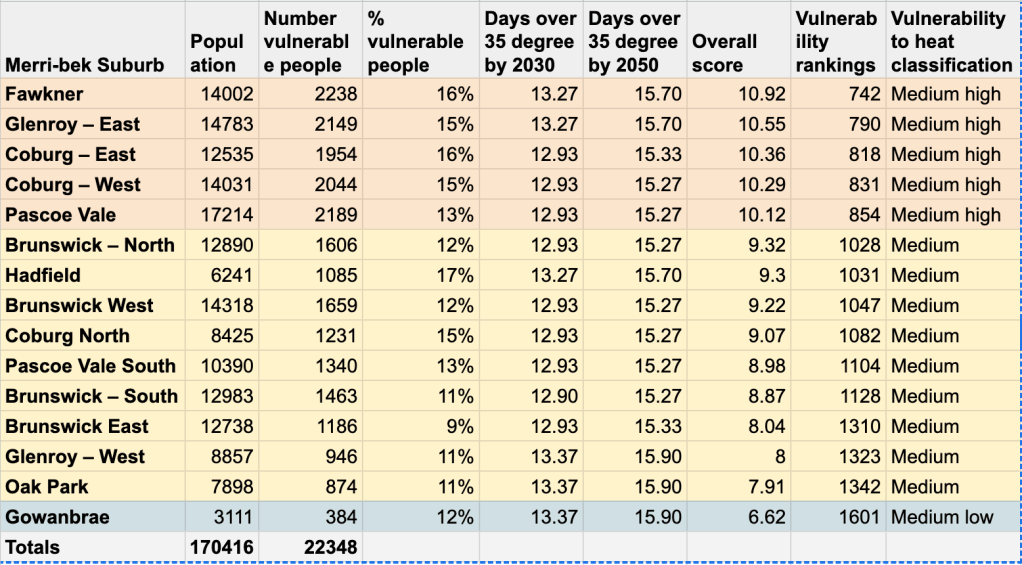
Table 1: Merri-bek suburbs ranked by population vulnerability to heat (Click to Display)
| Merri-bek Suburb | Population | Number vulnerable people | % vulnerable people | Days over 35 degree by 2030 | Days over 35 degree by 2050 | Overall score | Vulnerability rankings | Vulnerability to heat classification |
| Fawkner | 14002 | 2238 | 16% | 13.27 | 15.70 | 10.92 | 742 | Medium high |
| Glenroy – East | 14783 | 2149 | 15% | 13.27 | 15.70 | 10.55 | 790 | Medium high |
| Coburg – East | 12535 | 1954 | 16% | 12.93 | 15.33 | 10.36 | 818 | Medium high |
| Coburg – West | 14031 | 2044 | 15% | 12.93 | 15.27 | 10.29 | 831 | Medium high |
| Pascoe Vale | 17214 | 2189 | 13% | 12.93 | 15.27 | 10.12 | 854 | Medium high |
| Brunswick – North | 12890 | 1606 | 12% | 12.93 | 15.27 | 9.32 | 1028 | Medium |
| Hadfield | 6241 | 1085 | 17% | 13.27 | 15.70 | 9.3 | 1031 | Medium |
| Brunswick West | 14318 | 1659 | 12% | 12.93 | 15.27 | 9.22 | 1047 | Medium |
| Coburg North | 8425 | 1231 | 15% | 12.93 | 15.27 | 9.07 | 1082 | Medium |
| Pascoe Vale South | 10390 | 1340 | 13% | 12.93 | 15.27 | 8.98 | 1104 | Medium |
| Brunswick – South | 12983 | 1463 | 11% | 12.90 | 15.27 | 8.87 | 1128 | Medium |
| Brunswick East | 12738 | 1186 | 9% | 12.93 | 15.33 | 8.04 | 1310 | Medium |
| Glenroy – West | 8857 | 946 | 11% | 13.37 | 15.90 | 8 | 1323 | Medium |
| Oak Park | 7898 | 874 | 11% | 13.37 | 15.90 | 7.91 | 1342 | Medium |
| Gowanbrae | 3111 | 384 | 12% | 13.37 | 15.90 | 6.62 | 1601 | Medium low |
| Totals | 170416 | 22348 |
This report identifies the locations across Australia that have the highest number of people vulnerable to intensifying heat because of age, illness, or income level.
In 2020 Researchers at the Australian National University identified and calculated that heat related deaths have been greatly underestimated. In the 11 years between January 2006 and October 2017 an estimated 36,765 deaths in Australia can be attributed to heat-related causes.
Melbourne, where heatwaves already start 17 days earlier than in the past, is expected to see double the number of days above 35 °C by 2050.
Merri-bek Council is already pro-active in addressing heat vulnerability. On the local level this includes:
- supporting low income households in energy efficiency and cheap cooling,
- ensuring public buildings become cool refuges when they are open,
- providing infrastructure such as water fountains at key locations,
- more public seating on key walking routes,
- planting trees for canopy shade,
- shaded bus shelters.
- Mitigating urban heat such as adding tree plantings in car parks
- Extended hours at Council pools during extreme heat days
While we need to adapt to rising temperatures, we also need to tackle the root problem of fossil fuel emissions from coal, oil and gas. That means both the State Government and Federal Government need to be taking action. Especially in updating Australian environment laws and to stop approving new coal and gas projects.
The researchers classified each location into five levels of vulnerability:
- High: 81st – 100th percentile
- Medium high: 61st – 80th percentile
- Medium: 41st – 60th percentile
- Medium low: 21st – 40th percentile
- Low: 1st – 20th percentile
For this study authors used “estimations based on the Representative Concentration RCP 4.5, ‘intermediate emissions’ scenario, as this most closely reflects the outcomes we could expect see if all countries implement their current commitments under the Paris Agreement.” Only we are not on that path yet, but tracking closer to RCP8. So this is a conservative optimistic assessment of heat vulnerability.
The researchers used 35°C as the measurement of “extreme heat” because it is the
critical temperature threshold at which exposure of six hours or more can result in death. For Melbourne there is research showing that a Mean daily temperature of 28C is a threshold for heat health emergencies, especially among vulnerable cohorts.(See Loughnan et al, NCARF, 2013)
The people most vulnerable to extreme heat are those who not only have health conditions, but who are also aged 65 and older and/or are experiencing poverty. As spending on electricity, especially for cooling, has increased during the cost-of-living crisis, many people reliant on government payments are cutting back on cooling to lower their energy bills. Energy bills are one of the top three most stressful bills for Australians. As a proportion of household income, lower income households spend more on utilities (including electricity for cooling) than medium and higher income households, which means they have less capacity to pay increasing costs of air-conditioning.
The information is important as it identifies for Local Council, State and Federal Government where to allocate more resources to address heat vulnerability.
Another research paper by Fei Li et al (Assessing heat vulnerability and multidimensional inequity: Lessons from indexing the performance of Australian capital cities) published in November recommended the following actions (some are local, some State and some Federal):
“For high vulnerability zones, enhancing urban infrastructure with more cooling centres and green spaces, alongside comprehensive heat action plans and improved healthcare access, is essential. Medium vulnerability areas would benefit from community-based outreach, residential retrofitting incentives, and increased green infrastructure. Low vulnerability zones should focus on continuous monitoring, integrating heat mitigation in urban planning, and public awareness campaigns to maintain resilience. “
Merri-bek Council
We note that Merri-bek Council has been pro-active in addressing Climate Change in Merri-bek. In 2016 Council developed the Urban Heat Island Effect Action Plan (PDF), and have policies on Trees and Urban Forest Strategy, Cooling the Upfield Corridor (PDF), and is rolling out public drinking water fountains around the municipality for people to keep hydrated, and using Council facilities for heat respite during opening hours.
Council recently in 2023 planted canopy trees in the CB Smith Reserve car park. They won’t have grown much by this summer but important in years to come to reduce the urban heat of the car park black asphalt in years to come.
In September 2023 we raised with Council, including a question at Council meeting, that they should be preparing for worst case scenarios for operation of Council buildings offering cooling respite, or possible operation of emergency relief centres. Power resilience should be planned for. It is no good saying in the event of a power failure we’ll just hire a diesel generator, when many businesses may also be doing the same risking unavailability.
In March 2024 we reported on the Better Renting report that revealed the cruel summer heat impacts for renters in a housing and cost of living crisis
Victoria and Australia
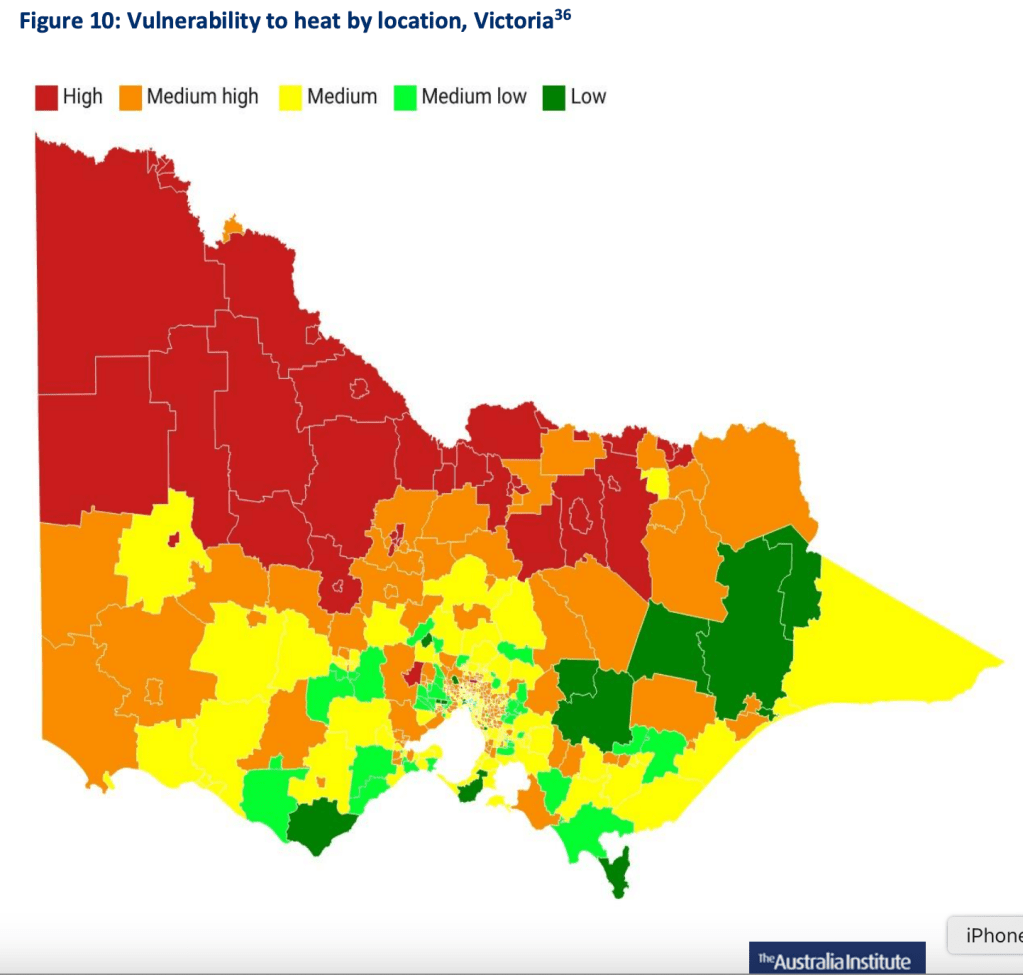
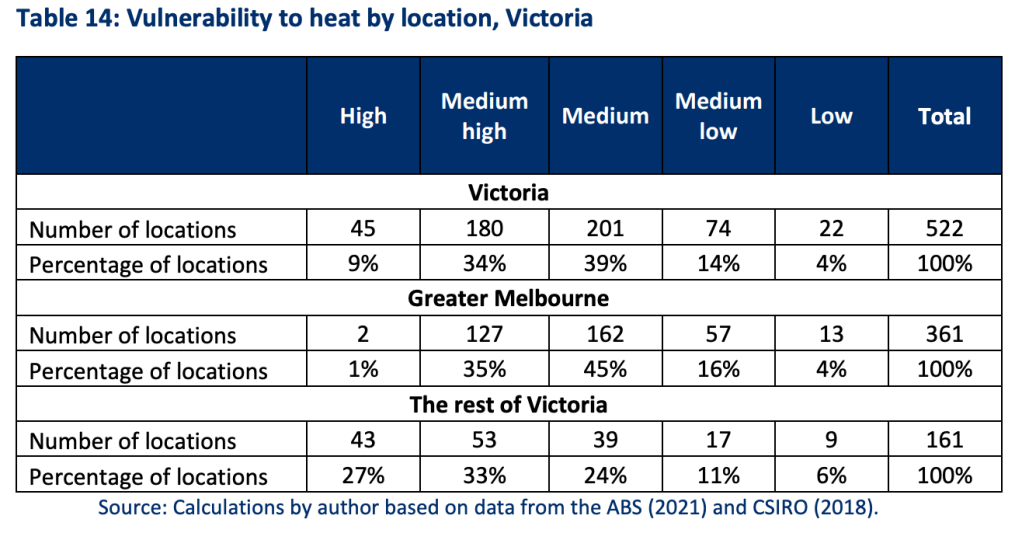
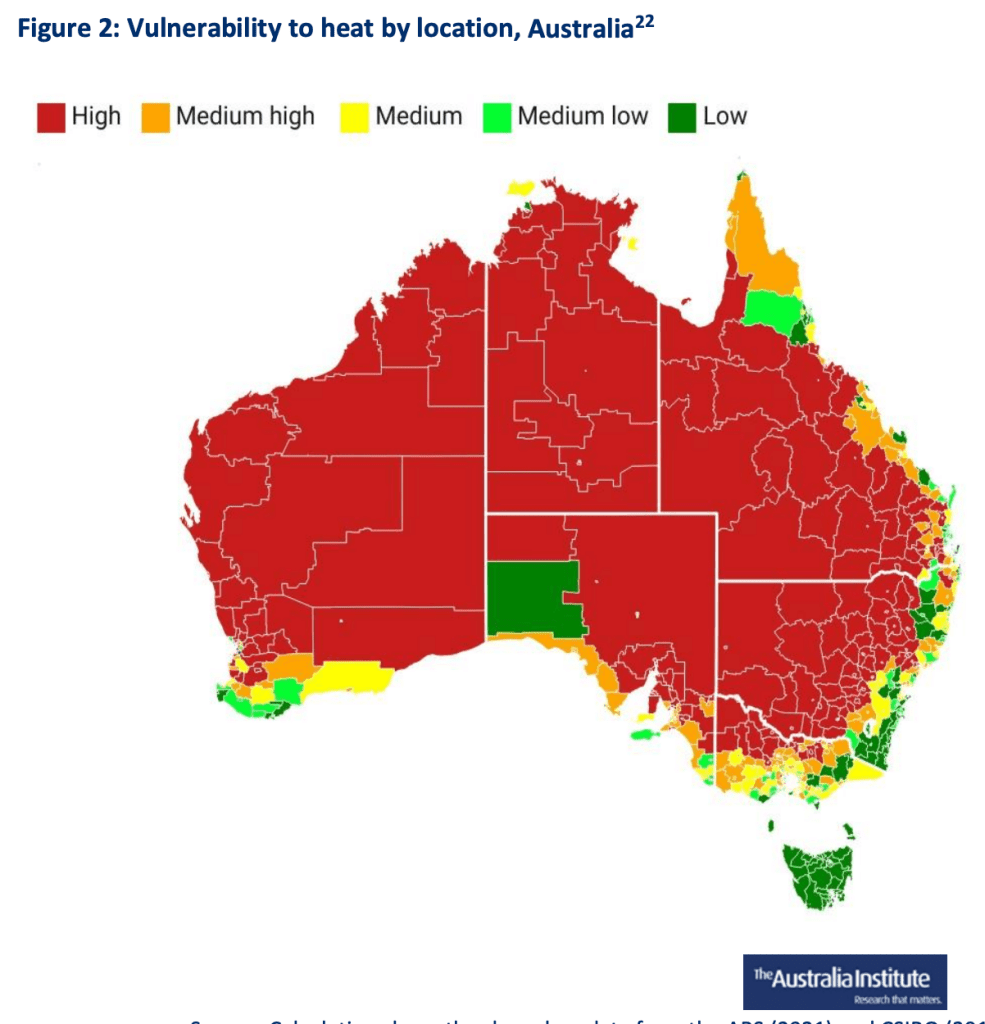
Here is what the map of Australia looks like:
References:
The Australia Institute, 2 December 2024, Vulnerability to extreme heat. The inequitable impacts of a warming Australia. by Minh Ngoc Le, Alexia Adhikari and Morgan Harrington https://australiainstitute.org.au/report/vulnerability-to-extreme-heat/
Loughnan, ME, Tapper, NJ, Phan, T, Lynch, K, McInnes, JA 2013, A spatial
vulnerability analysis of urban populations during extreme heat events in Australian
capital cities, National Climate Change Adaptation Research Facility, Gold Coast, 128
pp., https://nccarf.edu.au/wp-content/uploads/2019/03/Loughnan_2013_Spatial_vulnerability_analysis.pdf
The researchers found that for Melbourne the optimum threshold measure was daily mortality, where at a Mean daily Temperature of 28°C there was a 3 to 13 percent increase in mortality. See our January 2015 article: Heatwaves and Victoria’s Heat Health Alert warning system
Fei Li, Tan Yigitcanlar, Madhav Nepal, Kien Nguyen, Fatih Dur, Wenda Li, Novermber 2024, Assessing heat vulnerability and multidimensional inequity: Lessons from indexing the performance of Australian capital cities, Sustainable Cities and Society, https://www.sciencedirect.com/science/article/pii/S2210670724006991
ABC News, 2 December 2024, Concerns more Australians at risk of heat-related injuries as people do it tough in cost-of-living crisis https://www.abc.net.au/news/2024-12-02/experts-warn-not-to-downplay-heatwave-risks/104669928
 Climate Action Merribek
[…] or not. There are now 12,000 properties in Merribek now at flood risk due to climate change. Over 20,000 people are vulnerable in Merribek to extreme heat. Both increased flood risk and increase in extreme heat is driven by increasing emissions from […]
LikeLike