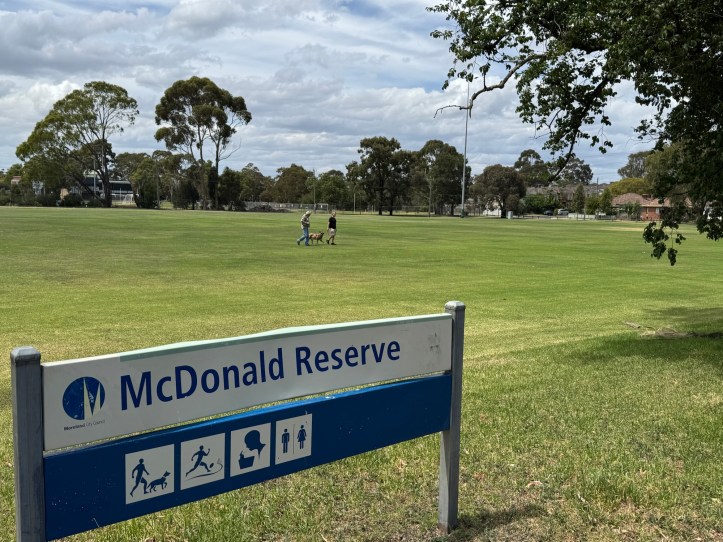
In December we made a submission to the upgrade of McDonald Reserve and the Facility Design Plan. It is presently proposed to put a synthetic hockey pitch at McDonald Reserve and the plans also include adding 2 new synthetic tennis courts. There is no vegetation plan presently as part of the design parameters. (See Conversation Merri-bek McDonald Reserve)
Executive Summary
We have an in principle concern at the installation of synthetic turf or plastics/rubber based softfall in the municipality.
This concern arises out of a number of issues
- The unknown chemicals used in synthetic turf and softfall.
- The possible presence of PFAS forever chemicals or other toxic chemicals that can impact human health and the environment
- Generation of both airborne and water based microplastics pollution as synthetic turf or soft fall wears.
- Urban heat microclimate implications from converting grass to synthetic turf.
- What is the vegetation plan for mitigating heat and biodiversity impacts?
- If synthetic surface is decided upon after the Sports Surfaces Policy is applied:
- How will microplastics pollution be minimised and mitigated against?
- What is the End of Life Plan and is it consistent with Council’s Sustainability and Circular Economy Policies?
Synthetic surfaces are a non-essential plastics product derived from fossil fuels. We should, in principle, be reducing use of non-essential plastics to reduce the climate crisis, biodiversity crisis and the plastics pollution crisis. (Note 1)
This entails curbing non-essential plastics use such as synthetic surfaces. We note and applaud Council doing this in other areas, such as Council’s Plastic Wise Policy.
The issue of Microplastics pollution and PFAS contamination was raised by Climate Action Merribek Convenor John Englart in his statement to Council meeting 14 September 2022 when the 2nd Hockey Field Feasibility Study was presented. (Note 2)
The health and environmental impacts of Synthetic turf, PFAS and microplastics are active areas of research, with substantial knowledge gaps, and very far from being settled. (Note 3)
Design of McDonald Reserve sports facilities will be a significant test of Council’s new Sports Surfaces policy in weighing up all the benefits and impacts, and applying the precautionary principle.
Full submission is below:
References:
Note 1: See: Chen, Xuejing, Kristen McDonald, Madeline Rose, Pacific Environment, 23 May 2023, “Stemming the Plastic-Climate Crisis: Paris Alignment for Plastics Requires at least 75% Reduction,”, https://www.pacificenvironment.org/wp-content/uploads/2023/05/Stemming-the-Plastic-Climate-Crisis-1.pdf
Note 2: See Blog article: https://takvera.blogspot.com/2022/09/microplastics-pollution-threat-fails-to.html
Note 3: The extensive knowledge gaps on use of synthetic surfaces within an Australian context are explained in the report and scientific appendices of the NSW Office of the Chief Scientist, Synthetic Turf in Public Spaces, (2022)
https://www.chiefscientist.nsw.gov.au/independent-reports/synthetic-turf-in-public-spaces
Full Report:
https://www.chiefscientist.nsw.gov.au/__data/assets/pdf_file/0004/542263/CSE-Synthetic-Turf-ReviewFinal-Report.pdf
 Climate Action Merribek