Climate change is contributing to the cost of living in multiple ways. Any government that is not ambitious with climate action and stopping new coal and gas is embedding an increase to cost of living for all Australians generally through increasing food prices, energy costs, and insurance premiums.
- Summary
- Food price rises driven by climate change
- Insurance costs increasing due to Climate Change and Extreme Weather
- Energy Cost increases driven by Fossil Fuels and climate change
- Coal and Gas Approvals under Albanese Labor
- Redirect Middle Arm subsidy to Recharge the Territory
- Cost of Living and Gas expansion
- Coalition Nuclear Policy adds to Cost of Living
- Use your preferential vote
- References
Summary:
Here is how climate change is increasing cost of living:
- Extreme weather events damage and reduce food from agriculture, which will push up food prices (ABC) See Farmers for Climate action 2022 report: Fork in the Road PDF
- Extreme weather events can disrupt transport of food and other items. For example, Bananas from north Queensland won’t be able to get to market due to the North Queensland Floods washing away essential bridges, causing banana prices to rise. This can also disrupt delivery of other goods and services.
- Extreme weather damages are causing Insurance premiums to rise. Between 2022 and 2023, the average home insurance premium in Australia rose by 14%, the biggest rise in a decade. International climate disaster events like the LA fires will impact the large re-insurance companies, which will put up their re-insurance rates to retail insurance companies. Of cause, many people in bushfire or flood zones have already found they are now effectively uninsurable.
- Approving new coal and gas projects reduces labour availability to work in housing construction, making construction costs higher, exacerbating housing affordability and housing crisis.(Australia Institute)
- Energy prices have risen and are a major contributing factor to the cost of living crisis in all sectors of the economy. Reliance on coal and gas for electricity and energy with aging infrastructure has fuelled cost of living increases and inflation while renewables in the medium-long term reduce energy prices. In 2023 energy cost increases were driven initially by temporary ‘shock’ increases in global coal and gas prices following Russia’s invasion of Ukraine. CSIRO continues to show in the annual GenCost report that Firmed renewables are the cheapest energy source, and AEMC projects electricity price falls over the next decade with renewables and electrification.
Update Note 17 February 2025 – The Australia Institute launches a new report: Cost-of-Living and the Climate Crisis. How climate change inaction drove up the cost-of-living. This report mirrors our own post with some more in depth details.
Key Findings (Click to Open)
Key findings:
- Insurance premiums have soared due to an increase in natural disasters, with some households now spending over seven weeks of gross income just to cover home insurance
- Food prices have risen by 20% since 2020, with climate-related disruptions wiping out harvests and making it harder for some regions to grow food
- Energy costs remain high due to a reliance on fossil fuels, underinvestment in renewables, and fossil fuel exports forcing Australians to compete with the global market for Australia’s resources
- The impacts of the climate crisis are disproportionately affecting lower-income and regional households, who are already feeling the financial strain more severely
The report underscores the need for urgent climate action to protect Australian households from these escalating costs. Addressing the root causes of climate change is essential to lowering future risks and alleviating the economic strain that millions of Australians are facing.
Update 20 February 2025: Anjali Sharma: The climate crisis is a cost-of-living issue for Australia. My generation will be the first to pay for it (Guardian) “Politicians have divorced the climate crisis from the issue of cost of living, allowing their often dismal records on climate and environment to escape scrutiny. This benefits no one but the major parties, as they talk about the cost of fuel, food and electricity one moment, and approve a fossil fuel extension which will drive up these very costs the next.”
Food price rises driven by climate change
Climate change is driving up food prices in Australia, as well as globally. Climate change increases the frequency and intensity of extreme weather events, which can damage crops and livestock, and disrupt supply chains.
How climate change affects food prices :
- Crop damage: Extreme weather events like droughts, floods, and heatwaves can damage crops, leading to lower yields and higher prices
- Livestock losses: Extreme weather events can cause livestock losses, which can increase the price of meat and dairy. Drought, flood and bushfires can cause livestock losses.
- Increased production costs: Farmers need to invest more in water management, pest control, and other adaptive measures to maintain their crops. Controlling Invasive species can also add to production costs.
- Supply Chains: food supply to consumer markets can be disrupted by extreme weather events causing temporary disruptions and price increases.
- Nutritional Yield: Grain crops like rice and wheat will see nutritional yield falling due to rising temperatures
- Disease spread: Helping the spread of the H5N1 bird flu virus and other diseases
What foods are most affected?
- Fruit and vegetables: These are likely to see the largest price increases
- Bread, cereals, and snack foods: These products rely on grains as an input, so their prices are likely to increase
- Dairy, eggs, and meat: These products are likely to see significant price increases.
- Bird flu has caused egg prices to increase and shortages in Australia. The disease has reduced the number of hens laying eggs, which has lowered the total egg supply. In the last three months of 2024, the price of eggs in Australia increased by 11.2%. This was the highest price increase for any food category in Australia. This is all before H5N1 has arrived in Australia. This virus strain is a highly pathogenic avian influenza (HPAI) virus that has impacted poulty and wild animals on many other continents. Climate change is helping the H5N1 bird flu virus spread and evolve
What can be done to reduce the impact of climate change on food prices?
- Build more food resilience with urban and backyard farming
- Move to a more plant based diet to reduce animal husbandry
- Promote energy conservation
- Reduce demand for carbon-based fuels
- Set medium and long-term emissions-reduction targets
- Price carbon to achieve emissions-reduction targets
- National climate adaptation strategy to build climate resilience, including in logistics and supply chain
- Increase Agro-ecological farming practices
14 February 2025 – The North Queensland extreme rainfall and flooding in February 2025 is a good example how extreme weather affects crop productivity and disrupts transport logistics which will drive banana price increases.
Price hikes and shortages flagged after banana crops ‘cop a flogging’ in north Queensland floods. Fruit prices expected to rise in short term while cost of sugar should remain stable despite damage to cane fields (Guardian) Oh, and Townsville has just set a new record February rainfall total, and a record for any month, just halfway through the month.
2 April 2025 – Meat price rises likely as Queensland floods cause massive stock losses. Climate change is not mentioned but it is one of the drivers for record flooding like this event, that may affect meat prices for up to 2-3 years. (ABC News)
Insurance costs increasing due to Climate Change and Extreme Weather
Climate change is significantly driving up insurance costs in Australia, primarily due to the increased frequency and severity of extreme weather events like floods, bushfires, and storms, which are leading to higher insurance claims and consequently, rising premiums for Australians; this is particularly impacting residents in high-risk areas, making insurance less affordable for many.
Climate disasters ocurring overseas can also lead to Australian insurance premium increases due to Re-Insurance companies increasing their premiums for our local retail insurance companies.
Key points about climate change and insurance costs in Australia:
- Increased claim payouts: More frequent and severe weather events result in higher payouts for insurance claims, putting pressure on insurers to raise premiums.
- Rising reinsurance costs: The cost of reinsurance, which insurers purchase to cover large-scale disasters, is also increasing due to global climate change impacts.
- Coastal and flood-prone areas hit hard: Regions like the coast and riverbanks are experiencing significant increases in insurance costs due to their vulnerability to extreme weather.
- Impact on affordability: Rising premiums are making insurance less accessible for some Australians, particularly in high-risk areas.
16 February 2025 – ‘People are paying too much’: Coalition could break up big insurance companies, Dutton says (Guardian) This will not resolve the issue of increasing insurance premiums driven by increase in climate damages. In fact the Coalition policies with nuclear power, coal and gas, and slowing renewables transition exacerbate climate change damages more than Labor.
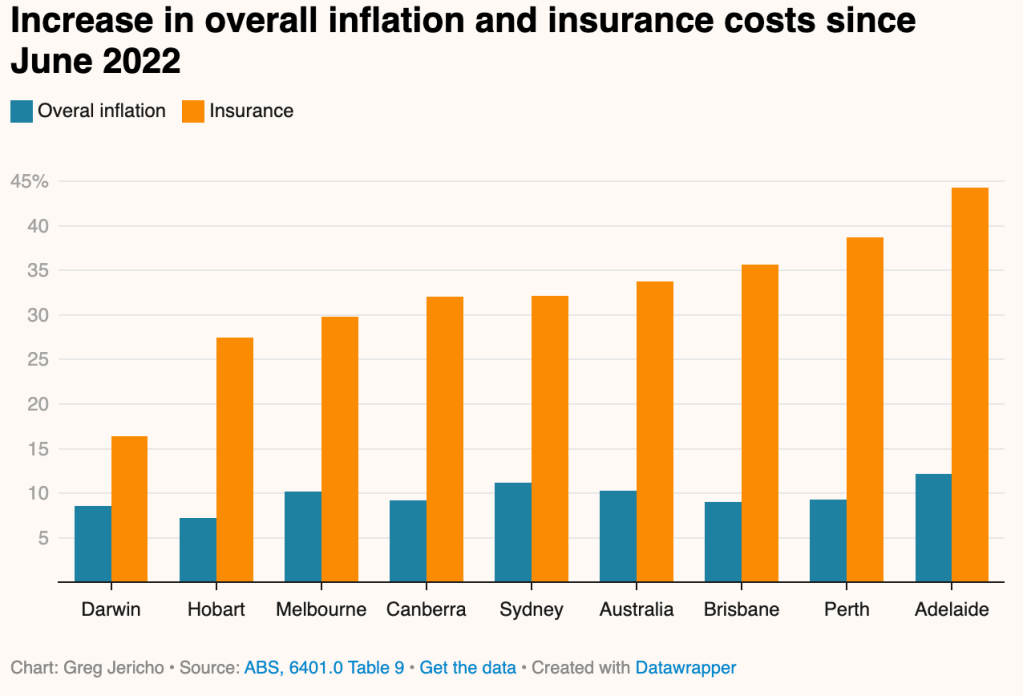
Energy Cost increases driven by Fossil Fuels and climate change
Climate change is significantly contributing to rising energy costs in Australia in the short to medium term. This is primarily by causing increased demand for electricity due to hotter temperatures and extreme weather events, while also putting stress on ageing fossil fuel power plants that struggle to operate effectively in extreme heat, leading to higher operational costs and potential supply disruptions.
Reliance on fossil fuels further exacerbates the issue as their prices fluctuate based on global market conditions. The Ukraine-Russia war has elevated coal and gas prices in recent years with impacts domestically.
Key points about how climate change impacts energy costs in Australia:
- Increased electricity demand: Hotter summers lead to greater usage of air conditioning, putting pressure on the electricity grid during peak demand periods.
- Fossil fuel power plant inefficiencies: Older coal and gas power stations struggle to operate efficiently in extreme heat, leading to potential breakdowns and reduced output.
- Extreme weather events: Severe weather like storms and droughts can disrupt energy infrastructure, impacting supply and driving up costs.
- Volatile fossil fuel prices: As Australia heavily relies on fossil fuels, global price fluctuations due to climate change mitigation efforts, and international conflict, can lead to sudden price spikes.
- Need for adaptation: Transitioning to renewable energy sources like solar and wind power is seen as a key strategy to mitigate the impact of climate change on energy costs.
As the energy transition progresses and household and business electrification occurrs electricity costs will stabilise and fall. The Australian Energy Market Commission (AEMC) released a report in November 2024 projecting Residential electricity price trends 2024 PDF for the next decade, which argues that electricity Prices are projected to fall over the next decade, if investment in renewables and electrification is efficient and policy well coordinated. It concludes the impact on households will be:
- Average household energy spending is projected to fall with electrification of transport and heating
- A household who fully electrifies could reduce their annual energy expenditure by 70%
- Households with EVs are projected to have significantly lower energy costs
- Switching off gas appliances further reduces household energy costs
- Households who can install rooftop solar are projected to see significantly lower energy costs
- Faster electrification could lower energy costs if well-managed
For Victoria, it projects that Victorian prices are projected to be stable and broadly mirror national trends. “Prices in Victoria are projected to fall by 9% over the outlook, with prices remaining below the national average. A higher rate of electrification should place downwards pressure on Victorian household energy costs. Victoria is also projected to have the largest increase in demand due to electrification.”

Coal and Gas Approvals under Albanese Labor
Opening new coal and gas mines diverts resources that could be put into housing, renewable energy projects, critical minerals mining and extraction and Future Made in Australia projects.
Since May 2022, the Federal Environment Minister has approved 10 new coal mines or expansions with 2,449 million tonnes of lifetime emissions. There are 22 additional proposals for new or expanded coal mines currently waiting for Federal Government approval. (Coal Mine Tracker)
The Albanese government (elected May 2022) approved at least four significant gas projects under the EPBC Act, including:
- Santos’ Barossa Gas Project (NT, revised plan approved late 2023).
- Port Kembla Gas Import Terminal (NSW, federal approval late 2023).
- Beetaloo Basin exploration projects (NT, federal funding and regulatory support).
- Scarborough Gas Project (WA, though initially approved earlier, expansions/related infrastructure may have post-2022 approvals).
Redirect Middle Arm subsidy to Recharge the Territory
The Federal Government has earmarked $1.5 billion for development of harbour facilities for the Darwin Middle Arm industrial hub. An LNG export plant will be built to facilitate the export of fracked gas from the Beetaloo Basin. This money could be alternatively put to recharging renewable energy in the Northern Territory and into projects such as housing in remote communities done in consultation with those indigenous communities.
The Envirnment Centre Northern Territory Recharging the Territory report, published February 2024, outlines how this $1.5 billion could be meaningfully redirected into sustainable jobs, skills and lower energy bills. This would provide sustainable benefits rather than in supporting a gas industry that is polluting, primarily for export with minimal jobs, with profits exported overseas, and with no social equity or energy bill reduction focus.
Cost of Living and Gas expansion
6 August 2024. An overwhelming proportion of Australia’s gas is literally given away for companies profit. New Australia Institute report highlights:
“Australia has ten facilities that export gas as liquified natural gas (LNG). Six of these projects—both of the Northern Territory’s facilities and four of the five operating in Western Australia—pay no royalties, either state or federal. These facilities represent 56% of Australia’s gas export capacity. This means that all the gas exported from the NT, and more than half the gas exported from Australia, is given for free to the companies exporting it.”
“The monetary value of this gas is enormous. The total value of LNG exports over the last four years is estimated at $265 billion Australia-wide, $37 billion of which was exported from the NT. All of the NT’s LNG exports were royalty-free and Australia’s royalty-free exports totalled $149 billion. To put this another way: in the last four years alone, Australians have given away the gas that made $149 billion worth of LNG, for free.”
7 August 2024 – $41 billion of new fossil fuel projects are gobbling up construction supply chain. Taxpayer money is helping fund private infrastructure that makes it harder to build public transport and housing, in the middle of a housing crisis, and when we need to build more public and active transport infrastructure to reduce transport emissions. In the NT alone, the Commonwealth Government is spending $100 million on roads explicitly for the onshore gas industry. (Australia Institute)
12 August 2024 – Australian fossil fuel exports ranked second only to Russia for climate damage with ‘no plan’ for reduction. Coal and gas exports expected to remain roughly at current level until at least 2035 with 4.5% of emissions linked to Australia, report finds (Guardian)
26 August 2024 – There is no gas shortage. Australia exports 35 times more gas than the “shortage” of gas projected in the 2030s (Australia Institute) Australia exports around 75% of the gas that is mined on our land and in our coastal areas, and another 7% of all of Australia’s gas is used to convert gas to LNG. That adds up to 82% of our gas. For comparison, Australian households use 2.6% per cent of all the gas produced in Australia. See Report: What is the case for more gas? Government modelling of the Future Gas Strategy does not show a need for more gas.
Coalition Nuclear Policy adds to Cost of Living
The Coalition Nuclear Plan relies on continuing coal and gas for at least the next twenty years, if not longer. It would also greatly increase energy costs and the Cost of Living.
The Liberal and National Parties would be even more gung-ho in expanding coal and gas, and the export of profits from mining.
4 February 2025 – Energy experts refute Dutton’s claims on Nuclear cuting electricity costs. ‘No idea what he’s talking about’: Dutton’s nuclear plan could raise – not cut – electricity bills, experts warn (Guardian)
3 February 2025 – Ten million Australians will see their power bills more than double under Peter Dutton’s nuclear policy, according to detailed analysis from the Smart Energy Council. For the 4 million solar homes across the nation, power bills will go up more than $1,100 a year. For non-solar homes, power bills will go up by an average $665 a year – a 30% increase. (Smart Energy Council)
7 January 2025 – Worth reading this Factcheck by Andrew Gunner on Peter Dutton’s statements on electricity pricing and Coalition Policy: “The Coalition’s presentation of current Australian electricity costs and their cost comparisons are flawed to a remarkable extent. Not one aspect of their analysis is valid.” (FeedbackReigns) He has also done a Factcheck on the Coalition Nuclear Power Folly (FeedbackReigns)
Or just watch the Juice Media Honest Government Ad on the Liberal Party Nuclear Energy Plan:
Use your preferential vote
When you vote during the Federal election in 2025, reflect on who will address the root causes of the increase in cost of living.
Only parties and Candidates that commit to no new coal and gas, phasing out fossil fuel subsidies, have a national climate adaptation and climate resilience strategy, actually have a plan to tackle the root causes of Cost of Living and Inflation in a Warming world.
You need to use the preferential voting system to vote for strong climate candidates, and place Labor above Coalition candidates.
This The Juice Media video from 2019 is still extremely relevant and outlines why preferential voting here in Australia differentiates us from voting systems in the USA, UK or Canada:
References
Climate driving increased Food prices:
ABC News, 22 March 2024, Higher temperatures mean higher food prices, new inflation study finds https://www.abc.net.au/news/2024-03-22/higher-temperatures-mean-higher-food-and-other-prices-new-study/103619378
Nature, 21 March 2024, Kotz, M., Kuik, F., Lis, E. et al. Global warming and heat extremes to enhance inflationary pressures. Commun Earth Environ 5, 116 (2024). https://doi.org/10.1038/s43247-023-01173-x
The Conversation, 22 March 2024, Food prices will climb everywhere as temperatures rise due to climate change – new research, https://theconversation.com/food-prices-will-climb-everywhere-as-temperatures-rise-due-to-climate-change-new-research-226345
Carbon Brief, 23 August 2024, Five charts: How climate change is driving up food prices around the world https://www.carbonbrief.org/five-charts-how-climate-change-is-driving-up-food-prices-around-the-world/
Aishwarya Venkat, William Masters, Elena Naumova (June 2022), Extreme Weather Events Differentially Impact Retail Food Prices: Evidence from Early Warning Systems, Current Developments in Nutrition, Volume 6, Supplement 1, June 2022, Page 82 https://www.sciencedirect.com/science/article/pii/S2475299123131489
Farmers for Climate Action, March 2022: The Fork in the Road, https://farmersforclimateaction.org.au/wp-content/uploads/2022/03/Fork-in-the-Road_V5.pdf
ABC News, 10 January, 2025, Egg shortages, supermarket limits continue as strong demand puts pressure on supply chains https://www.abc.net.au/news/rural/2025-01-10/australian-egg-shortage-avian-flu-supermarket-limits-2025/104795000
The Conversation, 19 June 2024, Climate change is helping the H5N1 bird flu virus spread and evolve https://theconversation.com/climate-change-is-helping-the-h5n1-bird-flu-virus-spread-and-evolve-230361
Climate driving increased Insurance costs:
David Richardson, Stephen Long and Rod Campbell, Australia Institute, 4 November 2024, Premium price: The impact of climate change on insurance costs https://australiainstitute.org.au/report/premium-price-the-impact-of-climate-change-on-insurance-costs/
Insurance Council of Australia, 19 August 2024, New data shows long-term cost of extreme weather, https://insurancecouncil.com.au/resource/new-data-shows-long-term-cost-of-extreme-weather/
The Conversation, 16 January 2025, The LA fires have prompted a reckoning for the insurance industry – Australian premiums could soar as a result https://theconversation.com/the-la-fires-have-prompted-a-reckoning-for-the-insurance-industry-australian-premiums-could-soar-as-a-result-247207
Climate Council, 8 August 2023, Report: Weathering the storm: Insurance in a changing climate https://www.climatecouncil.org.au/resources/weathering-the-storm-insurance-in-a-changing-climate/
Climate Change increasing Energy Costs with firmed renewables cheapest path:
Climate Council, November 23, 2022, Four reasons why your power prices are sky high and rising https://www.climatecouncil.org.au/four-reasons-why-your-power-prices-are-sky-high-and-rising/
Climate Council, June 28, 2024, An Aussie Roadmap: building a clean, reliable and low-cost electricity grid https://www.climatecouncil.org.au/understanding-whats-next-for-australias-main-electricity-market/
CSIRO, 22 May 2024, CSIRO releases 2023-24 GenCost report. Significant industry participation drives key insights on future electricity generation technologies while renewables remain lowest cost https://www.csiro.au/en/news/all/news/2024/may/csiro-releases-2023-24-gencost-report
Australian Energy Market Commission (AEMC), November 2024, Residential electricity price trends 2024 , https://www.aemc.gov.au/sites/default/files/2024-11/Price%20Trends%202024%20Final%20Report.pdf
 Climate Action Merribek