The projects that have successfully applied for Federal active transport funding in Victoria have been announced. Merri-bek Council applied for funding for three projects, and a fourth one in conjunction with Hume Council, but have not received funding for any of them.
Support for active transport was one of the agenda items of the Wills Climate and Environment Advisory Group when it met with Wills Labor MP Peter Khalil before resigning en masse in September 2024. It particularly raised importance of a National e-bike subsidy program.
Merri-bek municipality has one of the highest rates of cycling already, but with so much more cycling infrastructure needed. It looks like a Federal Labor Government has passed over our community in funding cycling.
The Merri-bek projects that the Federal Government failed to fund have all been endorsed by Council, and have established community support:
- Craigieburn Shared Path
- Making Dawson Street path permanent
- O’Hea St extension
The co-project between Merri-bek and Hume Councils was a paved connection to Jack Roper reserve under the Western Ring Road.
In 2019 Peter Khalil MP, along with then Infrastructure Minister Anthony Albanese, promised $500,000 to extend the O’Hea Street shared use bike path. It seems there is no Federal money this time allocated for this bike path extension.
A total of $21 million will be invested in 19 projects across Victoria to build new or upgrade existing bicycle and walking paths. (See projects being funded at end of this post)
- The Benefits of Funding Active Transport
- Comparing Federal Roads funding with active transport
- International Comparison
- List of Victorian Projects Funded
- Conclusion
The Benefits of funding Active Transport
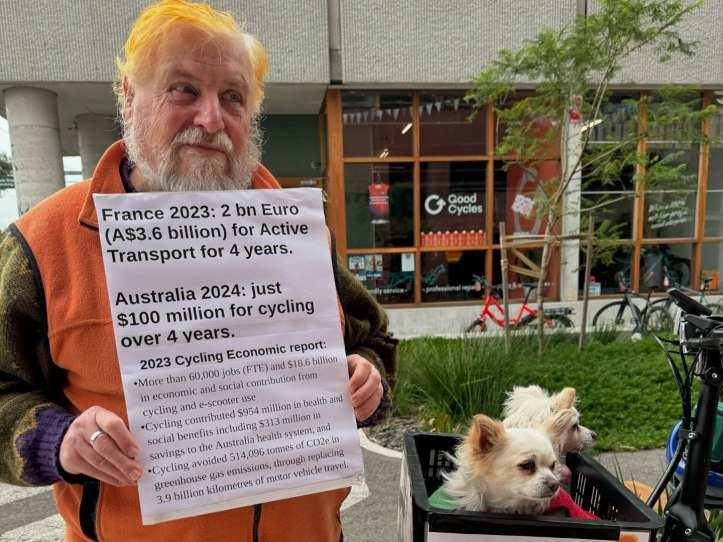
The Australian budget 2024 announced $100 million for active transport over 4 years. It sounds like a lot of money, but not when compared as a percentage of other road transport, or internationally.
Researchers say that Providing infrastructure for cycling has multiple benefits:
- Road use is inherently dangerous – in Australia last year, more than 1,300 people died on our roads, which is more than 25 people a week.
- Owning a car is also expensive, with many people in Merri-bek cycling or walking to save money with the cost-of-living.
- The typical Australian household spends 17% of its income on transport – with car ownership making up 92.5% of that figure, compared to 7.5% on public transport.
- Many Australians feel forced to own a car to get around, so investing in paths and public transport provides people the freedom to get around how they choose.
- Congestion is getting worse in most major cities and we can’t build our way out of it with more or wider roads.
- About two-thirds of car journeys in our cities could be walked, wheeled or cycled in 15 minutes or less, but these short car trips clog up our roads with traffic.
- A major source of all emissions in Australia are from driving.
- If more people felt safe to walk, cycle or take public transport, it would reduce this major climate pollution emissions source.
- There is a strong rationale and economic argument, too. The NSW government has estimated every kilometre walked benefits the national economy by $6.30, while every kilometre cycled benefits the economy by $4.10.
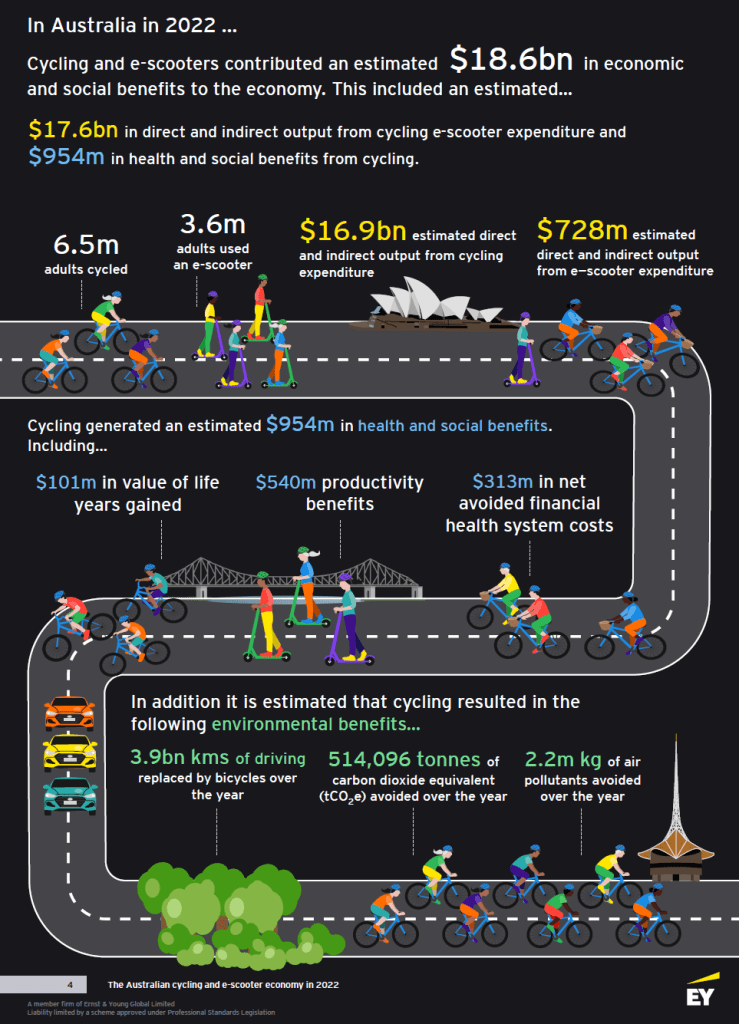
The We Ride 2023 Australian Cycling and E-scooter Economy Report revealed that in 2022 the micro-mobility sector generated:
- More than 60,000 jobs (FTE) and $18.6 billion in economic and social contribution from cycling and e-scooter use
- Cycling contributed $954 million in health and social benefits including $313 million in savings to the Australia health system, and
- Cycling avoided 514,096 tonnes of CO2e in greenhouse gas emissions, through replacing 3.9 billion kilometres of motor vehicle travel.
The report by EY, with support from Program Partners including RACV and the Amy Gillett Foundation, highlighted that cycling also generates considerable cost of living benefits for Australians.
Comparing Federal Roads funding with active transport
The Australian government allocated $9.9 billion for roads in the 2024-2025 federal budget. This funding is part of a larger $39.2 billion investment in roads over four years. Also in the budget was $100 million over four years for the Active Transport Fund.
Researchers have calculated that Australia spends $714 per person on roads every year – but just 90 cents goes to walking, wheeling and cycling.
In July 2024 the Australia Institute undertook polling and found that:
- Three quarters of Australians (76%) support building more walking and cycling paths in their areas
- Two-thirds of Austalians (62%) are in favour of a cycling mileage allowance
- Two-thirds of Australians (63%) support schemes that would allow for internal combustion engine cars to be traded in for EVs, e-bikes and public transport tickets
- More than half of Australians (60%) support introducing a government e-bike subsidy scheme
The Australia Institute report – Proactive investment: Policies to increase rates of active transportation – had the following Key recommendations:
- Increase funding for active transportation to the equivalent of at least 10 percent of road-related expenditure
- Introduce a tax-deductible per/km ride to work mileage allowance similar to programs in place in Europe, where employees can claim an allowance for riding to work ($A0.25-0.50 per kilometre, capped.)
- Introduce a scheme that would allow people to trade in end-of-life internal combustion engine cars for EVs, e-bikes and public transport tickets. Such schemes exist in Finland ($A3300 credit) Canada ($A1100 credit) and Lithuania ($A1600 credit).
- Legalise private e-scooters in all states and territories, with supporting rules, regulation and infrastructure
- Subsidise the purchase of e-bikes
International Comparison
In May 2023 France announced 2 billion Euro (A$3.6 billion) active transport funding over 4 years. To compare apples with apples, on a per capita per annum basis: this works out as:
- France
 A$13.87 per person
 - Australia
 A$0.90 per person
It works out France is spending nearly 15 times more than Australia on a per capita basis for active transport.
This ignores expenditure at municipal and regional levels for both countries, with many French cities, including Paris, with well established cycling infrastructure programs.
List of Victorian Projects funded
| Proponent | Project | Funding amount |
| Moorabool Shire Council | Gordon Township Active Transport Loop | $678,825 |
| Mount Alexander Shire Council | Design and construction of McKenzie Hill to Parker Street Shared Pathway, Castlemaine | $3,010,600 |
| Hume City Council | Highland Drive Shared User Path Upgrade | $50,000 |
| Hume City Council | Lygon Drive Shared User Path and Cycling Facilities Upgrades | $200,000 |
| Yarra Ranges Shire Council | Design and construction of the Liverpool Road Trail, Kilsyth | $463,938 |
| City of Darebin | BT Connor Reserve Shared Path | $158,000 |
| Maroondah City Council | Design and construction of Greenwood Avenue Shared Use Path | $681,630 |
| Frankston City Council | Construction of Shared User Path on Towerhill Road, Frankston South | $923,650 |
| Hobsons Bay City Council | Kororoit Creek Shared Trail Stages 4 and 5 | $5,000,000 |
| Melton City Council | Design and construction of a shared use path along Westwood Drive, Burnside/Ravenhall | $969,527 |
| Melton City Council | Design and Construction of Raised Priority Crossings – Caroline Springs Boulevard and Gourlay Road Corridor, Caroline Springs. | $1,147,093 |
| Moorabool Shire Council | Griffith Street, Maddingley Active Transport Corridor | $1,814,503 |
| City of Port Phillip | Beacon Road Active Transport Safety Upgrade, Port Melbourne | $515,000 |
| City of Glen Eira | Improving Paths, Connecting Communities | $2,336,000 |
| Horsham Rural City Council | Horsham Central Activity District – safe eastern access for cyclists and pedestrians | $900,000 |
| City of Melbourne | Rathdowne Street Traffic Signals Upgrade | $963,095 |
| Bass Coast Shire Council | Design and construction of the Ventnor Road Shared Path, Phillip Island | $980,000 |
| Ararat Rural City Council | Design and Upgrade of the Active Transport Bicycle Network, Ararat | $266,000 |
| Warrnambool City Council | Industrial Precinct Footpath Construction | $266,626 |
Conclusion
We need to recognise the Historical Bias in transport funding: Funding reflects decades of car-centric policy, prioritizing car based freight and commuting.
We also need to keep in mind Sustainability Goals: Active transport receives <1% of federal transport budgets, despite its role in reducing emissions and congestion.
There is a need for rebalancing Federal Transport funding toward active/public transport, with the United Nations recommending targeting 20% of transport budgets.
While the 2023–24 budget includes modest active transport increases it remains minimal compared to road commitments.
Recent commitments signal growing recognition of active transport’s benefits, but federal funding remains overwhelmingly skewed toward roads. Systemic change would require policy shifts to align with climate, health, and urban livability goals.
As the Climate Council highlighted in their 2023 report – Shifting Gear: the path to cleaner transport –
“The transport infrastructure in place determines the choices we make every day about how Australians can get around, and in turn the emissions profile of personal transport in Australia.”
References:
Matthew Mclaughlin (University of Western Australia), Grant Ennis (Monash University), Peter McCue (University of Western Australia), 3 February 2025 – Australia spends $714 per person on roads every year – but just 90 cents goes to walking, wheeling and cycling https://theconversation.com/australia-spends-714-per-person-on-roads-every-year-but-just-90-cents-goes-to-walking-wheeling-and-cycling-247902
Hon Catherine King, Minister for Infrastructure, Media Release, 20 February 2025 – Active transport boost for Victoria https://minister.infrastructure.gov.au/c-king/media-release/active-transport-boost-victoria
Australia Institute, 23 October 2024, On your bike. Policies to increase rates of active transport https://australiainstitute.org.au/post/on-your-bike-policies-to-increase-rates-of-active-transport/
5 June 2023 – France’s 2023-2027 Cycling and Walking Plan is Launched https://leva-eu.com/frances-2023-2027-cycling-and-walking-plan-is-launched/
Climate Council, 23 May 2023, https://www.climatecouncil.org.au/resources/shifting-gear-the-path-to-cleaner-transport/
We Ride, 2023, 2023 Australian Cycling and E-scooter Economy Report, https://www.weride.org.au/australiancyclingeconomy/
 Climate Action Merribek