
This is a live page.
The Federal budget has provided a range of measures to address cost of living and also add marginally to the energy transformation. The budget also includes foreshadowed tax cuts. As Greg Jericho said using a Douglas Adams term: ‘Mostly Harmless’, although it largely ignores the risks from climate change.
The $150 energy subsidy (non-means tested) for the period July – December 2025 has already been announced.
Some important initiatives as detailed by the Australian Conservation Foundation include :
Nature
- No new funding to establish a national environment protection agency.
- No funding for the full reform of national nature protection laws (EPBC Act).
- No new funding for threatened species recovery, except for $3m from existing resources towards a Maugean skate captive breeding program.
- $250m over the forward estimates for the Saving Australia’s Bushland program to purchase high biodiversity value land, better protect degraded government land, establish new Indigenous Protected Areas and Indigenous Ranger programs, and private and state/government partnerships to protect high conservation value areas.
- $12m to deliver increased ocean protection over four years.
- $55.2m to renew lease arrangements with Traditional Owners of the jointly managed Booderee, Kakadu, and Uluru-Kata Tjuta National Parks.
- $11m to reduce the economic and environmental damage caused by feral animals, pests and weeds.
Energy transition
$4.3bn in new net zero spending commitments which includes:
- $1bn over seven years (off budget) for the Green Iron Investment Fund.
- $2bn towards the recapitalisation of the Clean Energy Finance Corporation to invest in renewable energy and low emissions technology (the Government has already provided funding for this measure).
Stop funding fossil fuels
- $57.8bn for the Fuel Tax Credits scheme.
Climate resilience
- $28.4m to construct urgent additional coastal defences to protect vulnerable communities and infrastructure against climate disasters such as floods and erosion.
- $17.7m to support bushfire resilience activities in rural and regional Australia.
Treasurer’s Speech
Here is what the Treasurer, Jim Chalmers outlined in terms of environment/climate related issues in the budget in his budget speech.
A word search found zero references for ‘climate’, 2 references for ‘net-zero’, 1 reference to ‘sustainability’, zero references for ‘nature, ‘conservation’, or ‘environment’. ‘Cost of Living’ had 4 references, ‘health’ had 6 references, ‘medicare’ had 8 references. While energy had 11 references, most of these related to the energy bill rebate.
New Energy Rebate
Providing $1.8 billion more energy bill relief. Every household and around one million small businesses will receive energy rebates until the end of 2025.
Future Made in Australia
Investing more than $3 billion to support the production of Australian‑made green metals, like aluminium and iron. Building on the tax incentives for critical minerals and green hydrogen previously legislated.
Backing clean technologies through our Future Made in Australia Innovation Fund and by recapitalising the Clean Energy Finance Corporation.
Disaster Funding and Cyclone Alfred
Provisioning another $1.2 billion to properly fund recovery from ex‑Tropical Cyclone Alfred.
As part of $13.5 billion in natural disaster funding for further north and around the country.
International Climate Policy
Nil
Nature
$262 million to preserve and conserve our natural land and ocean assets.
Infrastructure and reducing transport emissions
$3 billion in additional equity to complete the rollout of the National Broadband Network.
$17.1 billion over 10 years for transport projects. Including:
- $7.2 billion to upgrade the Bruce Highway in Queensland – the single largest investment ever in the Bruce.
- $2.3 billion for Western Sydney, with $1 billion for the rail network alone.
- And $2 billion towards transforming Sunshine Station, taking our Melbourne Airport Rail investments to $7 billion.
Budget Papers
The following was found in Budget Papers No 1 on Page 83-84:
New net zero spending measures
Table 3.6 sets out $4.3 billion in new net zero spending commitments over the forward estimates period and $6.9 billion over the medium term, across 2024–25 MYEFO and this Budget. This follows net zero spending commitments of $24.3 billion (over the medium term) in the 2024–25 Budget, climate-related spending of $4.6 billion (to 2030) committed in the 2023–24 Budget and the $24.9 billion (to 2030) committed in the 2022–23 October
Budget.
Classification of spending is informed by the net zero spending framework. The total commitment includes spending, balance sheet and tax expenditure measures and therefore presents a broader view than the impact on the underlying cash balance.
Reporting new net zero spending measures supports transparency around the fiscal impacts of climate change and the net zero transformation. However, it does not provide a complete summary of climate action. Only measures that entail funding commitments or forgone revenue (such as tax concessions) are captured.
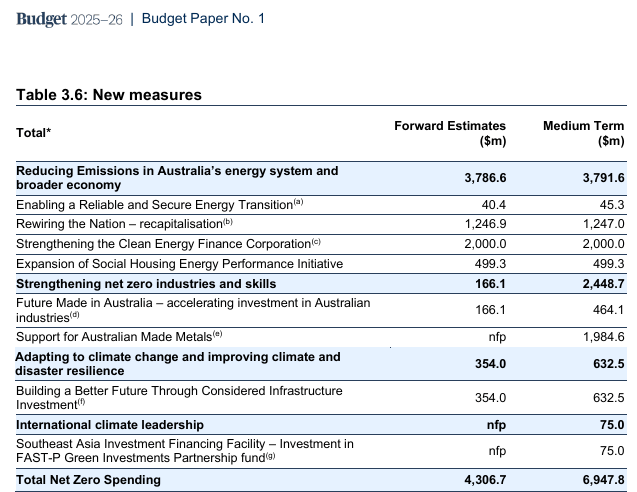
- This table summarises the Government’s key climate-related spending commitments in the 2024–25 MYEFO and 2025–26 Budget to 30 June 2036 and presents a broader view than the impact on the underlying cash balance. Some measures extend beyond the end of the medium term or include both initial and ongoing funding to the end of the medium term. Figures align with the timeframes for measures reported in the 2024–25 MYEFO and 2025–26 Budget Paper No. 2, but timeframes for figures align with the forward estimates and medium term for the 2025–26 Budget. Spending outlined in these measures for the purposes of this table may differ in some instances from figures reported in the 2024–25 MYEFO and 2025–26 Budget Paper No. 2 due to the exclusions described in the footnotes.
a) The spending outlined in this measure for the purposes of this table excludes funding to support the Australian Energy Market Operator to uplift core digital systems. The cost of this measure will be partially
met from savings identified in the Climate Change and Energy and the Environment and Water portfolios.
b) This measure contains $1.2 billion in funding for concessional finance.
c) This measure contains $2.0 billion in funding for concessional finance.
d) The spending outlined in this measure for the purposes of this table excludes funding for the Australian Made Campaign Limited. The cost of this measure will be partially met from savings identified in the
Industry, Science, and Resources portfolio and the Climate Change and Energy portfolio.
e) The funding profile for this measure is not for publication due to commercial sensitivities. The spending outlined in this measure for the purposes of this table only includes the Green Aluminium Production
Credit and the Green Iron Investment Fund related funding.
f) The spending outlined in this measure for the purposes of this table includes Infrastructure Investment Program projects that support flood resilience, including upgrades to Townson Road, Burdekin Road and
Garfield Road West in New South Wales.
g) The funding profile for this measure is not for publication due to commercial sensitivities.
On Page 36 of Budget Papers No 1 on Protecting the Environment:
“The Government is providing $262.0 million over five years from 2025–26 to meet its ‘30 by 30’ commitment of conserving 30 per cent of Australia’s landmass and 30 per cent of Australia’s marine areas by 2030.
The Government will partner with state and territory governments and private landholders to preserve Australia’s iconic bushland. This will be done through a range of measures including investment in nature repair market projects and working with landholders in regions with high biodiversity value, creating havens for endangered species, restoring degraded government land and supporting the establishment of new Indigenous Protected Areas. It will also build on the Government’s investments that have increased ocean protection while continuing to support sustainable commercial fisheries.”
Gorgon Gas LNG and carbon Storage project Pg 205 Budget Paper 1
“Contingent liabilities – unquantifiable
Gorgon liquefied natural gas and carbon dioxide storage project –
long-term liability The Australian and Western Australian (WA) Governments have provided an indemnity to the Gorgon Joint Venture Partners (GJV) against independent third-party claims (relating to stored carbon dioxide) under common law, for loss or damage caused by the injection of carbon dioxide into the Dupuy formation under Barrow Island, WA. Claims can only occur at least 15 years after the cessation of carbon dioxide injections into the formation. The project commenced in 2019 and has an expected life of around 40 years. The claims are subject to conditions similar to those set out in the Offshore Petroleum and Greenhouse Gas Storage Act 2006.
The WA Government has indemnified the GJV and, subject to certain conditions being met, the Australian Government has indemnified the WA Government for 80 per cent of any amount determined to be payable under that indemnity.”
Commentary
Australia Institute
Chief Economist at the Australia Institute, Greg Jericho, says this budget is mostly harmless. “This pre-election budget is designed to annoy the least number of people. It has modest sweeteners in the form of tax cuts, electricity rebates, cheaper medicines, and incentives to increase bulk billing. To paraphrase Douglas Adams, this budget is mostly harmless.”
For climate and environment he says it is a missed opportunity:
“Being mostly harmless, this budget also does little to combat some of Australia’s biggest problems. There is funding to help with climate related disasters but no additional funding to reduce emissions. Australia is unlikely to hit its emissions reduction targets and there is nothing in this budget that will stop that.”

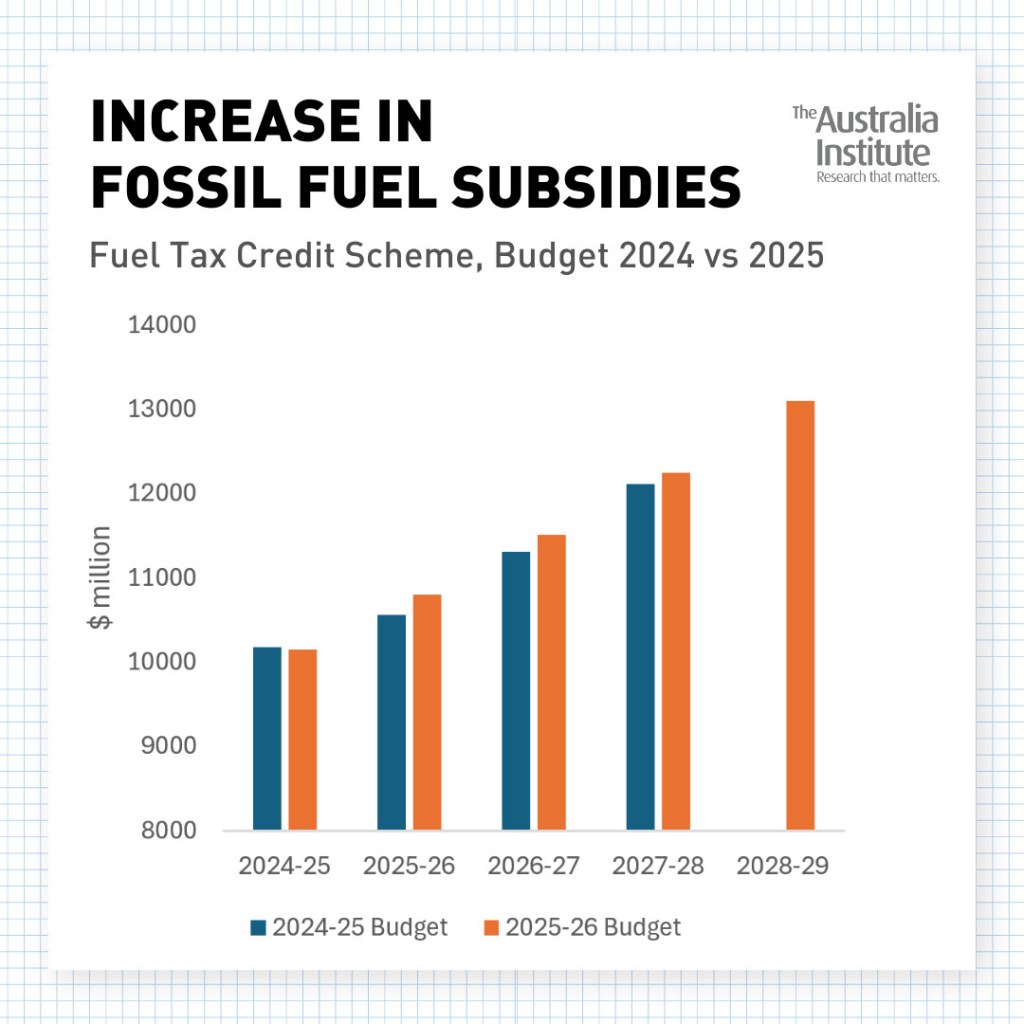
Australia Institute: “Fossil fuel subsidies are one of the big winners from tonight’s budget. Fuel tax credits are not only predicted to continue to rise but the govt now thinks they will be even higher than last year’s budget. Why? “this largely reflects an expected increase in the use of [fossil] fuels” – #Budget25“
While gas export is expanding, Tax on Gas declining
Greg Jericho at the Guardian says: Australia budget 2025: the seven graphs you need to see: “One thing that we are not seeing is much tax from gas companies. Revenue from the petroleum resources rent tax is set to keep falling.
“Two years ago the treasury estimated that over the four years of 2023-24 through to 2026-27 we would raise $10bn from the PRRT. Now we are down to $6.3bn. So, during a major gas boom, the government raised half the revenue from the PRRT than it did from excise on spirits – well done, gin and whisky drinkers, we salute you.”

Australian Conservation Foundation:
Despite Australia’s natural world facing the double whammy of climate change and an extinction crisis, less than one cent out of every dollar in Budget 2025-26 is allocated to protecting nature, the Australian Conservation Foundation said.
“With rampant habitat destruction and the accelerating impacts of climate change, numerous ecosystems are on the brink and people’s livelihoods are at risk, yet investment in nature protection and climate action remains a tiny fraction of Commonwealth spending,” said ACF Chief Executive Kelly O’Shanassy.
“Even though 42 more species and ecosystems were added to the threatened species list in 2024 and a further 14 were moved to a category closer to extinction, less than one cent out of every dollar in this Budget is earmarked for nature protection and resilience.
“There is no new funding for threatened species in this budget, except for a paltry allocation of $3 million from existing resources for a captive breeding program for the Maugean skate. This does not lessen the blow dealt to this fragile and endangered creature today by the passing in the House of the amendment to national nature laws, which will terminate a review of the impacts on salmon farming on the Maugean skate.
“All the government has to show for threatened species funding in its term is the $224.5 million over four years that it announced three years ago. Its priorities are all wrong.
“While spending on all environment protection programs totals $9.4 billion over the forward estimates, a single fossil fuel subsidy, the notorious Fuel Tax Credits scheme – which encourages diesel fuel use and discourages innovation – is allocated $57.8 billion over the same period. This subsidy has increased by $13.6 billion across forward estimates.
“The government is spending six times more on fossil fuel subsidies than it is investing to protect our precious environment. This is a disgrace.
“The budget includes $250 million for the Saving Australia’s Bushland program which is an important first step towards meeting our 30 X 30 target. More will be required.
“Funding previously committed to establish the EPA remains in the budget and will support the establishment of this critical agency in the future.
“The Albanese government has made some good moves to invest in the energy transition, continuing to invest in clean manufacturing and green metals.
“Yet while Australia’s natural world faces a double whammy of climate change and an extinction crisis, this budget offers little more than loose change.”
The Conversation argues this budget ignores climate change.
“One missing element of the budget is new spending to combat climate change. The threat of climate change to the budget estimates has grown significantly. This is acknowledged briefly with a half page in the budget’s “statement of risks” – “climate change is expected to have a significant impact on the budget”.
“However, that impact is not quantified – possibly because of “significant uncertainty”. Yes, there is uncertainty.
But the same applies to other parts of the budget, including the international economy, which is discussed in much more depth. The climate change department is one of a handful that lose staff in this budget. It may take more severe disasters before it regains prominence in the budget papers.”
Biodiversity Council : Federal budget nature spending still inadequate to deliver the government’s own commitments
A review of the 2025-26 federal budget by the Biodiversity Council has found that the Albanese Government is still far short of investing what is required to meet the Australian Government’s own environmental commitments, despite recent funding commitments for protected areas.
The Australian Government’s own targets include preventing extinctions of plants and animals, restoring degraded lands and conserving 30% of lands and seas by 2023.
Biodiversity Council Director James Trezise said, “Whilst there are some positive signs, the reality is this budget doesn’t come close to addressing the systemic underinvestment in nature protection that we have seen from successive federal governments.
“The National Strategy for Nature outlines how the Australian Government intends to deliver its international obligations, but sufficient funding to carry out that work is dramatically lacking.
“The government has committed $250 million over the next five years to tackle invasive species, create new national parks and expand private and Indigenous protected areas.
“However it’s estimated that 20 times that amount is needed just to fulfil Australia’s commitments on protecting 30 per cent of land in a connected and well-represented protected area network.
“It’s also estimated that $2.34 billion per year is needed to safeguard threatened species on land and in the oceans from extinction.

Climate Council: Climate fuelled disasters already cost us $13.5 billion
Australians are footing a $13.5 billion bill for worsening extreme weather fuelled by climate pollution, which underscores why we should be spending more on permanent solutions that better protect Australians, the Climate Council said in response to this evening’s Federal Budget.
Climate Council CEO, Amanda McKenzie, said: “Australians are concerned about both the rising costs of living and escalating costs of unnatural disasters driven by climate pollution from coal, oil and gas.
The massive hit to the budget from recent Tropical Cyclone Alfred – supercharged by dangerous climate pollution – is expected to cost taxpayers about $1.2 billion. This shows the on-going terrible cost to Australians from unnatural disasters. It is more important than ever to invest in solutions that slash climate pollution and make Australians safer.
“The good news is that measures like investing in access to rooftop solar backed up by batteries – that cut climate pollution – also provide Aussies with cheaper, reliable power for years to come. It’s far less expensive than constantly cleaning up the mess of worsening disasters.”
The 2025-26 Federal Budget confirms funding for climate solution commitments already made by the Albanese Government, including:
- $3 billion in funding for investment in green iron and aluminium
- $2 billion for the Clean Energy Finance Corporation to invest in renewable power and storage, energy efficiency, and other low emissions technology
- $3 billion for rail projects in Western Sydney and Melbourne
While $1.8 billion of further electricity bill rebates will provide temporary relief for households, the Climate Council is calling for the government to make commitments that permanently bust power bills and slash climate pollution, like rooftop solar, household batteries, electrification, and energy efficiency.
References
Treasurers Speech to Parliament, 25 March 2025, https://ministers.treasury.gov.au/ministers/jim-chalmers-2022/speeches/2025-26-budget-speech-parliament-house-canberra
Australian Conservation Foundation, 25 March 2025, Federal budget 2025-26: a fail for nature, https://www.acf.org.au/federal-budget-2025-26-a-fail-for-nature
The Conversation, 25 March 2025, The 2025 budget has few savings and surprises but it also ignores climate change https://theconversation.com/the-2025-budget-has-few-savings-and-surprises-but-it-also-ignores-climate-change-253026
Biodiversity Council, 25 March 2025, Federal budget nature spending still inadequate to deliver the government’s own commitments https://biodiversitycouncil.org.au/news/federal-budget-nature-spending-still-inadequate-to-deliver-government-commitments
Climate Council, 25 March 2025, Federal Budget: Climate-fuelled disasters already cost us $13.5 billion https://www.climatecouncil.org.au/resources/federal-budget-climate-fuelled-disasters-already-cost-us-13-5-billion/
 Climate Action Merribek