
Minimal notice and tight timeframe with lots of activity happening, but we got our 20 page submission on Victoria’s Climate Strategy 2026-2030 in on time on 8 April 2025 via the Vic engage website.
The timeline is: Review feedback from April 2025 – May 2025; Publish summary of findings in Mid-2025; Prepare strategy Mid – Late 2025; Release strategy End of 2025.
Victoria’s Climate Targets
Victoria already has relatively ambitious climate targets with an overall target of a net-zero emissions and a climate resilient Victoria by 2045. Legislated emission reduction targets include:
- 28–33% by 2025
- 45–50% by 2030
- 75-80% by 2035
- Net zero by 2045
Renewable energy targets are 65% renewables by 2030, 95% by 2035.
Victorian Energy Storage Target of 2.6 gigawatts by 2030 and 6.3 gigawatts by 2035.
Offshore wind target by 2050 of potential capacity of 13 GW, with interim targets of:
- 2032 – target of 2 GW
- 2035 – target of 4 GW
- 2040 – target of 9 GW
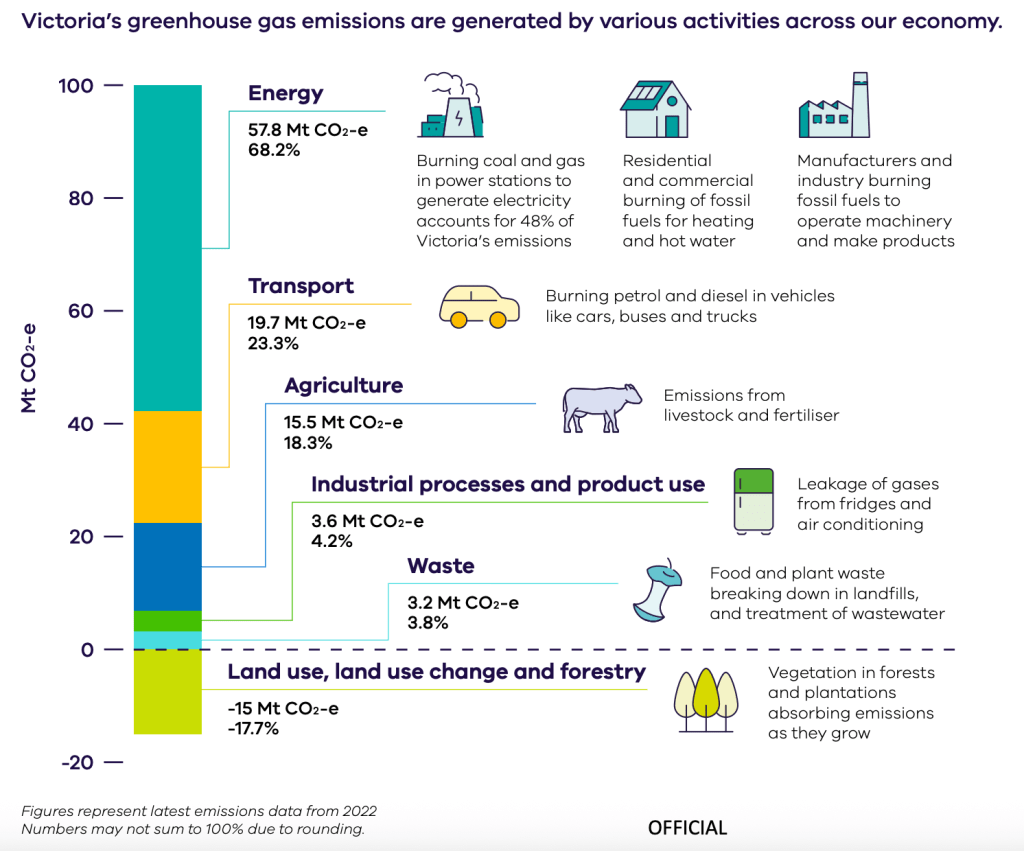
A couple of images from the Summary discussion paper for Victoria’s climate Targets and a breakdown of emissions by sector:

Here is our Executive summary of all our recommendations:
Executive Summary and recommendations
Headline items
- Ban all New fossil fuel projects in the State of Victoria
- Continue to Phase out use of Gas by industrial, commercial and residential users
- Reduce Transport Emissions
- Victorian Human Rights Charter should be amended to add a right to a safe climate
- Latrobe Valley must be supported to embrace new industries and former coal sites must be cleaned up and mine sites rehabilitated
- Prepare for increased bushfire and grassfire risks, more frequent and intense extreme heat events.
- Prepare for more extreme wind and extreme rain and flash flooding events.
Public and Active Transport
- Victoria needs to step up funding for active transport planning and infrastructure, along with addressing public transport infrastructure to deliver a turn up and go service for most of suburban Melbourne
- Increase cycling infrastructure, especially arterial routes of the Principal Bicycle Network and Strategic Cycling Corridors. More protected bike lanes to encourage greater take up of micro-mobility.
- Assess main walking and cycling routes for heat exposure and existing shade to plan for adding canopy shade to improve thermal comfort
- Address Northern Transport Capacity issue through extending heavy rail network and provision of bus services
Phasing out gas use
- Stop approving new gas drilling
- Continue refining Gas Substitution Roadmap to achieve goals of phasing out gas by residential, commercial and industrial users.
Waste Management and Waste to Energy
- Move away from Waste to Energy Framework and develop separation of waste into recycling streams, pre-sorted landfill with bio-stabilisation as waste solutions.
Addressing urban heat, heatwave and heat health risks
- Increase vegetation on public lands, car parks. Through planning process and controls minimum vegetation requirements for private land and urban development
- Statewide heatwave plan and mandate each council develop a heatwave plan
- State Guidelines for reducing urban heat from car parks, both public and private.
- The Victorian Government needs to respond adequately to Victorian Parliamentary Inquiry into Environmental Infrastructure for Growing Populations. (Report published 9 Feb 2022) . In particular it needs to urgently address guidelines for synthetic turf use in both sporting and education environments.
- Develop a synthetic turf in public places decision making tool based on triple bottom line factors incorporating the precautionary principle, based on best available science
Planning Department
- A permanent Victorian Climate Change Adaptation Fund to support community-led efforts to adapt and prepare for extreme weather.
- Emergency response and climate resilience planning that is led by communities most affected and most at risk.
- Urgently update the Planning Department Cooling and greening Melbourne map with a current dataset for urban heat, vegetation cover, heat vulnerability index
Residential dwelling standards
- Focus on ensuring rental properties are heatwave-safe
- Strengthen appropriate legislation on enforcing compliance of rental standards for both cooling and heating.
Increasing storm intensity and convective wind
- Assess flash flooding and riverine flooding risk. Assess existing drainage and greenspaces for dealing with increased extreme rainfall in Melbourne and regional towns. Upgrade Water Sensitive Urban Design and green infrastructure to deal with more intense rainfall episodes.
- Program to assess High Voltage transmission grid and upgrade infrastructure to deal with more episodes of more intense storms and greater convective winds. This may entail moving some of the grid underground, replacing existing towers with a higher specification.
Sea Level Rise and Coastal erosion
- Reassess coastal planning controls including guidelines to Councils. Include low probability, high impact range predictions as a worst case scenario
Rising Insurance Costs
- State government advanced bushfire and flood risk preparations can reduce future Insurance premium increases, which is important for addressing inflation and cost of living.
- State Government needs to discuss risk reduction and mitigation measures with Local Insurers and Reinsurance companies
Agriculture, Food and food insecurity
- Programs to Reduce use of synthetic fertilisers. Encouragement of permaculture, agro-ecological farming practices that are more conducive to rebuilding soil carbon and nutrients.
- State support for the Food and Material Relief Network in Victoria
- Fund Community Food Hubs in targeted communities
- Support and promote the benefits of community urban agriculture
- Work with CALD communities to encourage food culture
- Honour First Nations knowledge and culture in urban agriculture/edible landscapes
- Agricultural education to encourage farm agroecological farming techniques
- Address the accelerating use of UREA nitrogen fertiliser on Victorian farms by helping farmers to reassess farming techniques
- Encourage local food system networks, forums and farmers markets
- Upskill community organisations in addressing food insecurity, urban agriculture and distribution
- Support for local independent production, processing, logistics / distribution and food retail options which support employment and keep money circulating in local economies
Species and Eco-systems Resilience
- The Government should urgently formulate a detailed response to the findings and recommendations of the Parliamentary Inquiry into ecosystem decline in Victoria to address the climate resilience of all endemic Victorian species, whether on the threatened list or not, and threatened eco-systems.
References
June 6, 2022 – Submission: Setting Victoria’s 2035 climate target https://climateactionmerribek.org/2022/06/06/submission-setting-victorias-2035-climate-target/
May 3, 2021 – New Victorian interim climate targets welcome but underwhelming https://climateactionmerribek.org/2021/05/03/new-victorian-interim-climate-targets-welcome-but-underwhelming/
July 22, 2019 – Submission: Setting Victoria’s climate targets for 2025 and 2030 https://climateactionmerribek.org/2019/07/22/submission-setting-victorias-climate-targets-for-2025-and-2030/
 Climate Action Merribek