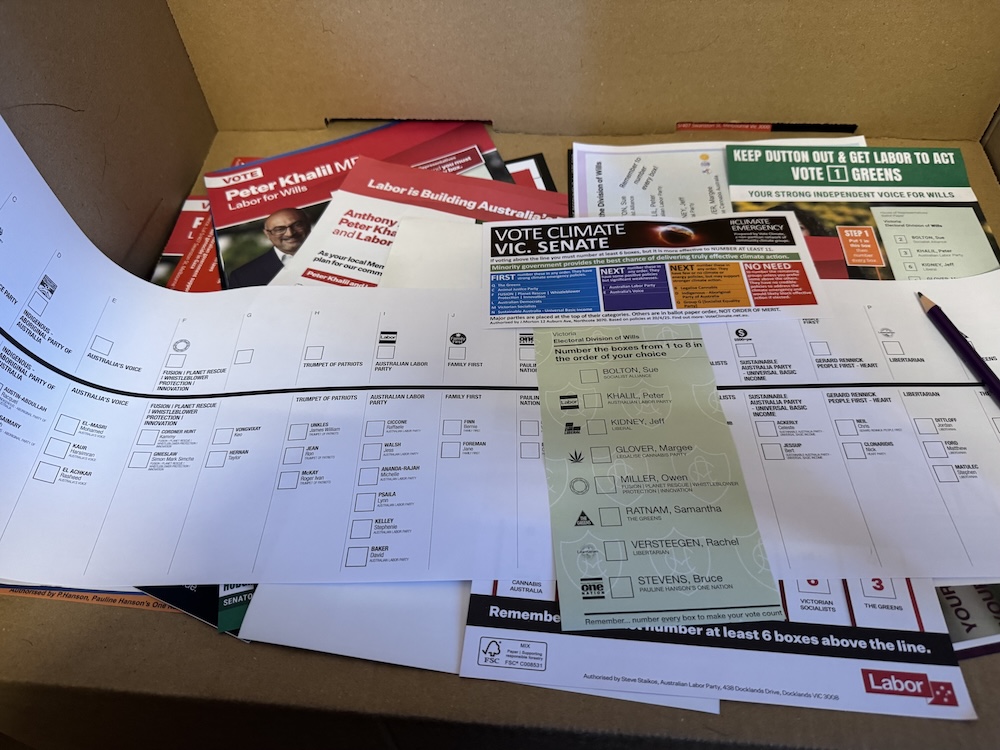
Labor achieved a landslide win in the 2025 Federal election on May 3. While the election top issue was Cost of Living, climate change was an essential issue in the background. Both the Coalition and Labor Parties presented plans for the energy transition. People chose a renewable path and repudiated Peter Dutton’s Coalition nuclear plan.
Addressing the housing crisis with more housing stock and boosting funding for Medicare and rollout of more Emergency Medical Clinics were also important issues. In a world with greater instability with Trump’s tariff war, Dutton’s strong persona and negative policies proved anaethema to voters. Add to this poor policy in presentation and rollbacks and the poor campaign by the Liberals, and voters turned away from the Liberals to give them their worst result since 1943.
The Climate Council commented that Climate denial is now electoral poison, with voters expecting Labor to go harder on climate pollution.
Most Teal independents held their ground. Although the Liberal Party may take back Kooyong and Goldstein in late counting of postal votes. Some seats we may not have a result in till the end of this week, or even next week due to postal votes and the preferential counting complexities.
Similar to Pierre Poilievre, Canada’s conservative leader in the recent Canadian election, Coalition Opposition Leader Peter Dutton lost his own seat of Dickson in Brisbane.
The Greens suffer losses while maintaining overall vote level nationally
The Greens are set to lose two of their three Brisbane seats they won in 2022 to Labor, but this is not because of a deline in their primary vote, but a collapse of the Liberal vote in these seats and the way 3 cornered contests under the preferential system determine the result. In the slightly more conservative seat of Ryan in Brisbane, the Greens are likely to win on Labor preferences.
Greens leader Adam Bandt in his Melbourne electorate has suffered a swing to Labor, and the Liberal vote has also declined, with the final result that Adam Bandt has lost his seat, he first won in 2010. Watch his full press conference conceding defeat.
Right wing astro-turf group Advance, funded by fossil fuel interests and the Liberal Party Investment group the Cormack Foundation, have already claimed they were responsible for the Greens seat losses, according to Independent journalist Anthony Klan. Certainly there was a concerted letterbox and social media campaign by this group targeting Green seats.
The Greens Senate vote has remained strong with 6 Greens Senators elected. Labor has also done well in the Senate. They will require either a grand coalition with the LNP or the Greens to pass legislation in the Senate. Climate champion Independent David Pocock was re-elected representing the ACT in the Senate.
Coal and gas expansion was never raised or discussed by either Labor or Coalition Parties during the campaign, but we know both want to continue expanding fossil fuels which makes global warming worse. The Greens did talk during the campaign on ending fossil fuel approvals, so have a mandate to call for an end to new coal and gas projects and negotiate on that through their Senate representation.
The Guardian reported just before the election that Labor and Coalition were on a fossil fuel ‘unity ticket’ as thermal coal exports hit record high. Australia shipped 57m tonnes of coal for burning in overseas power plants between October and December last year, the most recorded for a three-month period .
Liberal Party have lost touch
It is clear the Liberal Party have lost touch with proffessionals, women, and Millenial and Gen Z voters. The Liberal Party has continued policies that only dimly obscure a persistent climate denial. Many of their policies focussed on ripping up the moderate policies by Labor on Renewables, vehicle efficiency standards. The Liberal Party has dropped any pretence to support environment policies. The last time the Liberal Party had climate and environment policies was under John Hewson in 1993. The Liberal and National Parties have used the environment and climate for political division rather than consider good policy for Australia.
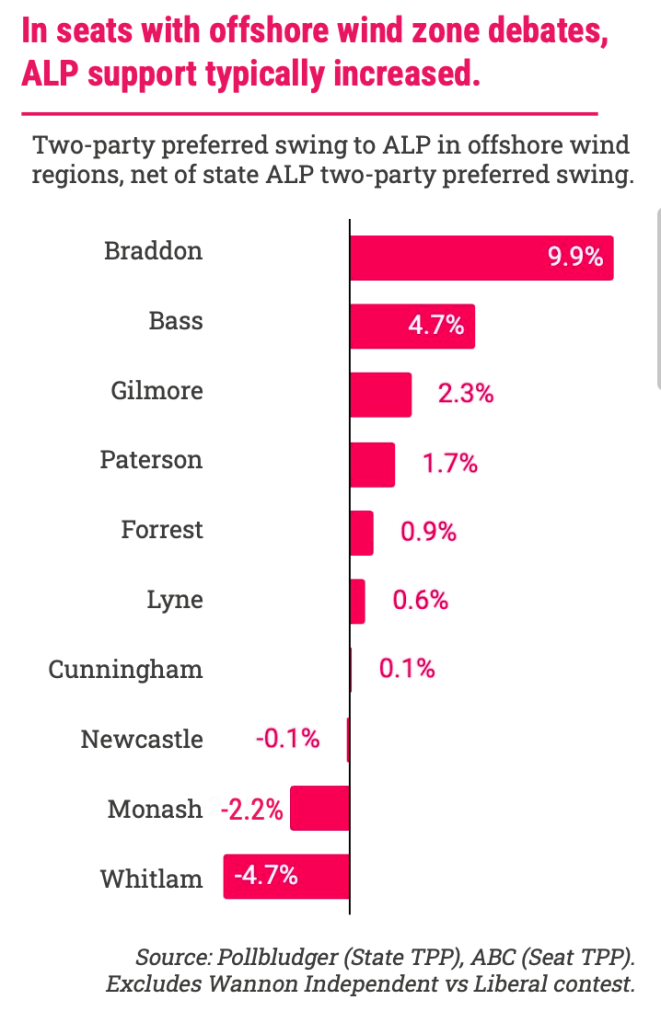
The Age reports that The Coalition’s nuclear energy policy was toxic to voters, delivering big swings against Peter Dutton’s candidates in electorates chosen to host reactors, while support for Labor grew in many places it chose for massive offshore wind farms.
The Liberal party did not have an official climate policy for this election, only an energy policy. Most of their ‘climate’ oriented policy announcements were ripping up present government programs effectively to cancel out climate action and emissions reduction. See here.
Here is some advice for the Liberal Party from one of their failed candidates: Andrew Constance, who campaigned in the NSW South Coast seat of Gilmore against Labor’s renewable energy platform, has conceded defeat, admitting Australians have spoken on the energy transition and his party needs to be “pro-environment”.
Meanwhile The National Party ‘100 per cent’ back nuclear being kept as Coalition policy, as Liberal Party dissects loss.
Labor offered a renewables plan, but no plan to stop new Fossil Fuels
The Labor Party did take a climate policy to the election, as well as implementing programs such as Rewiring the Nation, Future Made in Australia, New Vehicle Efficiency Standard. One new major policy announcement was made during the election campaign: to subsidise batteries for households and small businesses. But Labor still have no policy on fossil fuel expansion, or reducing the fossil fuel subsidies. See here.
Greens push for end to fossil fuel expansion
The Greens policies were consistent with science and they continue to argue for Labor to go further on climate action. Whatever their representation in the House of Representatives, they do have a mandate to push for greater ambition in the Senate. See here.
The Election in Wills in Melbourne’s northern suburbs
Here in Wills, a traditional Melbourne Labor urban electorate, it was a tight race between Labor’s Peter Khalil and the Greens Samantha Ratnam. It was a close race, but Peter Khalil pulled ahead in postal votes and will likely be decalared re-elected. But it is now extremely marginal and Labor can no longer afford to ignore this electorate, one of the most climate aware electorates in Australia.
Climate action featured throughout the local election campaign, with signage, with questions in forums, doorknocking and climate conversations, and with a plethora of climate and environment scorecards and rateing of candidates and their party climate policies.
Peter Khalil, flanked by two local State Labor MPs, committed $7 million in Federal Funding to plan, design and schedule the duplication and extension of the Upfield rail line. Lets hope its not on the never-never like the Upfield Bike Path extension funded by the State Government in 2018 but with work still to start seven years later.
Every election is now a climate election
Here are some key insights to be drawn from this election:
1. Australians made a resounding choice: keep powering on with renewables and storage.
– Already, 40% of our national electricity grid is powered by renewables and storage. At the 2025 election, Australians endorsed the progress that’s already been made by the first term Labor (ALP) government, and backed a renewable-powered future.

– Nuclear bombed at the ballot. It was politically toxic, especially with women and undecided voters.


– The ALP’s two-party preferred support increased in most seats with offshore wind debates, despite significant campaigns against the projects, often funded by fossil fuel backed astro-turf groups.
– By the next election, Australia’s main grid is expected to be more than two-thirds powered with renewables and storage – making this switch unstoppable.
2. There is a fundamental shift in Australian politics. Climate change is now a fixture of Australian elections, and a large voting block prioritises climate champions at the ballot box.
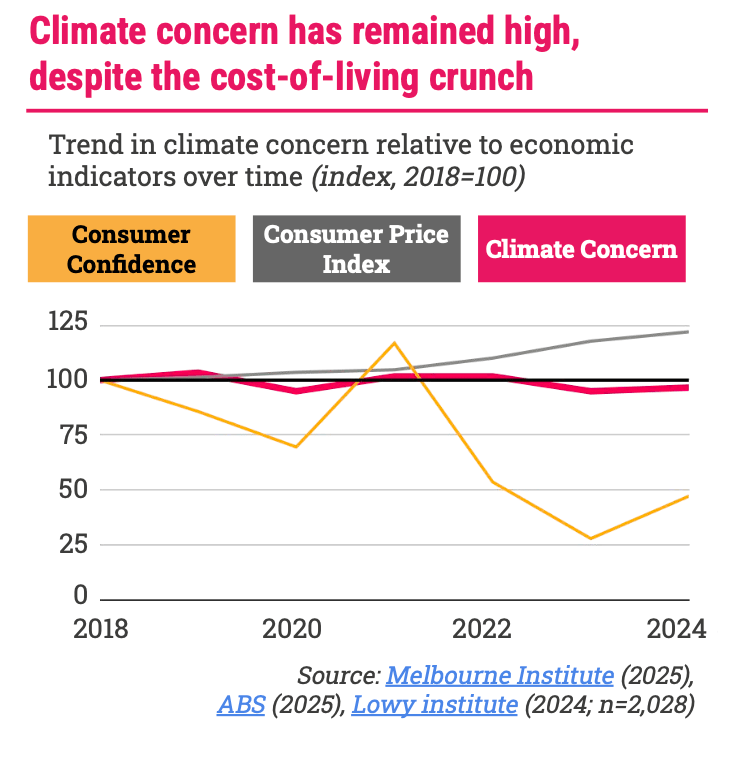
– Climate concern has remained persistently high across swathes of the Australian community, in spite of the cost-of-living crunch.
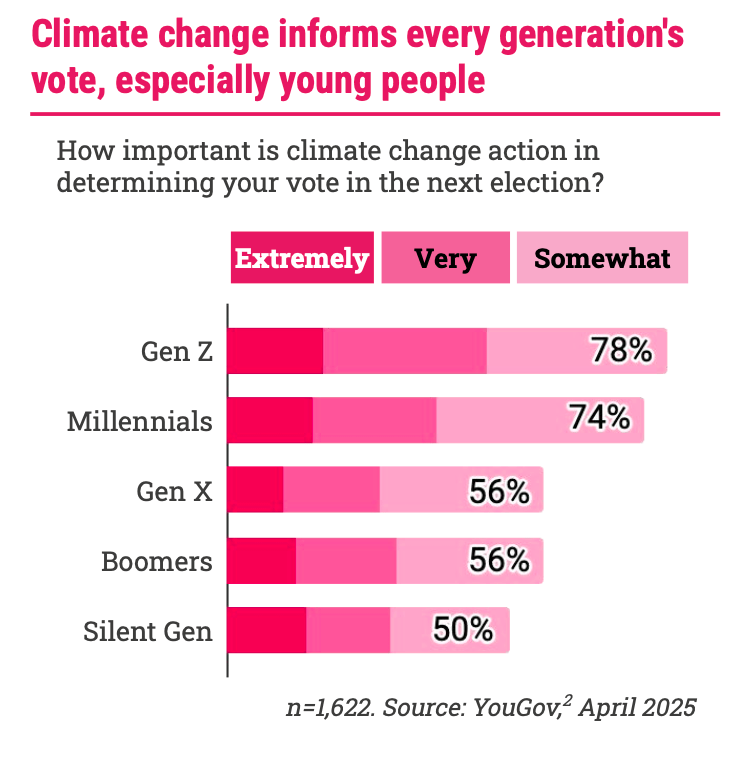
– Three-quarters of Millennials and Generation Z voters named climate change as a top tier voting issue for the 2025 election. This climate voting bloc is now the largest – and still growing – group of Australian voters.
– For ALP voters, climate change was a top 2 issue in this election. (Although in Wills there was little to indicate this from Labor’s Peter Khalil’s social media posts)
– Pro-climate independents have won more votes than ever before, with a 3.8% increase in their primary vote across contested seats.
– The Australian Greens is likely to hold the balance of power in the Senate, providing a path to pass stronger climate laws through the upper house.
3. The Federal Coalition’s sweeping defeat points to the party being unelectable until it advances credible climate and energy policies.
– The ALP held a 17 percentage point lead over the Coalition as the party most trusted to “address climate change”.
– The Coalition’s inner-city heartland has been decimated as pro-climate independent incumbents retaining their seats from the 2022 Federal Election, signaling a lasting shift in voter priorities.
– New community independent challengers performed strongly in 10 traditionally safe Liberal and National seats. These are the next wave of seats at risk for the Coalition in 2028.

The teal Independents and Labor gains this election has mostly wiped out Liberal representation in capital cities: Sydney, Melbourne, Adelaide, Perth, Hobart. Their city electorates are very few, indicating a loss of connecting with urban voters.
4. Australians have given the ALP its strongest mandate since World War II to roll out more renewable power and storage, better regulate polluters and set new, stronger climate targets.
Our job now is to keep Labor on target for existing climate policies and the many policy changes that need to be made, the increased productivity needed, addressing the housing crisis, moderating the cost of living pressures, revamping the taxation system to make it more intergenerationally equitable and fair, and the mechanisms and behaviour to reduce greenhouse gas emissions.
In coming months the Albanese Government will need to set Australia’s 2035 climate targets and submit them to the UNFCCC. Current Australian legislated target is 43% emissions reduction by 2030. In an issues paper the Climate Change Authority has already suggested that the evidence to date suggests the authority consider targets broadly within the
65% to 75% range for 2035. The Climate Council has put forward 100% by 2035 as a target consistent with what science demands.
The new Albanese Labor Government will go to Bonn midyear to bid for COP31, the UN Climate Change conference in Adelaide in 2026. We are in competition with Turkey to host this conference. Countries that host the UN Climate summit usually get a local boost in climate support, and in climate action according to a Climate Council report. Australia would play a major international role in the UNFCCC process with assuming the COP Presidency in the year before and the year after the conference.
References
Information drawn from Climate Council briefing on Election 2025 outcome and also these media reports: https://www.climatecouncil.org.au/resources/election-2025-unpacking-the-impact-of-climate-on-australian-voters/
6 May 2025 – Australians choose batteries over nuclear after election fought on energy https://www.abc.net.au/news/2025-05-06/federal-election-shows-voters-support-renewables-over-nuclear/105252888
6 May 2025 – Australia has backed a rapid shift to renewable energy – and given Labor a chance on climate. How will it act? by Adam Morton https://www.theguardian.com/australia-news/commentisfree/2025/may/06/australia-has-backed-a-rapid-shift-to-renewable-energy-and-given-labor-a-chance-on-climate-how-will-it-act
5 May 2025 – Climate denial now electoral poison, with voters expecting Labor to go harder on climate pollution https://www.climatecouncil.org.au/resources/voters-expecting-labor-harder-climate-pollution/
5 May 2025 – Nuclear fallout: Coalition’s energy policy proved toxic to voters https://www.theage.com.au/politics/federal/nuclear-fallout-coalition-s-energy-policy-proved-toxic-to-voters-20250504-p5lwcp.html
5 May 2025 – Liberal candidate Andrew Constance, who campaigned against Labor’s renewable energy platform, has conceded defeat, admitting Australians have spoken on the energy transition and his party needs to be “pro-environment”. https://www.abc.net.au/news/2025-05-05/andrew-constance-concedes-gilmore-federal-election/105254130
5 May 2025 – Nationals MPs ‘100 per cent’ back nuclear being kept as Coalition dissects loss https://www.abc.net.au/news/2025-05-05/nationals-keep-nuclear-coalition-review-election-2025-loss/105253116
4 May 2025 – Nuclear threat extinguished, but much work needed to protect nature and climate https://www.acf.org.au/nuclear-threat-extinguished-but-much-work-needed-to-protect-nature-and-climate
3 May 2025 – Coalition nuked https://www.climatecouncil.org.au/resources/coalition-nuked/
2 May 2025 – A climate election? The Coalition wants to take Australia backwards, while Labor is standing still https://www.theguardian.com/commentisfree/2025/may/02/climate-crisis-australia-federal-election-2025-coalition-labor
2 May 2025 – Labor and Coalition accused of being on fossil fuel ‘unity ticket’ as thermal coal exports hit record high. Australia shipped 57m tonnes of coal for burning in overseas power plants between October and December last year, the most recorded for a three-month period https://www.theguardian.com/environment/2025/may/01/labor-and-coalition-accused-of-being-on-fossil-fuel-unity-ticket-as-thermal-coal-exports-hit-record-high
2 May 2025 – As the world cooks, why have our political leaders gone cold on global warming? https://www.theage.com.au/environment/climate-change/as-the-world-cooks-why-have-our-political-leaders-gone-cold-on-global-warming-20250501-p5lvmk.html
1 May 2025 – Australians’ support for nuclear power ban rises despite Dutton’s best efforts to sell atomic future, survey finds https://www.theguardian.com/australia-news/2025/may/01/australians-support-for-nuclear-power-ban-rises-despite-duttons-best-efforts-to-sell-atomic-future-survey-finds
 Climate Action Merribek