Summary
Merri-bek wants to introduce a shared e-bike scheme. These allow private operators to hire out e-bikes, which are stored on public land and managed with an app.
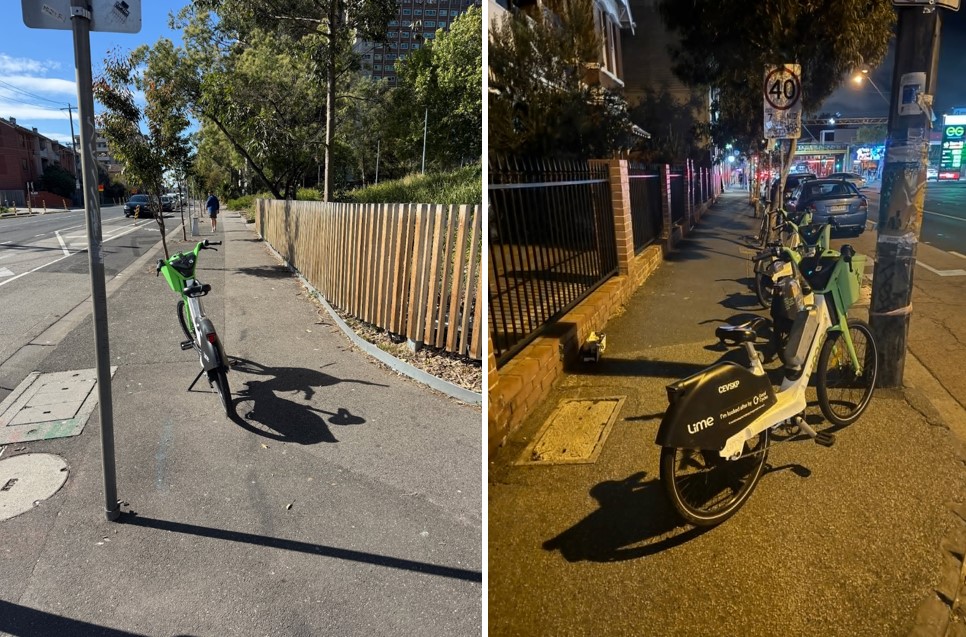
Merri-bek is currently consulting on where shared e-bikes are to be parked, and have proposed designated parking bays on the road (called “on-street”) and on footpaths. The prospect of footpath parking has led to concerns about accessibility. GPS and Bluetooth can be used to indicate the parked position of these e-bikes. But these technologies are unlikely to be accurate enough to ensure footpaths aren’t obstructed (without extra enforcement). On-street parking bays are necessary to ensure footpaths are accessible. But on-street parking bays are expensive. Income from the operators of shared e-bikes is unlikely to cover this cost, so a subsidy will be required. Merri-bek’s budget for active transport is low. Other sources of funding will be needed for shared e-bike parking.
Climate Action Merri-bek wants parking bays for shared e-bikes to be on the road to ensure footpaths remain accessible. We also want greater clarity on how Merri-bek will handle the costs. This should not come at the expense of other active transport infrastructure.
Residents can do the Council survey by June 15. Unfortunately, the consultation does not ask what people think about footpath parking. Concerns about footpath parking can be raised at question 5 “Other comments”. See FB post for more details. Residents can also write to Councillors.
Introduction
Merri-bek’s plan to introduce a shared e-scooter / e-bike scheme with designated parking bays has hit a snag. Merri-bek is considering only shared e-bikes for now, because neighbouring Councils (Yarra and Melbourne) no longer have shared e-scooters. This could significantly reduce the income to Council. While other Councils have contracts with e-bike operators, these do not include a fee to operate. (We have checked several Memorandums of Understanding, and seen no mention of fees, apart from impounding fees.) It seems that only e-scooters attract a fee ($1 per day per e-scooter). E-bikes have been less popular than e-scooters (usage data is here). Even if Merri-bek can extract a fee for shared e-bikes, the income is likely to be relatively small. Hence there is less income to pay for parking infrastructure.
Merri-bek is currently consulting on where shared e-bikes should be parked. They propose designated parking bays, both on the street and on the footpath . But even on wide footpaths, the location technology is unlikely to be accurate enough to ensure footpaths remain clear. For accessibility, we believe e-bike parking bays should be on the road, not the footpath. However, on-street bays are more expensive.
If Merri-bek delivers a shared e-bike system that won’t cause accessibility issues (and won’t lead to a huge backlash), it’s likely that this will be subsidised. Of course, Councils have long subsidised car parking for residents and visitors. Merri-bek subsidises parking spaces for private car share companies, and charges significantly less than similar councils. (However, these are cheaper to establish than on-street e-bike parking bays).
The last thing we want is for Merri-bek to adopt a poor parking approach in order to save money, while compromising accessibility and safety. So how will costs be managed? Merri-bek’s budget for active transport is quite low, and we desperately need more protected bike lanes, safe crossings and traffic calming infrastructure (and a much bigger active transport budget). Without protected bike lanes, bike riding is risky, and there is more footpath riding. A recent survey in Melbourne showed that that the most popular change needed for e-scooters to be reintroduced were more dedicated cycling lanes.
Problems with Merri-bek’s consultation
Merri-bek’s designated parking plan for the south of Brunswick includes 161 on-street bays and 47 footpath bays. But their map is poor – it doesn’t show the actual location of their proposed bays due to mapping inaccuracies, and it doesn’t even call them footpath bays. (They use the term “off-street”.) Indeed, some proposed sites appear as though they are within a park or a private car park, when they are actually on the footpath. Others are shown in the middle of buildings. Apparently these errors are due to a mismatch in the different mapping software. We think that Merri-bek should have corrected these errors before going to consultation. More details here.
Merri-bek has established a Shared Mobility Stakeholder Panel, which recommended that designated parking bays be on the street to ensure footpaths remain accessible and to discourage footpath riding. But this was not reflected in the consultation. We hope Merri-bek Councillors heed the Panel’s advice.
Yarra’s problems with footpath parking
Our neighbours, Yarra Council, offer a sobering lesson. They have had many complaints about shared e-scooters and e-bikes obstructing footpaths, and have been taken to VCAT for allegedly breaching the human rights of people with disabilities. In January, Yarra introduced geofencing (preventing parking on footpaths less than 2 metres wide), virtual footpath parking pins (visible only on the app), and a few painted bays on footpaths. Yarra then tried to increase the fee paid by operators to $5 per day per scooter, to make the scheme revenue positive in the future. The e-scooter companies refused to pay this and pulled out. Yarra are negotiating future e-scooter contracts.
Yarra now has only shared e-bikes and is presumably not receiving any income. Yet as the images at the top show, these are still blocking footpaths. We recently checked several painted footpath bays (see example below) and found riders were mostly not using them.

Types of designated parking bays and accessibility
Merri-bek needs lots of these parking bays in convenient locations – less than 200 metres apart for easy access. (Without this, few people will use them.) Whatever parking arrangements Merri-bek sets in place now will probably be used for shared e-scooters in the future. So it is important to get this right.
It is vital that footpaths remain accessible. Privately owned devices are tethered and rarely cause obstructions. Shared e-bikes and e-scooters are typically free standing. (Though some cities use “lock-to” parking.) Shared e-bike parking must not have an adverse effect on people walking and using wheelchairs. Indeed, for many older residents walking is their main form of exercise.
What is a designated parking bay? The government defines them as “a mix of physical parking corrals, painted lines and digitised zones that are only visible within the operator’s app”.
- Physical parking corrals would generally be on the road. They require physical barriers and possibly hoops, and hence they are costly. They are the best type of parking bays to ensure minimal adverse impacts on pedestrians.
- Painted lines are typically on the footpath. The footpaths must be wide enough – Merri-bek is saying 3 metres or more – with 1.2 metres left for pedestrian access. Such bays rely on parked e-bikes remaining within the painted lines. (Shared e-bikes are 1.8 metres long, so there is not much leeway here.) These bays may incorporate Bluetooth beacons to signal that the device is parked nearby. We do not know if Bluetooth technology can be made accurate enough to ensure the devices are parked within the painted lines. So these will probably lead to accessibility problems.
- Digitised zones, or virtual parking bays, are on the footpath, but there are no line-markings. They typically rely on GPS to signal the location of the parked e-bike. We understand that the accuracy of this technology is measured in meters. They cannot tell if the e-bike is obstructing the footpath. So they rely on riders doing the right thing.
In our opinion, only physical parking corrals on the road will ensure our footpaths remain accessible, as well as discouraging footpath riding.
What about streets with few pedestrians and large kerb outstands? Could painted footpath parking bays work there? Perhaps, but Merri-bek hasn’t identified many such locations in its current consultation. There are unlikely to be enough of them.
Costs to Council and possible income
Physical parking corrals are expensive – perhaps a few thousand dollars each. Painted footpath parking bays were estimated by Yarra Council to cost on average $1500 each. Virtual parking bays are cheap: they just need someone to program them.
If physical parking corrals could also be used by regular bikes, then this would be extra infrastructure for Merri-bek residents. Of course the locations may not be optimum for regular bikes. This would need discussion with cycling representatives.
There are other costs associated with shared e-bike and e-scooter schemes, including staff time and enforcement. Yarra Council, which uses virtual parking bays and recently introduced a few painted footpath bays, incurred a cost of $750,000 in the year 2024/25. This included legal fees for a VCAT case. (A disability advocate took Yarra to VCAT due to Yarra’s shared e-scooters blocking the footpath. To date VCAT has not made a ruling.)
At Yarra’s March 2025 meeting, Council staff proposed that the e-scooter fee be increased to $3.20 per day per e-scooter (which comes to $584,000 per year for their 500 e-scooters) to cover their costs. The Yarra CEO stated that Yarra was not seeking to recover costs from past expenditure. This raised fee would only cover costs going forward. (So this didn’t cover their legal costs.)
Yarra’s annual costs include compliance, because they don’t have on-street parking bays. If Merri-bek has on-street parking bays, its compliance costs will probably be less. Our rough guess of the establishment cost of the proposed parking bays in the south of Brunswick is over half a million dollars, and many millions if they are rolled out across Merri-bek.
How much can Merri-bek extract from the shared e-bike companies? Currently they pay nothing. But they do pay $1 per day per e-scooter. Assuming 200 shared e-bikes in the south of Brunswick, and that Merri-bek could extract the e-scooter fee, the income would be $73,000.
The big question is whether Merri-bek can extract a higher fee from the operators. That will depend on usage. We calculated that for the Melbourne operating areas, in the first three months of 2025, each e-bike earned about $19 per day for the operator. It appears that most usage is in the City of Melbourne. In Greater Sydney, we estimated the income per e-bike at $14 per day. These are summer figures, with usage lower over the winter.
We calculated that each trip in Melbourne was 2.2 km, took 12 minutes and cost the rider about $7.30. This is more expensive than public transport, walking, and owning your own bike or scooter. The cost is a bit less than ride share. So it is unlikely that parking costs could be passed onto riders.
In conclusion, it is not clear to us how these schemes will work effectively without a large injection of funds, perhaps from the state government. We suggest that Merri-bek not rush into these schemes until the economics have been resolved. And please don’t compromise our footpath accessibility.
This article was written by Andrea Bunting, a member of Climate Action Merri-bek, convenor of Walk on Merri-bek and a member of Merri-bek Council’s Shared Mobility Stakeholder Panel.
Please also see Jane Holroyd’s social media post discussing issues with the parking consultation. Jane is also a member of Climate Action Merri-bek, a local walkability advocate and a member of Merri-bek Council’s Shared Mobility Stakeholder Panel.
 Climate Action Merribek
[…] e-scooters for the time being.) CAM has written extensively on this topic in blog posts here and here. So we are pleased that Merri-bek Councillors have shown leadership by properly addressing the […]
LikeLike
[…] Shared e-bikes in Merri-bek: Will footpaths remain accessible? […]
LikeLike