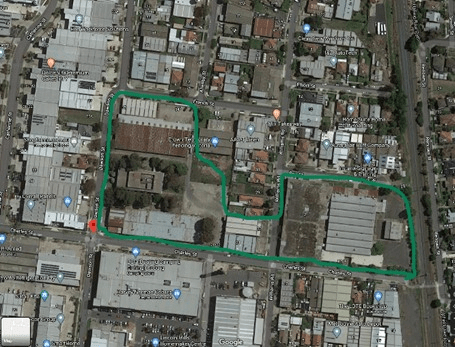
Community consultation for the former Kangan Tafe site in Coburg North is open until November 9. More information here.
The Coburg North site consists of several individual sites:
- 21, 23, 29 Williams Road
- 20 – 22 Charles Street
- 54 Dawson Street
- 3 French Street
The combined sites total 1.83 hectares and are currently occupied by buildings that are no longer in use. The land is zoned as Industrial 1 Zone (INIZ) and located within the Coburg North Core Industry and Employment Area.
The former Kangan TAFE site in Coburg North (Charles St, Williams Rd, Dawson St) is a Victorian state-owned asset, used for automotive, welding and other skills training from the 1970s until around 2010, when it was abandoned, looted, and fell into disrepair. In the last four years to 2024 it has been used as a depot by John Holland while level crossing removal works were underway.
The recent consultations revealed that the section of the site between Williams Rd and the railway line is not being consulted on. No further information is available as to why this is, or what plans are afoot for that section, whether it will be rezoned, sold, developed or kept as a depot for future level crossing works.
Regarding the section which is open to consultation, the community was told that housing is not on the table. The reason given is that Merri-bek has already rezoned a lot of industrial to housing and there is a desire to hold on to this particular patch as industrial. (The Coburg Activity Zone Centre starts just south of the property.) There was a sense at the consultation that the focus for the site will be on jobs/training/community, with a retrofit of the existing buildings.
Attending the consultations was Merri-bek local, Mario, from Upshop.com.au, who has shown interest in the site since 2017 and is now testing the idea in the community of an ‘Eco-village of Employment’. Upshop would like to see the site “become an exemplary ‘centre of excellence’ demonstrating transferable sustainable practices that engage Business, Communities and LGAs across the country” (source: pamphlet distributed by Upshop). The proposal is a repurposing of the site and renovation of existing facilities for uses such as materials recovery, tool library, repair facilities, bike share and repair, education/conference facility, sustainable materials library and a variety of environmentally-driven enterprises.
Upshop also says the Eco-village could “work directly with community based organisations and provide temporary and permanent facilities that engage sustainable activities within the grounds. A community garden and opportunities for local employment would assist with the ‘wellbeing’ of the immediate community and enhance the industrial surroundings with engaging outdoor space.”
An earlier submission by locals was made to State MP for Pascoe Vale, Anthony Cianflone, with regards to the whole site and before it was known that housing would not be contemplated:
Proposal submitted by local residents and businesses
Housing
With 67,000 households on the Victorian Housing Register waitlist, it makes sense to retain this site as a Government asset and use it largely for housing. We have all the amenities here for households and families, with proximity to PT, bike paths, parks, schools and shopping. But as local residents we know we have a special mix in this area of work spaces, creative makers’ spaces, cultural interests and green spaces that hold us together as a community. Housing should address lower income needs, and apply all the socially and environmentally advantageous principles the world has learnt from social housing experiments, such as green communal spaces that draw residents together, providing edibles and biodiversity, exercise and engagement. Homes should be accessible and safe. They should be sustainable, efficient and meet the demands of a circular economy. Perhaps co-design with social housing residents/residents to meet the needs of those waiting for a secure home.
Culture
We have an amazing resource of creative practitioners here in the north, and this site could build on this asset, creating a landmark cultural precinct such as an arts hub for performance, film, sculpture, with creative workshops coupled with artist accommodation, music rehearsal space. This might be an opportunity to create a safe and welcoming space with and for first nations people with a cultural centre and activities spaces.
Working and living
The local neighbourhood already embraces the practice of living and working in adjoining spaces. In doing so, we save travel time, which we spend with family, friends, or putting value and attachment into the place where we live. It means we shop locally, and know our neighbours. It means we care about our waste practices from our workshops, because we want our homes and neighbourhood to be beautiful. (Obviously we’re not talking about heavy industry occurring next to homes.) There is the added benefit of having a mixed use of residential and work spaces in that there is a constant presence day and night. This greatly reduces the likelihood of criminal activities that occur in fully industrial precincts (and for that matter fully residential areas too). It also increases the safety for people residing, working and visiting the area.
Training
There is already a history of training in the area, both through the TAFE itself, and apprenticeships in businesses in the vicinity. It would be appropriate to include training, potentially in new sustainable industries. A training workshop space could be used to offer many opportunities for people young and old to learn valuable skills and provide training from many of the skilled people within (and outside of) the community.
Employment
With the introduction of new cottage industries and training facilities there will be greater opportunities for employment in the area and to provide younger generations with jobs, training and new skills in a variety of vocations.
Energy
The site presents a great opportunity for locating a community battery and/or piloting a microgrid project. The design and orientation of the buildings and open spaces should employ the most up-to-date concepts and understandings of efficiency, sustainability, passive thermal design and renewable energy.
Nature positive
Maintaining existing tall trees (spotted gums and others that must be around 50 years old) and introducing more green spaces achieves a myriad of proven positive outcomes:
- Mental health benefits with better concentration and cognitive performance and less anxiety
- Better learning outcomes in school students
- Less cancer and chronic illness, lower blood pressure, better sleep, less stress
- Cooler homes and streets and play spaces
- Less risk of flooding thanks to ‘sponge’ or permeable surfaces
- More wildlife (urban settings are very important for wildlife with some 37 Australian animals being found only in urban settings)
These green spaces can be for play, meeting, strolling, sitting, edible gardening, biodiversity gardens. They could link with the many biodiverse plantings already undertaken by the neighbourhood – in Charles St, along both sides of the Upfield line, on the Commons, around Richards Reserve, and on our nature strips.
By keeping access to and through the site, residents feel part of the broader community and can welcome interaction and assistance from neighbours and we can all get about more easily and safely using active transport.
Transport and access
As mentioned before, we have both trams and trains in close proximity. By having such good access along with combined residential workspaces there is the knock-on effect of reducing local vehicular traffic congestion. There is also the possibility of extending the Batman Train platform to have a secondary access point from Charles Street giving direct access to the proposed Tafe site redevelopment.
In Summary
This is a unique opportunity for some fresh, outside-the-box thinking with an eye to the current and future needs of the community and an opportunity to put Wills/Pascoe Vale/Merri-bek on the map!
By looking to develop a new space with an eye to housing, workspaces, affordability, environment efficiency, employment, greenspaces and training facilities all with easy access via public transport and the Upfield bike path, a truly unique development could be achieved, one that might just set the template for other developments in Australia and abroad.
 Climate Action Merribek