Representatives of Climate Action Merri-Bek met with Peter Khalil, MP for Wills, on
December 15 to discuss federal government climate action.
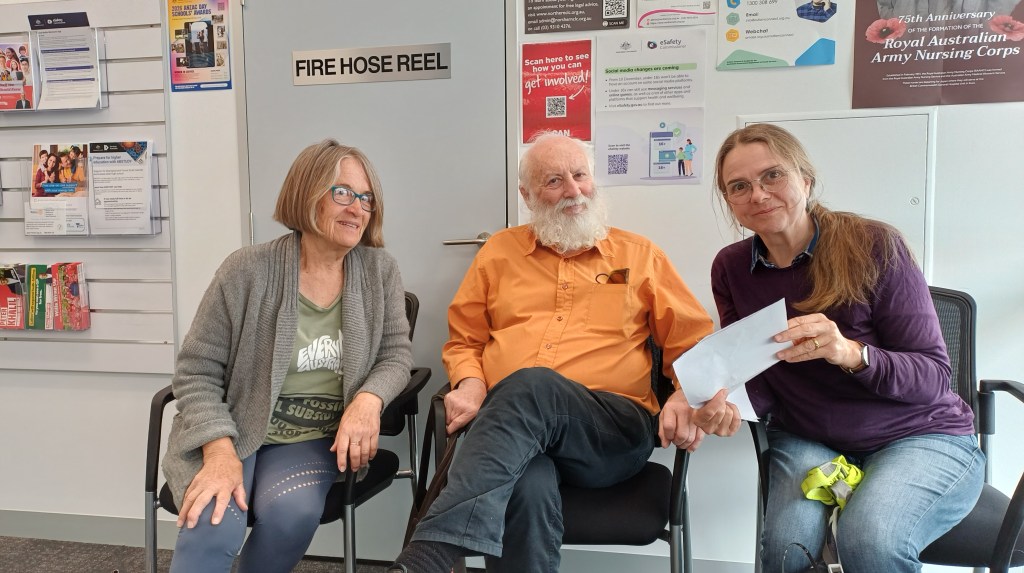
Mr Khalil mentioned the revised Environment Protection and Biodiversity Conservation (EPBC) Act and acknowledged the constructive role of the Greens, particularly Sarah Hanson-Young. He also mentioned the new emissions reduction targets of 62-70% by 2035, new vehicle emission standards and increased finance for renewables and infrastructure.
He acknowledged that the government was disappointed Australia would not be hosting the next Conference of the Parties (COP) on climate change, which will be held in Türkiye, but said it had aimed to achieve as much as possible for the Pacific region. He noted that Chris Bowen, Australia’s Minister for Climate Change and Energy, will be serving as President of Negotiations in the lead up to the COP.
CAM representatives raised questions on issues below.
The EPBC Act
We asked:
- When will new standards under the Act be developed?
- What is the extent of authority of the new Environment Protection Authority (EPA)?
- What will the Minister’s power to over-ride decisions under the Act mean in practice?
- How effectively will forests be protected?
Overall, we asked how will the public actually know if the Act is achieving its purposes?
Mr Khalil said he expected that new standards would be developed in 2026 but did not give definite answers on broader questions. He said independence of the EPA was important but also said Ministerial discretion was important. He did not identify specific measures to evaluate the effectiveness of the Act, although agreeing these would be useful.
Overall, he argued it was not always possible to achieve everything in politics but the new Act was definitely an improvement. It seems we will have to wait and see!
The Belem Declaration on the Transition away from Fossil Fuels
Following the recent COP in Brazil, Australia was one of 26 countries that signed the Belem Declaration calling for “a just, orderly and equitable transition away from fossil fuels”. CAM representatives strongly welcomed this decision but asked what it would mean in practice.
We pointed out that there is no clear framework for achieving such as transition, especially since the government refused to include a climate trigger in the EPBC Act. Mr Khalil argued (as the government consistently has) that a climate trigger in the Act would duplicate measures under climate change legislation.
We pointed out in response that there is no clear framework for transitioning away from fossil fuels under existing legislation.
In practice there is a mixture of legislation, policy and action, including the Climate Change Act, the Net Zero Plan, the Safeguard Mechanism, the Future Gas Strategy and actual decisions on fossil fuel approvals. Taken together all these are often internally inconsistent and sometimes contradictory: for example, a stated commitment to net zero by 2050 versus an actual decision to extend Woodside’s gas processing to 2070.
We suggested that a holistic strategy to transition away from fossil fuels is needed. Mr Khalil agreed with us that a holistic strategy would be positive and agreed to put this to Chris Bowen and report back to us.
We propose that a holistic strategy needs to include positive measures, such as supporting the shift to renewables in the energy sector (as in the Net Zero Plan) but also needs to:
- Acknowledge that actual reductions of fossil fuel emissions since 2005 have been quite small (approximately -5%) and have mainly been in the electricity sector
- Measure and report on actual fossil fuel use and emissions, without off-setting these against actual or estimated improvements in the land use and forestry sector
- Include a comprehensive framework for phasing out fossil fuels, including exports
- End subsidies for fossil fuel production and use
- Engage the whole community
- Include measures to ensure a just and equitable transition
We have provided a preliminary paper to Mr Khalil (copy available on request) and will provide follow up information.
The federal government’s contribution to public transport in Merri-Bek
We asked Peter Khalil about federal government support for the Upfield rail line. He noted that in 2025, the federal government provided $7 million for a scoping study into the duplication and extension of the Upfield rail line. (Note that the funding was for the Upfield and Cragieburn lines.) We understand that Peter Khalil has been in discussions with the federal Minister for Infrastructure about the Upfield upgrade. We are looking forward to an announcement soon!
 Climate Action Merribek