Household Preparedness
On an individual and household level we need to be prepared for coping with extreme heat. Have a heat action plan ready.
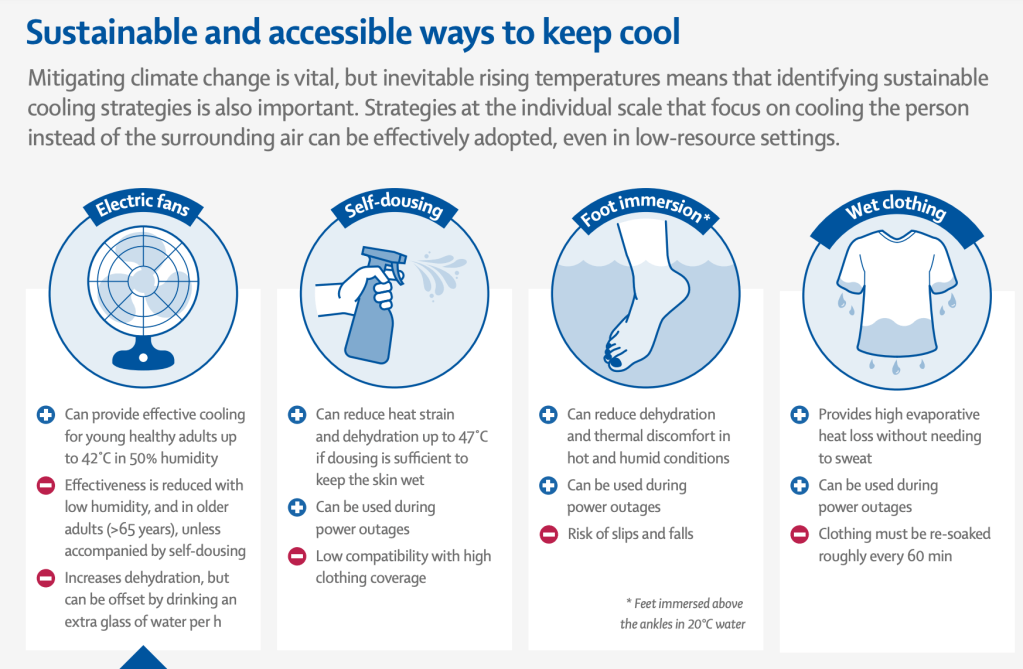
- Use pedestal fans for air circulation
- Use air-conditioning.
- Take cool showers or baths.
- Wet your skin using a damp cloth, spray, or wet light clothing.
- Use heavy blinds or shutters on windows exposed to direct sunlight
- Avoid going out in the hottest part of the day. Plan ahead. Schedule activities in the coolest part of the day and avoid exercising and being outdoors in the heat.
- If you must go out, wear a hat and sunscreen, and take a bottle of water with you.
- Put water out in our gardens for wildlife.
- Ensuring comfort of our pets by bringing them inside, ensuring they have water. Avoid taking pets walking on hot concrete or asphalt.
- Never, ever leave children or pets alone in a hot car
- Know Places to seek respite from the heat. Libraries, Cooling Centres, Shopping Centres.
- Consider coolest room for sleeping for your body to recuperate.
- Wear lighter coloured clothes if out in the sun
- Stay well hydrated, and be aware of early signs of heat exhaustion and act early
- Take a water bottle out if you go out. Use the network of public drinking fountains in Merri-bek to do refills and stay hydrated.
- Research shows plastic water bottle may have high levels of micro and nanoplastics. A metal water bottle avoids microplastics. Consider using a vacuum flask to keep water cool when out.
- See Sustainable and accessible ways to keep cool from the Lancet (below)

Heat Health Tools and Resources
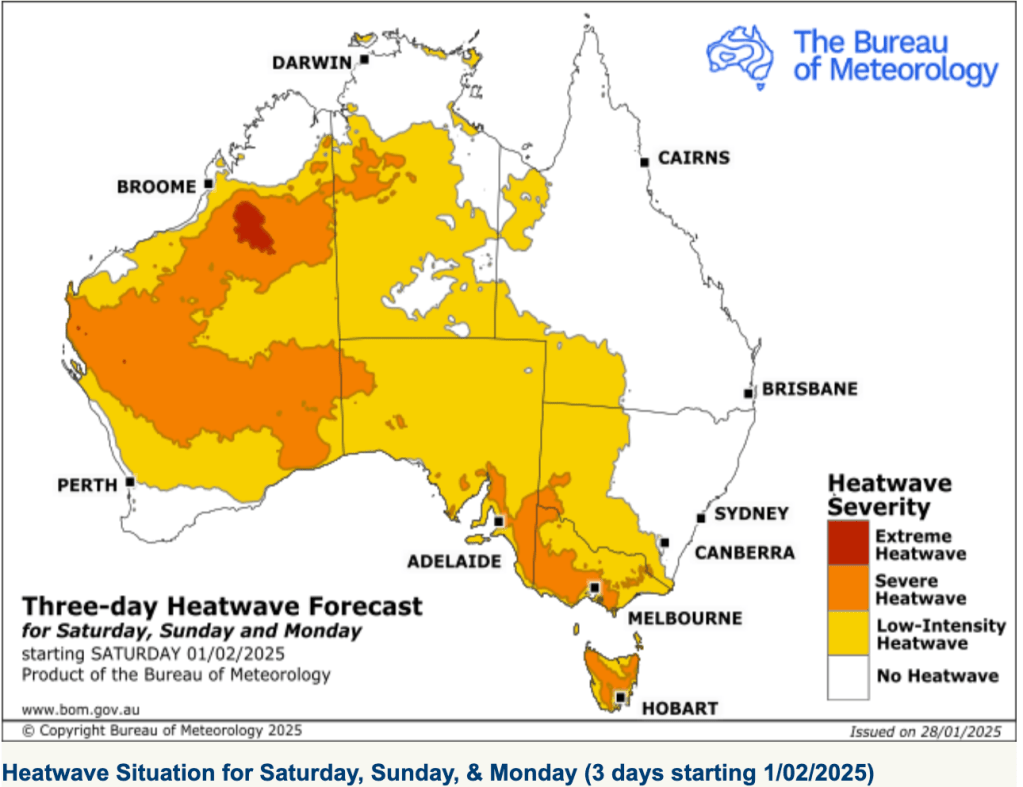
- Keep a watch on BOM Heatwave Service for Australia
- Victoria Department of Health also issues Heat Health warnings when thresholds are exceeded. The current threshold for Central Victoria for issuing a Heat Health Warning is a forecast of daily mean (average) temperature of 30C degrees. There is evidence that health impacts threshold, especially amoung vulnerable people may start at 28C or lower mean temperatures.
- Use the Heat Watch app developed by Sydney University to assess your heat health risk. You can add some personal health and suburb profile data to fine tune the app for your individual circumstances
- Use the Is It Hot Right Now app developed by climate researchers for comparing Australian current mean temperatures to historical temperatures. They also include tracking each day of the current year and its percentile deviation from the average.

Research shows that:
The first Extreme Heat event in Spring can result in more heat related ambulance calls and emergency visits, as people’s bodies may not be adequately acclimated to high temperatures after a cooler winter period, making them more susceptible to heat stress and related illnesses.
During a multi-day heatwave, the trend for heat-related illnesses is a significant increase in cases, with the highest number of occurrences happening on the hottest days and potentially peaking towards the end of the heatwave as cumulative heat stress builds up, particularly impacting vulnerable populations like the elderly, young children, and those with pre-existing health conditions; this increase is often accompanied by a rise in hospital admissions related to heat-related illnesses like heat exhaustion and heatstroke.
Still summer nights when the temperature remains elevated, when it is difficult to sleep, are also periods of high heat vulnerability and mortality risk. High Minimum temperatures are showing a rising trend, including during extreme heat events.
In Australia the risk of dying in a heatwave increased with age, socio-economic disadvantage, social isolation, geographical remoteness, the presence of disabilities (physical or mental) and some prescribed medications and the absence or non-use of air conditioning or other building heat protection.
The 2018 survey of urban heat by Victorian Planning Department showed most of Merri-bek was 5-10C hotter due to the urban heat island effect, with small pockets in the 10-15C range.
A 2024 Australia wide study by the Australia Institute showed there were over 22,000 people in Merri-bek potentially vulnerable to extreme heat.
Community Preparedness
- Check on vulnerable people (elderly, children, those with medical conditions). There are over 22,000 people in Merri-bek with a potential vulnerability to extreme heat.
- Be aware of Places to seek respite from the heat. Merri-bek Council Libraries, Cooling respite Centres, Shopping Centres, Leisure Centres (swimming pools).
- Use walking or cycling routes that are shady, have canopy cover.
- Advocate for more canopy street trees in car parks and along streets. We need about 40% canopy cover in our suburb just to counter the Urban Heat Island Effect.
- Leave your car where it will be shady when you pick it up can reduce fuel use energy for air-conditioning when you get in.
- The Climate Council in 2016 highlighted the need to:
“Reduce greenhouse gas emissions rapidly and deeply is the best way to protect Australians from worsening extreme heat events. Limiting heatwaves requires urgent and deep cuts to greenhouse gas emissions. Importantly there must be a rapid transition from fossil fuel based energy systems to renewable energy.” - The Urban Heat Island Mitigation Performance Index developed by the Low Carbon Living CRC provides ranked recommended UHI Mitigation Strategies based on selection of: An objective, a climate region, an urban context and at least one of: Building mitigation strategies, Public realm mitigation strategies, and Community mitigation strategies.

Drinking Fountain Map (Up to 2020)
Council have a committment to an online map of public drinking fountains in the municipality. There is no current map. Find below a map accurate up to 2020.
Related Blog Posts:
January 4, 2015 – Heatwaves and Victoria’s Heat Health Alert warning system
December 4, 2024 – Heat Vulnerability in Merri-bek
February 13, 2024 – Community sport and heat health risk from extreme temperatures and heatwaves
March 5, 2024 – Drinking Fountains in Shopping Strips Update
Other Relevant References
January 8, 2024 – Plastic water bottles are full of microplastics.
Research has found if you drink bottled water you likely consume about 250,000 nanoplastic particles for each liter of water. Many of these particles are so fine they can be transported around in our blood system and delivered to organs and cells throughout our body. Health impacts are being researched. Plastic Bottled water uses polyethylene terephthalate (PET) plastic bottles. https://www.pbs.org/newshour/science/scientists-find-about-a-quarter-million-invisible-microplastic-particles-in-a-liter-of-bottled-water
PNAS study: Rapid single-particle chemical imaging of nanoplastics by SRS microscopy https://www.pnas.org/doi/full/10.1073/pnas.2300582121
2016 Climate Council Report on the Health Impacts of Extreme Heat – The Silent Killer: Climate Change and the Health Impacts of Extreme Heat https://www.climatecouncil.org.au/resources/silentkillerreport/
21 July 2023 – No Reprieve: Extreme Heat at Night Contributes to Heat Wave Mortality, Nate Seltenrich, Environmental Health Perspectives, Volume 131, Issue 7, https://doi.org/10.1289/EHP132
25 March 2019 – We need about 40% canopy cover in our suburbs, with less paving and more trees just to counter the Urban Heat effect. C.D. Ziter, E.J. Pedersen, C.J. Kucharik, M.G. Turner, Scale-dependent interactions between tree canopy cover and impervious surfaces reduce daytime urban heat during summer, Proc. Natl. Acad. Sci. U.S.A.
116 (15) 7575-7580, https://doi.org/10.1073/pnas.1817561116.
January 2022 – Heatwave fatalities in Australia, 2001–2018: An analysis of coronial records.
Lucinda Coates, Jonathan van Leeuwen, Stuart Browning, Andrew Gissing, Jennifer Bratchell, Ashley Avci, Heatwave fatalities in Australia, 2001–2018: An analysis of coronial records, International Journal of Disaster Risk Reduction, Volume 67, 2022, 102671, ISSN 2212-4209, https://doi.org/10.1016/j.ijdrr.2021.102671
 Climate Action Merribek