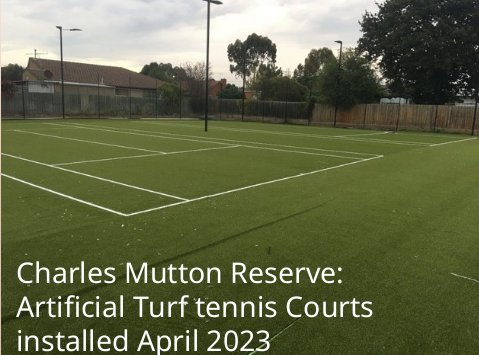
On 9 June the Office of the NSW Chief Scientist and Engineer released its review report on synthetic turf. It confirms many of the issues raised by the Climate Action Merribek submission to Council in March 2021. See also our Campaign page on synthetic Turf.
The Chief Scientist report was completed in October 2022 totalling 530 pages, 77 pages of report backed by 462 pages in 19 commissioned scientific assessments or expert resonses.It reveals many knowledge gaps with some concerns over health and many issues of environmental impacts and pollution, and disposal at end of life. It targets mitigating the worst effects of existing synthetic turf pitches and favours natural turf for new installations following new guidelines for best performing natural turf sports fields.
Merr–bek Council has commissioned a consultancy report on Sports surfaces to be prepared for July Council meeting. It aims to deliver a decision making framework, taking into account science based research and all the social, environmental, health and economic benefits, costs and impacts.
Climate Action Merribek Convenor John Englart prepared a summary presentation on artificial turf, which included information from the Chief Scientist report, which he recently presented to Moonee Valley Sustainability Group. See below:
Many of the commissioned experts for the NSW Chief Scientist report, from diverse research areas, identified a singular major knowledge gap – that chemical constituents of synthetic turf components, and their associated human and environmental health impacts, are not fully known. (9.1 page 73)
Key insight in the report executive summary questioned the long term sustainability of synthetic turf sporting surfaces given changing climatic conditions due to global warming::
“Overall, it is not clear whether expectations about the longevity and carrying capacity of synthetic fields can be met under Australian climatic conditions, potentially influencing decisions about installation and cost-benefit considerations”
The review also proposed that increased performance of natural turf surfaces may be able to meet the demand for use:
“Best practice guidelines for improving the performance of natural turf have been developed in NSW. If applied to installation and ongoing management of natural turf sporting fields, these practices may allow increased performance of natural turf fields to meet demand”
The Natural Turf Alliance, a collection of community campaign groups in three states, put forward in a media release that the following should result from this major science based review:
- That a moratorium is placed on synthetic turf in public parks, open spaces, schools and other education environments;
- Until a full set of guidelines, data sheets, funded research, safety standards and end of life disposals are developed for synthetic turf
- Forthwith: all new and current builds are paused and immediately converted to natural turf projects. Any grants for developing synthetic fields are immediately untied and used for well built natural turf fields.
REPORT RECOMMENDATIONS
The top recommendation as part of planning and approvals, argues that environmental risk issues with existing and future synthetic need to be mitigated, while best practice natural turf management is implemented to meet increasing demand/use requirements.
“Given longer-term climate and heat projections, attention should be given to mitigating environmental risk in existing and planned synthetic turf installations, implementing best practice natural turf management, advancing materials research into new alternative materials.”
It further spells out priority in the next paragraph:
reduce potential human health and environmental impact of synthetic turf through planning, design, and mitigation measures. These focus initially on managing pollutant ‘runoff’ and ‘walk-off’ risks and exploring the potential of best-practice design and maintenance of natural turf fields to meet increasing use requirements.
Regarding sustainability and End of Life, the recommendation was for a staged plan involving both government and businesses to develop appropriate standards and end of life solutions. Once again it specifies the importance of the capacity of natural turf sporting fields to meet demands for use.
In its third area of recommendation the report argues there needs to be more data collected, and also better collation of data, and the establishment of minimum open data standards for sporting fields to enable informed investment decisions about surfaces installed in public open space.
The fourth and final set of recommendations are to establish a research program to fill many of the significant knowledge gaps highlighted by the scientific assessments, which hinders
effective decision-making. A key research priority recognised by several contributing experts to the Review is understanding the characteristics and composition, including the chemical composition, of materials used in synthetic turf and associated layers.
KEY INSIGHTS (FROM EXECUTIVE SUMMARY)
There is a long list of key insights in the executive summary. This lists them all in point form:
- SBR crumb is the material most associated with community concerns about contamination.
- Currently, there is insufficient information and a lack of standards about the materials and chemical composition of synthetic turf.
- More accessible data regarding the installation, volumes, and composition of synthetic turf in public and private settings required.
- Data on the composition of fields is particularly important to inform end of life disposal plans,
- Demographics: Increasing population density is driving demand for green space, while constraining availability of open space. Overallocation of existing sport and recreation facilities is a driver increasing the installation of synthetic turf in areas of higher population density.
- Climate and weather:
- The changing climate will impact the safety, health and wellbeing of citizens and biodiversity, as well as the durability and resilience of built infrastructure and urban ecosystems.
- Future extremes of flooding, heat and fire risk will affect the performance of different types of both synthetic and natural turf.
- There are concerns around the impact of intense rainfall and flood on the durability of synthetic turf surfaces and increased water runoff and pollution impacts.
- Increased heat effects are also a concern, as synthetic turf lacks the cooling and latent heat loss of natural turf;
- Overall, it is not clear whether expectations about the longevity and carrying capacity of synthetic fields can be met under Australian climatic conditions, potentially influencing decisions about installation and cost-benefit considerations.
- Sustainability: Decarbonisation and appropriate end of life solutions are driving change in government policy, regulatory frameworks, and business models globally.
- With government and industry involvement, there are ways in which the synthetic turf industry can become more circular. This includes technical and scientific considerations as well as requirements for product information and standards for materials involved.
- This is particularly relevant to SBR crumb infill, given the lack of import standards for waste tyres, which are known to contain contaminants and heavy metals.
- New materials and alternatives:
- Policy shifts are driving industry research into alternative synthetic turf materials and substitutes for chemicals or compounds of concern. Biopolymers that are recyclable and/or compostable are emerging as an alternative material.
- Best practice guidelines for improving the performance of natural turf have been developed in NSW. If applied to installation and ongoing management of natural turf sporting fields, these practices may allow increased performance of natural turf fields to meet demand.
- Health
- Overall, literature reviews and expert advice did not identify major health risks associated with synthetic turf, although there are knowledge gaps, particularly around Australian-specific studies.
- some evidence was found that synthetic turf can generate greater stress on players’ feet
- Heat Strain: The interplay of factors influencing thermal comfort is complex. A need to consider low-level activities of more vulnerable populations, including children
- health risks through direct (such as dermal, ingestion and inhalation) or indirect contact (such as leachate and microplastic runoff) from synthetic turf is likely to be low. Restrictive measures to limit potentially harmful chemicals, leachates and microplastics in synthetic turf components may reduce unforeseen consequences to health, such as restrictions enacted by the EU and US.
- Aspects of mental health, well-being and social cohesion were identified, usually very site specific. Include community access and continued use; consequences of field type and infrastructure, such as odour from synthetic materials and increased artificial light
- Environmental and ecological impacts (Water contamination and soil health)
- a synthetic turf field without structures to reduce infill loss will wash tens to hundreds of kilograms of infill per year into stormwater systems or waterways.
- The amount of turf fibres lost from a synthetic turf field is likely to be in the 100s of kilograms per year, with the amount increasing for fields near the end of life or under poor maintenance.
- Weathering, UV exposure and the association of microbes with plastic material influences leaching of chemicals into the environment.
- Research under Australian conditions has found mixed contaminants including heavy metals, have higher toxicity and bioavailability than those in isolation.
- Changes to habitat resulting from synthetic turf installation replacing grass or vegetation may include habitat loss, disruption of ecological functions, increased heat and increased artificial light at night.
- Increased light at night is a risk associated with synthetic turf sporting facilities that are installed with lights to increase their playing capacity; and has been recognised to fragment nocturnal habitat and impact biodiversity.
- strategic planting of vegetation is highlighted as ameliorating habitat loss, heat effects on fauna and light spill and is broadly effective across a range of habitats
A few important issues from this scientific assessment:
- Synthetic turf has been found to contribute to Suface and Canopy Urban Heat Island (UHI) effect locally. This can impact energy use of residents living adjacent to or in the vicinity of synthetic fields.
- Synthetic Turf pitches should not at End of Life be cut up for secondary uses. This is a clear recommendation of the report.
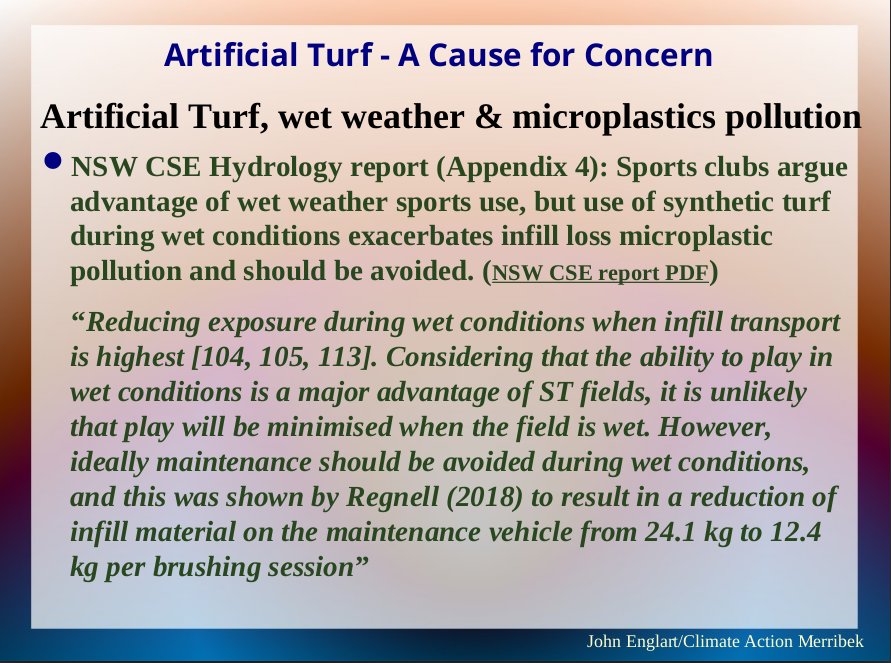
- Wet conditions on synthetic pitches exacerbates loss of microplastics causing more pollution. There are grounds for restricting synthetic turf use during wet weather to reduce loss of infill and microplastics pollution.
- Existing synthetic fields need to use best practice mitigation methods to reduce Microplastics pollution. Recommendation R1.1 has specific best practice mitigation measures that should be implemented at a minimum.
- Health risks are greater for children and there is a lack of studies focussing on health risk to children of playing on synthetic turf. Report identifies “Specific lack of empirical evidence around indirect and longer-term cumulative health impacts with a general lack of field studies, epidemiological studies and health risk assessments in the Australian context.”
- Well maintained and improved Natural turf has been shown to meet sports capacity demands in the NSW context
This insight in Appendix 4 from the University of NSW Water Research Lab assessment details enhanced microplastics pollution during use of synthetic turf field in wet weather conditions is worthy of noting. It wasn’t included in the CSE cover report. This highlights the importance of reading the detail.
 Climate Action Merribek
[…] the NSW Chief Scientist and Engineer’s report on synthetic Turf in Public Spaces, that we reported on […]
LikeLike