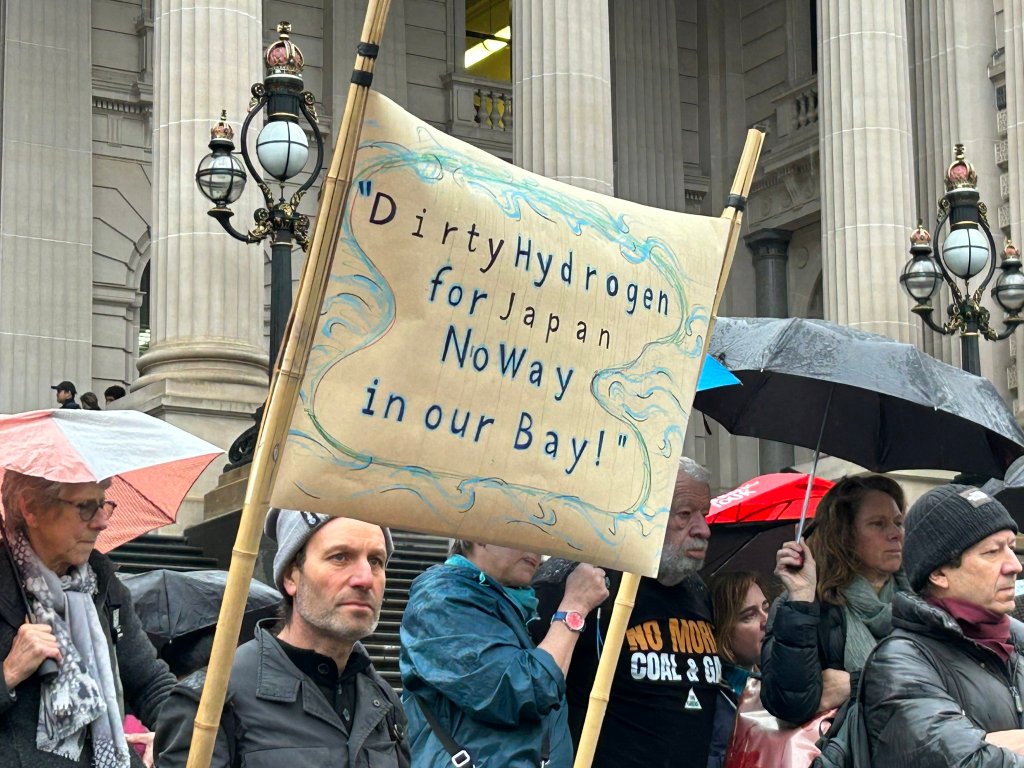
Say no to Victoria’s Hydrogen Energy Supply Chain project for Coal to Hydrogen for export to Japan. The hydrogen is marketed as clean, but it is based on the supposition that proposed carbon capture and storage will work. Industrial scale CCS projects from Western Australia and Norway show CCS is failing to meet its targets, and requires substantial regulatory action and ongoing monitoring.
Coal gasification to produce hydrogen and store the carbon dioxide is very emissions intensive process. They call it Blue Hydrogen .It is actually a very dirty, carbon emissions intensive way to produce hydrogen, rather than utilise renewables powered electrolysis process for hydrogen production, for Green hydrogen.
Friends of the Earth have a petition to the Victorian Legislative Council at the Victorian Parliamentary website on this issue, which closes 23 December 2023. Be sure to add your name to it.
Protest: Steps of Parliament House, 8.30am-9.30am Wednesday 30 August (Organised by Friends of the Earth Melbourne.
The Hydrogen Energy Supply Chain (HESC) project is a partnership between international fossil energy companies including Kawasaki Heavy Industries, Ltd (KHI), Royal Dutch Shell and AGL Energy. The project would turn La Trobe Valley brown coal into hydrogen for export from the Port of Hastings to Japan, while proposing to use carbon capture and storage in an attempt to store carbon dioxide (C02) in disused, offshore gas wells.
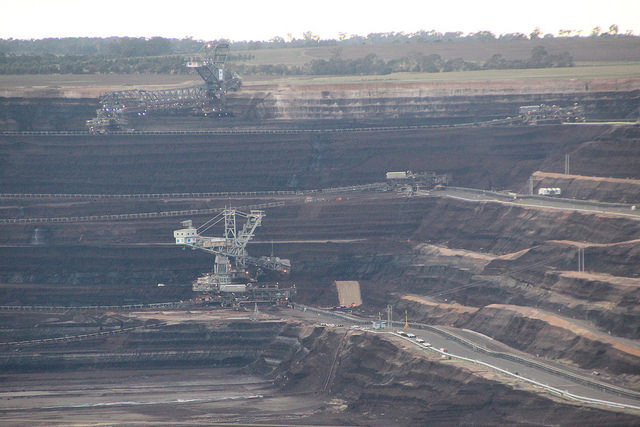
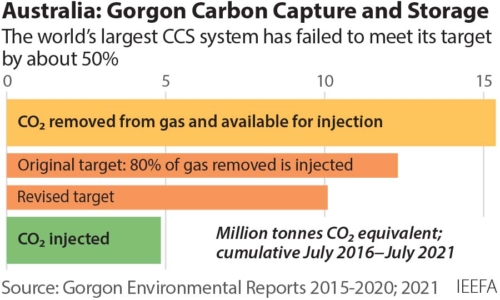
Japan will allocate $2.4 billion toward the Hydrogen Energy Supply Chain project, even though all the funding and risk in the carbon capture and storage component of the project will be upon Victoria and Australia. CCS is likely to require billions in investment, and be similar outlay to the costs of the Gorgon project of A$3.2 billion to date, with a 32% capture rate in its first six years of operation.
“The money now put on the table by the commercial proponents explicitly won’t go to capturing the project’s carbon or storing it,” Lily D’Ambrosio, Victoria’s climate action and energy minister, said. “100% of that risk … sits with Victorians. It’s a no-regrets investment for the commercial proponents, but we get the added emissions. You have to ask: is this a good deal for Victorians?” said D’Ambrosio according to a report in The Guardian.
Some background from IEEFA:
“The HESC pilot project was completed over five years to 2022 after the Australian and Victorian governments jointly invested $100 million. In March 2023, Japan committed to spend A$2.4 billion through its Green Innovation Fund to partially fund scaling up the project. Initially at 30,000 to 40,000 tonnes a year and at full scale, by 2030, it aims to produce 225,000 tonnes a year of liquified hydrogen for export.”
The Australia Institute in a report in May 2022 found:
Documents obtained under freedom of Information show the Victorian Hydrogen Energy Supply Chain (HESC) project, that uses brown coal to make hydrogen, is unlikely to meet its claimed emissions reductions of 1.8 million tonnes, and is more likely to increase emissions by up to 3.8 million tonnes
Friends of the Earth Melbourne’s No More Gas campaigner Freja Leonard said:
“Gassifying coal to produce hydrogen will drag Victoria further from realising our emission reduction targets of net zero by 2045 and drag the climate further into the danger zone. Carbon Capture and Storage is an excuse for fossil fuel industries to keep polluting.”
“The companies involved can spin this as clean hydrogen all they want but the reality is if it’s using coal this is just another dirty fossil fuel project that the climate can’t afford”, Ms Leonard said.
Hydrogen is a very flammable gas. It is also very fine and embrittles steel piping. Residents of Hastings have already faced a small taste of the risk associated with hydrogen export when a hydrogen tanker malfunctioned, sprouting a gas flame from the tanker in January 2022, according to Friends of the Earth.
“This project is an affront to Australia’s climate commitments, to community safety and at $A2.14-2.74/kg to produce from brown coal,is unlikely to pay economic dividends. Through this petition we are urging the Victorian Government to refuse this project. If hydrogen is to have any place in our energy future it must be produced using clean energy”, said Ms Leonard.
The project also maintains coal mining to produce hydrogen giving coal workers false hope and false security, instead of measures to ensure a just transition for workers and the community of the La Trobe Valley.
Industrial Carbon Capture and Storage is failing
Carbon Capture and Storage is highly problematic given it often fails to meet its sequestration targets. The landmark case is the failure of CCS in Chevron’s Gorgon gas project, which was developed as an intrinsic part of this gas project.
In May 2023 the ABC reported that the Gorgon Project was only able to sequester a third of its promised CO2 sequestration capacity.
Reported in April 2022 (IEEFA): “At a cost of more than A$3 billion, Gorgon, the largest carbon capture and storage (CCS) project in the world has failed to deliver, underperforming its targets for the first five years of operation by about 50% finds a new report from the Institute for Energy Economics and Financial Analysis (IEEFA)”.
“Gorgon CCS failed to reach its pre-defined targets,” says report author LNG/gas analyst Bruce Robertson. “CCS technology has been operating for 50 years. If Chevron and its partners can’t get it to work these past 5 years at Gorgon, it’s not an effective technology for reducing carbon emissions.”
Neither can the Norwegian CCS sequestration at Sleipner and Snøhvit in the North Sea be held up as examples without problems. “What the Norwegian projects demonstrate is that each CCS project has unique geology; that geologic storage performance for each site can change over time; and that a high-quality monitoring and engineering response is a constant, ongoing requirement. Every proposed project needs to budget and equip itself for contingencies both during and long after operations have ceased.”
“Sleipner and Snøhvit, rather than serving as entirely successful models for CCS that should be emulated and expanded, instead call into question the long-term technical and financial viability of the concept of reliable underground carbon storage. They cast doubt on whether the world has the technical prowess, strength of regulatory oversight, and unwavering multi-decade commitment of capital and resources needed to keep CO2 sequestered below the sea – as the Earth needs – permanently.” writes IEEFA analyst Grant Hauber.
So will storing the carbon dioxide from Hydrogen Energy Supply Chain project for Coal to Hydrogen in the Otway basin be any different?
If the promised CCS targets are not met, then the Australian emissions reduction target of 43 percent reduction by 2030, and the Victorian target of 75-80% emissions reduction by 2035 must be in jeopardy.
References
- Peter Kerr, Australian Financial Review, March 2023, $2.35b boost for plan to turn Victoria’s dirty coal into hydrogen, https://www.afr.com/companies/energy/japan-pledges-billions-for-victoria-s-coal-to-hydrogen-plan-20230306-p5cprj
- Daniel Mercer, ABC News, 17 May 2023, World’s biggest carbon capture plant running at one third capacity, Chevron Australia reveals https://www.abc.net.au/news/2023-05-17/chevron-australia-carbon-capture-storage-gorgon-third-capacity/102357652
- IEEFA, 27 April 2022, If Chevron, Exxon and Shell can’t get Gorgon’s carbon capture and storage to work, who can? https://ieefa.org/articles/if-chevron-exxon-and-shell-cant-get-gorgons-carbon-capture-and-storage-work-who-can
- Australia Institute, 19 May, 2022, Clean hydrogen is Dirty Marketing: FOI & Polling, https://australiainstitute.org.au/post/clean-hydrogen-is-dirty-marketing-foi-polling/
- Grant Hauber, IEEFA, 14 June 2023, Norway’s Sleipner and Snøhvit CCS: Industry models or cautionary tales? https://ieefa.org/resources/norways-sleipner-and-snohvit-ccs-industry-models-or-cautionary-tales
- Fiends of the Earth No Gas Campaign, 22 June 2023, Friends of the Earth launches petition to oppose coal to hydrogen project, https://www.melbournefoe.org.au/friends_of_the_earth_launches_petition_to_oppose_coal_to_hydrogen_project
- Parliament of Victoria, Legislative Council E-Petitions, Petition 491, Stop the Hydrogen Energy Supply Chain project https://www.parliament.vic.gov.au/view-sign-e-petitions/details/12/508
- Andrew Gorringe, IEEFA, 3 July, 2023, Hydrogen Energy Supply Chain project viability remains uncertain in wake of Hydrogen Headstart scheme for green hydrogen, https://ieefa.org/resources/hydrogen-energy-supply-chain-project-viability-remains-uncertain-wake-hydrogen-headstart
- Peter Hannam, The Guardian, 11 April 2023, Japanese-funded $500m project to extract hydrogen from Victorian coal is at risk, sources say https://www.theguardian.com/australia-news/2023/apr/11/japanese-funded-500m-project-to-extract-hydrogen-from-victorian-coal-is-at-risk-sources-say
 Climate Action Merribek
[…] Beetaloo gas and Barossa Gas CO2 emissions in the Northern Territory, and for Victoria’s Hydrogen Energy Supply Chain project for Coal to Hydrogen. The Australian Government is still promoting Carbon Capture and Storage when […]
LikeLike