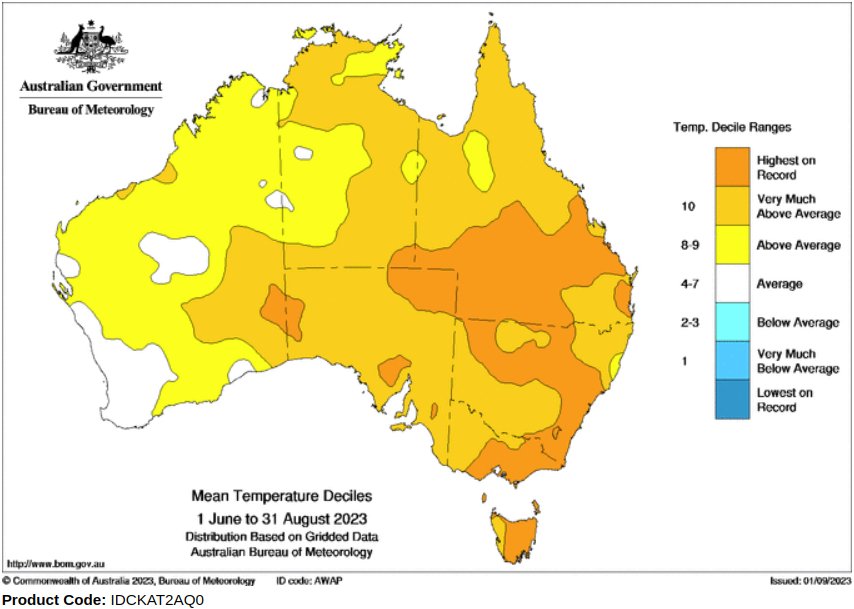
The Bureau of Meteorology issued its long term forecast on thursday 31 August. It was for drier and warmer conditions than normal for Spring 2023. This follows a winter season assessed to be the warmest on record,. with Temperatures highest on record or very much above average over most of Australia with an area average of 1.5C above normal.
There is a risk of early season heatwaves or extreme heat events. Evidence from the USA suggests that risk of heat-related mortality is higher when heatwaves occur ealier in the year, for example, in spring or early summer.(Note 1 & 2) Heat related deaths are often under-estimated (2020) See also Expert Statement on Extreme heat (2016)
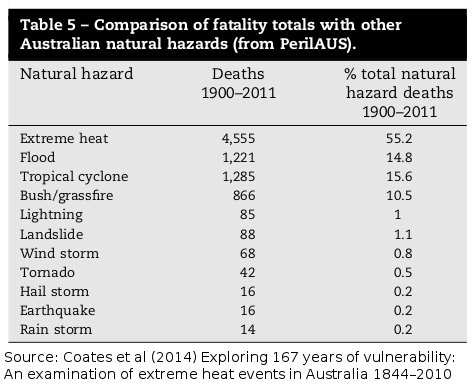
As Lucinda Coates and colleagues conclude in their landmark 2014 study – Exploring 167 years of vulnerability: An examination of extreme heat events in Australia 1844–2010 – “The dangers from extreme heat within Australia remain neglected, and fundamental changes will not take place until extreme heat is given the priority it deserves as Australia’s number one natural hazard killer.”
There are many vulnerable groups to extreme heat. This includes pregnant women and new born babies with maternal and fetal health outcomes. A July 2017 study highlighted:
“There is evidence that temperature extremes adversely impact birth outcomes, including, but not limited to: changes in length of gestation, birth weight, stillbirth,and neonatal stress in unusually hot temperature exposures”
Leeann Kuehn and Sabrina McCormick, (July 2017) Heat Exposure and Maternal Health in the Face ofClimate Change
The Elderly also are also at greater health risk, particularly cardiovascular related conditions from heat exposure.
“Our findings suggest heat exposure leads to elevated risk of morbidity and mortality for women, people 65 years and older, individuals living in tropical climates, and those in countries of lower-middle income. Heatwaves were also significantly associated with a 11·7% increase in risk of mortality (RR 1·117 [95% CI 1·093–1·141]), and increasing heatwave intensity with an increasing risk (RR 1·067 [95% CI 1·056–1·078] for low intensity, 1·088 [1·058–1·119] for middle intensity, and 1·189 [1·109–1·269] for high intensity settings).”
Liu et al (July 2022) Heat exposure and cardiovascular health outcomes: a systematic review and meta-analysis
Long-range forecast overview
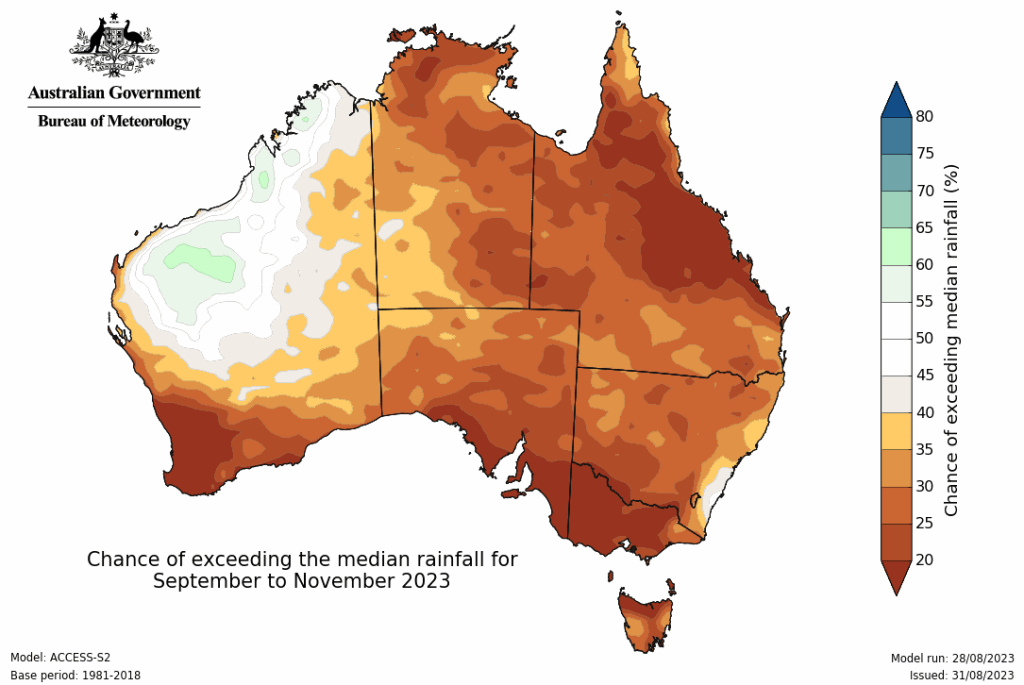
- For September to November, below median rainfall is likely to very likely (60% to greater than 80% chance) for most of Australia.
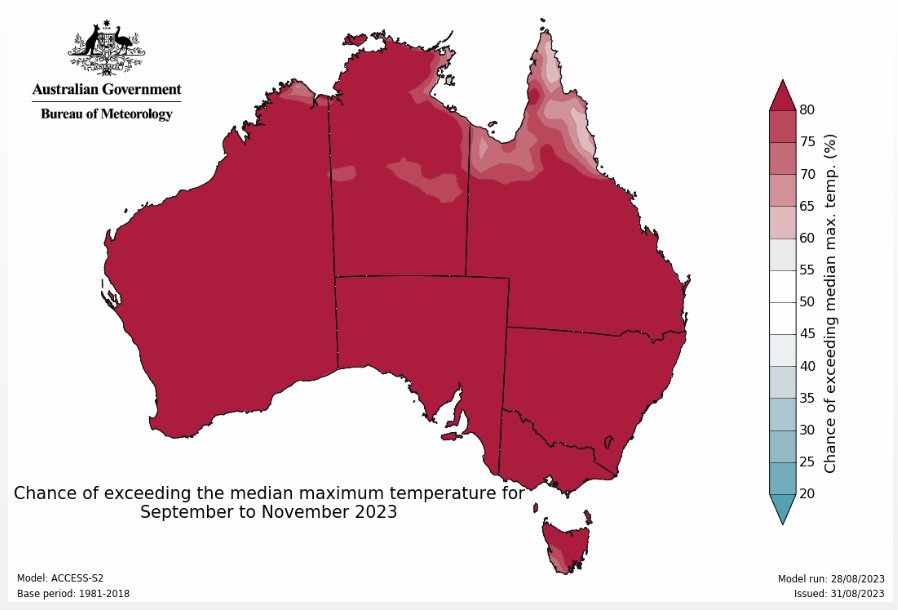
- For September to November, above median maximum temperatures are very likely (greater than 80% chance) for almost all of Australia.
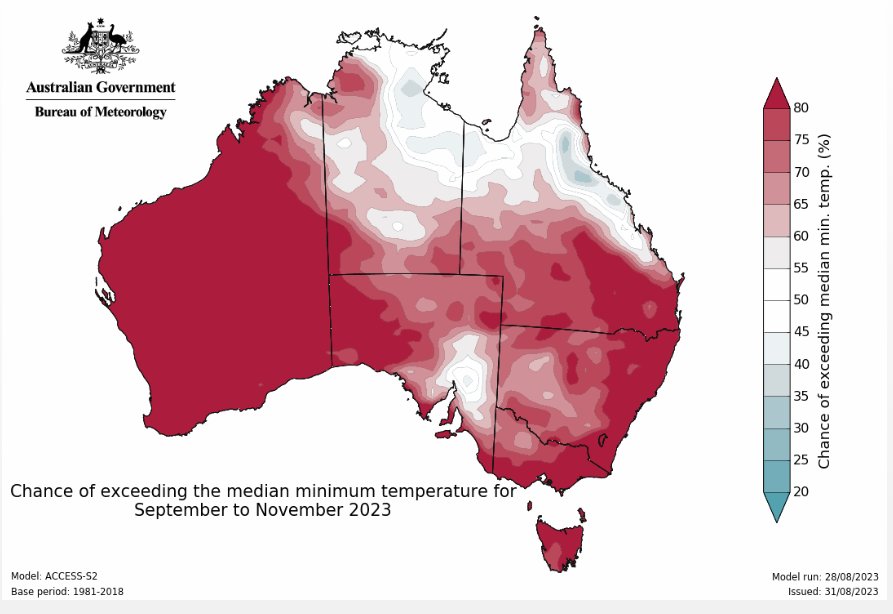
- For September to November, warmer than median minimum temperatures are likely (60 to 80% chance) to very likely for most of western and southern Australia.
- The long-range forecast is influenced by several factors, including likely El Niño development and positive Indian Ocean Dipole development, and record warm oceans globally.
This forecast for warmer Spring follows record global temperatures for July and August with rolling heatwaves for the Northern hemisphere, accompanied by wildfires in Greece, Spain, Canary Islands, Northern Africa, Canada and Siberia. We need to be prepared in Merri-bek for a long hot summer with multiple heatwaves.
Forecast for Maximum Temperatures, Minimum Temperatures and rainfall for September to November:
There is also higher risk for bushfires and grassfires in larfge parts of New South Wales, Queensland and the Northern Territory and for smaller areas in Victoria and South Australia. See our recent article on Fire Risk over the 2023/24 summer.
Global Boiling: Sea Surface temperatures
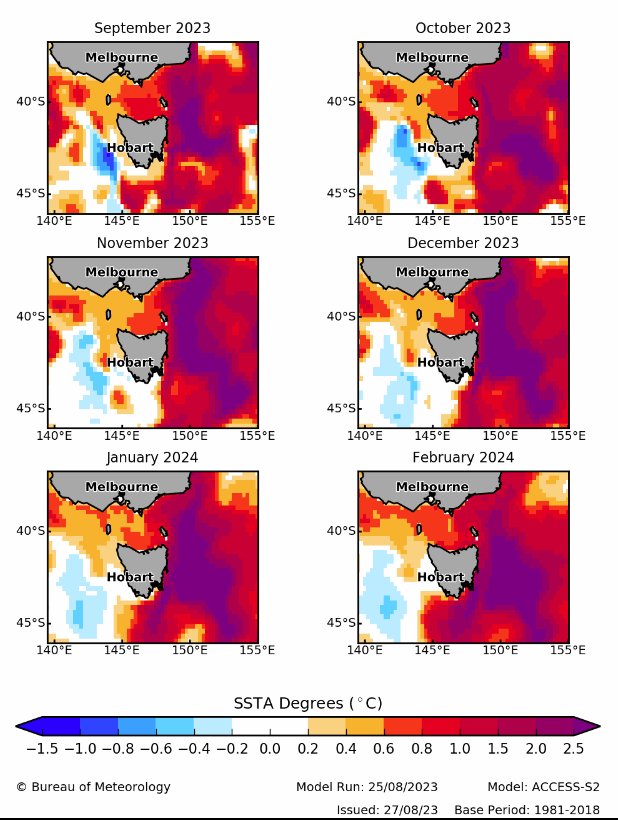
Ocean sea surface temperatures are also elevated and forecast to increase over the next six months around Australia. Below find forecast maps for Victoria/Tasmania and the Great Barrier Reef. The kelp forests off the coast of Tasmania, and the coral reefs in the Great Barrier Reef will be placed under great stress by water temperatures.

Meanwhile, the Federal Environment Minister Tanya Plibersek has just approved the 4th new coal mine or coal mine extension since coming to power in May 2022, despite the International Energy Agency (IEA) saying there is enough coal in production already and new projects will exceed climate targets adding to the climate crisis.
Read More:
- Doctors for the Environment – Heatwave Fact Sheet (PDF)
- Health Victoria – Extreme heat – community resources
- Climate Council (2014) – Heatwaves: Hotter, Longer, More Often
- Climate Council (2016) – The Silent Killer: Climate Change and the Health Impacts of Extreme Heat
- John Englart (2015) – Climate change and heatwaves in Melbourne – a Review
References.
- BOM, 31 August 2031, Long term forecast, http://www.bom.gov.au/climate/ahead/outlooks/archive/20230831-outlook.shtml
- BOM, Ocean Temperature Outlooks | Coral Bleaching Risk http://www.bom.gov.au/oceanography/oceantemp/sst-outlook-map.shtml
- Note 1. Kristen Guirguis, , Alexander Gershunov, , Alexander Tardy, , and Rupa Basu, (Jan 2014), The Impact of Recent Heat Waves on Human Health in California, Journal of Applied Meteorology and Climatology, DOI: https://doi.org/10.1175/JAMC-D-13-0130.1, https://journals.ametsoc.org/view/journals/apme/53/1/jamc-d-13-0130.1.xml
- Note 2. Evan M. Oswald, July 2018, An Analysis of the Prevalence of Heat Waves in the United States between 1948 and 2015, Journal of Applied Meteorology and Climatology,
DOI: https://doi.org/10.1175/JAMC-D-17-0274.1, https://journals.ametsoc.org/view/journals/apme/57/7/jamc-d-17-0274.1.xml - Coates, L., Katharine Haynesa, James O’Briena, John McAneneya, Felipe Dimer de Oliveiraa, (2014) Exploring 167 years of vulnerability: An examination of extreme heat events in Australia 1844–2010. Environmental Science and Policy. Volume 42, October 2014, Pages 33–44 (Full Paper) https://www.sciencedirect.com/science/article/pii/S1462901114000999
- Leeann Kuehn and Sabrina McCormick, (July 2017) Heat Exposure and Maternal Health in the Face ofClimate Change, International Journal of Environmental Research and Public Health, https://www.mdpi.com/1660-4601/14/8/853
- Jingwen Liu, Blesson M Varghese, Alana Hansen, Ying Zhang, Timothy Driscoll, Geoffrey Morgan, Keith Dear, Michelle Gourley, Anthony Capon, Peng Bi (July 2022), Heat exposure and cardiovascular health outcomes: a systematic review and meta-analysis, Lancet Planetary Health, https://www.thelancet.com/journals/lanplh/article/PIIS2542-5196(22)00117-6/fulltext
 Climate Action Merribek
[…] Today the Bureau of Meteorology declared an El Nino event was underway, which produces increased temperatures and increased bushfire risk and drought for Australia. We also have a positive Indian Ocean dipole which will add to warmer and drier conditions. Global sea surface temperatures have been elevated since April. Australia has just experienced our warmest winter on record. […]
LikeLike