“It is really up to individuals and communities to prepare for a summer of heat and fire hazards.” – BOM Spokeperson
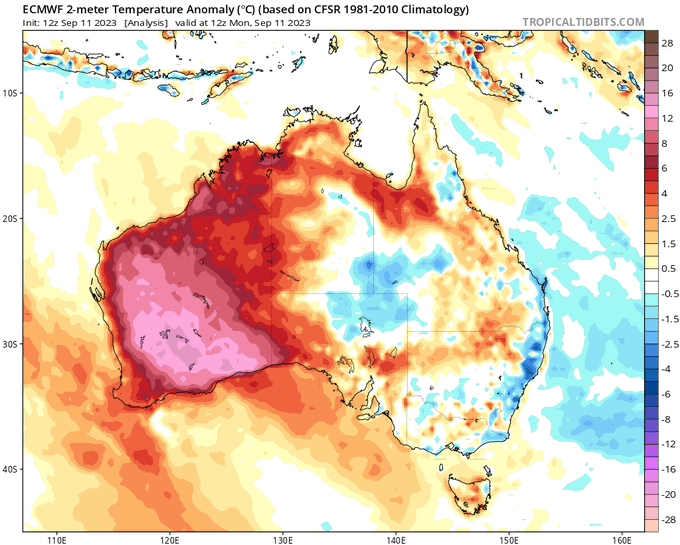
Catastrophic fire danger has been declared for the New South Wales Far South Coast today (19 September). Temperatures are in the mid 30s with high winds, in mid September, Spring. Orders to evacuate have also been given in the Coles Bay area of Tasmania, today. Sydney Airport reached 35.9C today at 1.30pm, a new Tmax record for September. This heatwave has been building from Western Australia since September 11.
It pressages what we may experience here in Merribek in Naarm (Melbourne) this summer with extreme temperatures. Scientists several years ago forecast that Sydney and Melbourne may achieve above 50C temperature. It could be in the 2023 or 2024 summer.
Today the Bureau of Meteorology declared an El Nino event was underway, which produces increased temperatures and increased bushfire risk and drought for Australia. We also have a positive Indian Ocean dipole which will add to warmer and drier conditions. Global sea surface temperatures have been elevated since April. Australia has just experienced our warmest winter on record.
Watch the full press conference:
Meanwhile the Bureau of Meteorology (BOM) has been caught napping. The Bureau’s Heatwave Service is seasonal and is not yet available providing heat warmings. Given record temperatures in both South America and Southern Africa, and the record warm winter here in Australia, this is a major oversight. An explanation is provided on the Heatwave page saying: “The Heatwave Service has been ceased following the end of the 2022/23 season but will restart at the beginning of the 2023/24 season.”
I hate to break it to BOM but we are already in the heatwave season in mid September.

Labor Government continues to make Global Warming Worse
Meanwhile Environment Minister Tanya Plibersek has approved 10 new or extended coal and gas projects since she became Federal Environment Minister, that will all stoke the increasing temperatures of global warming.
Her approval of some of these projects is currently being taken before the Federal Court in the Living Wonders case, being heard in the Federal Court in Melbourne this week.
On September 7 Bushfire Survivors for Climate Action called for the Federal Government to “pause” all new coal and gas projects until Australia’s national environment laws have been reformed (media Release).
BSCA is asking for the Federal Government to:
- Pause new coal and gas approvals, including expansions, until Labor’s promised environmental reforms and the new EPA are in place.
- Ensure a climate trigger is included in the EPBC reforms, requiring thorough assessment of all such projects against their impact on climate.
- Take responsibility for progressing all 80 recommendations of the Bushfires Royal Commission, for coordination and monitoring of all measures, and facilitating faster implementation across federal and state/territory jurisdictions.
You can sign the BSCA petition here: https://www.bushfiresurvivors.org/petition-pauseapprovalsepa
Climate Trigger needed in EPBC Act
Back on September 5, 2005, Anthony Albanese introduced a bill into parliament to address the failures in the EPBC Act: The Avoiding Dangerous Climate Change (Climate Change Trigger) Bill 2005 . The Howard Government failed to support this bill. Labor failed to legislate it when in power from 2007-2013. And in the last 18 months of power they have delayed changes to the EPBC act while approving 10 new or extended fossil fuel projects.
“The glaring gap in matters of national environmental significance is climate change. This bill closes that gap. The climate change trigger will enable major new projects to be assessed for their climate change impact as part of any environmental assessment process and will ensure that new developments represent best practice. The climate change trigger will apply to the establishment of any industrial plant or other facility which emits, or is likely to emit, more than 500,000 tonnes of carbon dioxide or carbon dioxide equivalent per year; or any other action, series of actions, or policies which will lead—or are likely to lead—to the emission of more than 500,000 tonnes of carbon dioxide or carbon dioxide equivalent per year. Any such action will require ministerial approval, unless the Minister for the Environment and Heritage decides that the action is not controlled under the act. If the action is approved, the minister can, under the act, attach conditions to the approval, such as the need to mitigate its greenhouse emissions.
The Avoiding Dangerous Climate Change (Climate Change Trigger) Bill 2005 provides that the minister must consider whether the direct or indirect emissions of carbon dioxide or carbon dioxide equivalent that are likely to result from the action will be minimised by the use of best practice environmental management and low emissions technology.
It is time to act. It is time for procrastination to end. The tragic events in New Orleans and in other southern states in the United States of America highlight exactly what can be expected from the impact of climate change. We cannot any longer afford to be complacent on this issue. We need action and one of the actions that we need, which has been acknowledged by the government for many years, is this amendment to the EPBC Act.
Anthony Albanese MP, in House of Representatives 5 Sep 2005 (Hansard)
So where is our Climate Trigger Tanya and Anthony? Where do you stand on this Wills MP Peter Khalil?
When will Labor step up and give the Environment Minister legislative powers to not approve new fossil fuel projects?
How many people need to die due to climate driven extreme weather events: floods, extreme heat, wildfires and wildfire smoke?
While fossil fuel companies sequester huge profits mainly offshore. In 2022 calendar year multinational fossil fuel corporations operating in Australia will book a staggering $120-140 billion gross profit on exports of our sovereign public LNG and coal assets, says Tim Buckley in the Sydney Morning Herald.
In Queensland a coalition of environment groups has released a joint letter calling on the Queensland Government to urgently improve its emissions reduction targets following today’s declaration that Australia will face hotter and drier conditions as a result of an El Niño event this summer.
2023 Joint letter to Qld Gov regarding Queenslands emissions reduction targets AMCS – calls on Premier Annastacia Palaszczuk to strengthen Queensland’s emissions reduction targets to at least 60% by 2030, 70% by 2032 and 90% below 2005 levels by 2035.
Cost in lives of extreme heat and bushfire smoke
In Australia more people die due to heat related reasons than any other weather cause.
In the 11 years between January 2006 and October 2017 an estimated 36,765 deaths in Australia can be attributed to heat-related causes.
A study published in the Medical Journal of Australia in March 2020 estimated the excess health burden during 19 weeks continuous fire activity in the states most severely affected by bushfire smoke. It found that at least 417 deaths could be attriibuted to the bushfire smoke and the PM2.5 air pollution particulates, and over 4,000 hospitalisations.
As Lucinda Coates and colleagues conclude in their landmark 2014 study – Exploring 167 years of vulnerability: An examination of extreme heat events in Australia 1844–2010 – “The dangers from extreme heat within Australia remain neglected, and fundamental changes will not take place until extreme heat is given the priority it deserves as Australia’s number one natural hazard killer.”

Anatomy of a heatwave: 11-19 September
“TWENTY SCHOOLS CLOSE on far south coast of NSW due to extreme fire danger. In early Spring. https://shorturl.at/AGIQU This is not normal – this is not OK. Our members are scared of what this fire season could bring – & now we see education suffering when the fires haven’t yet begun” says Bushfire Survivors for Climate Action in a tweet.
Jo Dodds, President of Bushfire Survivors for Climate Action, articulates further:
“36C. Extreme fire danger rating. Schools are closed for safety!! This is climate change on far south coast NSW. In September. If you want to approve a new coal mine @tanya_plibersek today’s a great day to do it. #ClimateAction #Pause #Fire @BSCA_Aus “
NSW’s Far South Coast fire danger rating upgraded to ‘catastrophic’ says the 9News headline and more details at The Guardian.
NSW RFS reports “As of 9am, there are 61 fires burning around the state, with 13 not yet contained. Over 500 personnel are working to contain these fires. There is a TOBAN for the Greater Sydney Region and Far South Coast.”
“Due to stronger than forecast winds along the Far South Coast, Catastrophic fire danger is expected this afternoon. For your survival, avoid being in fire risk areas today. Stay up to date, review your bush fire survival plan and know what you will do if a fire threatens.”

Weather and Climate historian M Herrera report on X on 19 September records broken:
Australia is living some extraordinary and unprecedented with between 30C and 40C in the South in early spring. 34.6C Sydney Observatory tied Sept record 35.9C the Airport beat the record Dozens of records smashed (see list below) 34.6 Gabo Island record beaten by 3.4C !POR 113y

M Herrera (@ExtremeTemps on X) reports on 18 September:
“Historic heat in Australia Stunning 38.4C at Port Augusta in South Australia,new monthly record And New South Wales with nearly 37C RECORDS 36.6 Moruya 35.9 Bega 35.4 Ulladulla 34.8 Forbes 34.7 Albion Park 34.6 Wyalong 34.5 Narooma 33.4 Mangrove 33.4 Montague Isl. 28.8 Braidwood”
Cameron H ( @Hitchy04 on X) reports for 18 September:
BREAKING: Mildura has reached an incredible 36.5c. That’s the 4th hottest Sep temp ever recorded in the state of Victoria!!! #heatwave This is 15.9c above Mildura’s Sep avg, and is 3rd hottest Sep day behind the state record of 37.7c in 2017, 37.4c 2003 POR 77yrs!
He followed this up on 19 September:
“More Tmin records fell last night in NSW and Vic: Jervis Bay 21.2c, smashes 2001 record by 2.8c POR 77yrs! Cabramurra 12.5c, 0.6c above 1981 record, combined POR 60yrs Mt Buller 11.3c, 1.4c above 1987 record POR 38yrs Falls Creek 10.3c, 2.4c above 2001 record POR 33yrs”
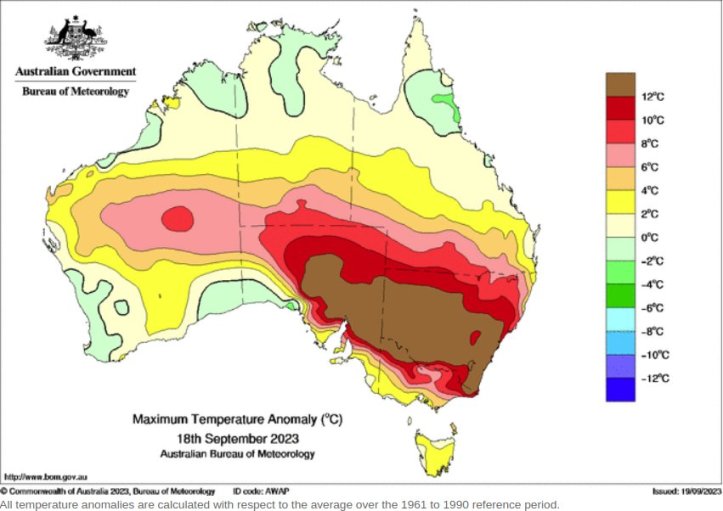
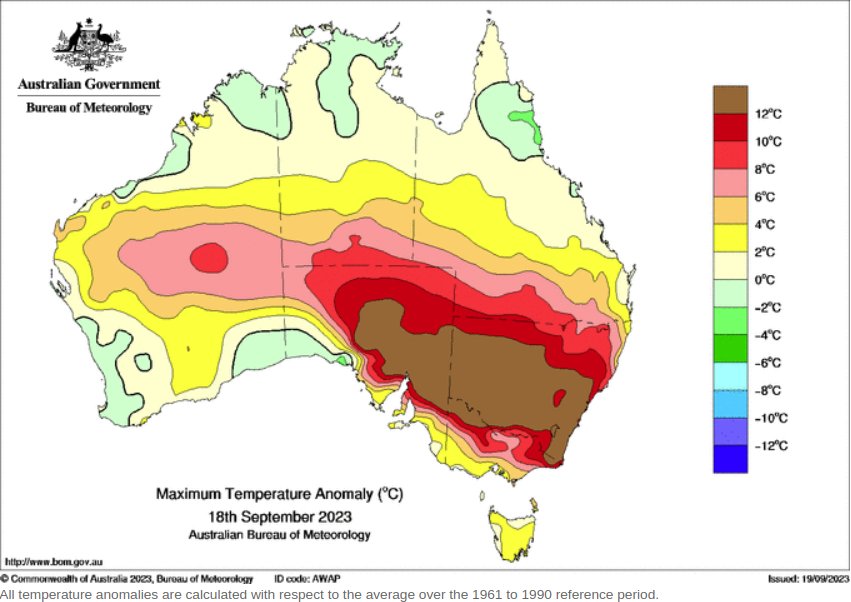
The BOM temperature anomalies for Australia for Monday 18 September shows much of NSW and portions of South Australia and northern and far east Victoria with temperature maximums exceeding 12C for this time of year.:
On September 17 M Herrera reported:
“Historic heat wave in Australia: More records fell today Tmin 19.1C Kiama highest in Sept MONTHLY RECORDS HIGHS IN SOUTH AUSTRALIA 39.8 Ceduna 38.9 Nullarbor 37.5 Wudinna 36.4 Minnipa It’s early spring and that ‘s South Australia…40C…”
On September 17 Pierre F. Lherisson (@P_F_Lherisson_ on X) reported:
“The record heat wave kicked off today in New South Wales, SE Australia with up to 35C (remember it’s early spring) ,33.3C Bellambi is a monthly record (short POR though). Incredible heat in Sydney with 34.7C at the Airport and 31.8C in the Observatory. It’s just the beginning..”

On September 16 M Herrera reported:
“The record heat wave kicked off today in New South Wales, SE Australia with up to 35C (remember it’s early spring) ,33.3C Bellambi is a monthly record (short POR though). Incredible heat in Sydney with 34.7C at the Airport and 31.8C in the Observatory. It’s just the beginning..”
On September 14 M Herrera warned:
“Spring warm spell in Australia Today few records of monthly high temperatures fell in the East mainly in short POR stations 24.4 King Island 21.2 Cape Sorell 20.5 Liawenee 20.6 Sheffield (long POR) 22.6 Tunnack 16.7 Mount Baw Baw 16.2 Falls Creek An exceptional warmth is coming…”
On September 12 M Herrera commented on a Cameron H tweet:
Herrera: “An exceptional warm spell is kicking off in Australia with temperatures +5C/+10C above average in large swathes of Southern areas for several days. First records are falling today: with September highest Tmins of 23.2C at Meekatharra and 22.8C at Kalgoorlie in Western Australia.”
Cameron H: “After a brief cold snap with 4 stations (POR 24-27yrs) setting Sep min records in Southern Aus last week, a strong and lengthy heatwave begins in SW WA (again): Mins: Kalgoorlie 22.8c, beats 1944 record by 0.8c POR 82yrs! Meekatharra 23.2c, smashes 1981 record by 1.7c POR 72yrs!”
References:
- 9 News, NSW’s Far South Coast fire danger rating upgraded to ‘catastrophic’ https://www.9news.com.au/national/nsw-south-coast-schools-closed-fire-danger/9c224b43-df02-4d2b-b8d4-2013887b0131
- Bushfire Survivors for Climate Action, Media Release, 7 September 2023, Bushfire Survivors for Climate Action call for Federal Government to “pause” all new coal and gas projects until Australia’s national environment laws have been reformed https://www.bushfiresurvivors.org/press-releases/bushfire-survivors-ask-federal-government-to-pause-all-new-coal-and-gas-projects-until-australias-national-environment-laws-have-been-reforme
- Tim Buckley, Sydney Morning Herald, 12 December 2022, Fossil fuel exporters’ $140b profit as bills soar, https://www.smh.com.au/national/fossil-fuel-exporters-140b-profit-as-bills-soar-20221209-p5c57b.html
- Nicolas Borchers Arriagada, Andrew J Palmer, David MJS Bowman, Geoffrey G Morgan, Bin B Jalaludin and Fay H Johnston, Med J Aust, March 2020 – Unprecedented smoke‐related health burden associated with the 2019–20 bushfires in eastern Australia https://www.mja.com.au/journal/2020/213/6/unprecedented-smoke-related-health-burden-associated-2019-20-bushfires-eastern
doi: 10.5694/mja2.50545 - Thomas Longden, Simon Quilty, Philip Haywood, Arnagretta Hunter, Russell Gruen, Lancet Planetary health, 1 May 2020, Heat-related mortality: an urgent need to recognise and record DOI: https://doi.org/10.1016/S2542-5196(20)30100-5
- Coates, L., Katharine Haynesa, James O’Briena, John McAneneya, Felipe Dimer de Oliveiraa, (2014) Exploring 167 years of vulnerability: An examination of extreme heat events in Australia 1844–2010. Environmental Science and Policy. Volume 42, October 2014, Pages 33–44 (Full Paper) https://www.sciencedirect.com/science/article/pii/S1462901114000999
- Daisy Dumas , Mostafa Rachwani and Australian Associated Press, The Guardian, 19 Sep 2023, ‘Worst risk since black summer’: NSW south coast fire danger upgraded to ‘catastrophic’ https://www.theguardian.com/australia-news/2023/sep/19/nsw-schools-closed-heatwave-australia-high-fire-danger-total-fire-bans
- Australian Marine Conservation Society, media release, 19 September 2023, Call for Queensland to improve emissions targets as El Niño declared, https://www.marineconservation.org.au/call-for-queensland-to-improve-emissions-targets-as-el-nino-declared/
 Climate Action Merribek
[…] Australia is already recording catastrophic fire weather and extreme heat and heatwaves over Spring. […]
LikeLike
[…] note NSW East Coast has already suffered an extreme heat event with catastrophic fire conditions during early Spring, which caught out the BOM heatwave […]
LikeLike