November has just finished and already climate scientists project that 2024 will be hottest year yet on record. “With eleven months of the year now in, 2024 will be the warmest year on record in the ERA5 dataset, at around 1.59C (with a 95% confidence interval of 1.57C to 1.61C given uncertainty in December temperatures).” – climate scientist Zeke Hausfather

Fossil fuel emissions are driving the increase in temperatures both over the land and in the ocean. And Australia keeps approving or subsidising new fossil fuel projects like Fracking the Beetaloo Basin and $1.9 billion subsidy to the Darwin MiddleArm Industrial hub which we heard about recently at a Coburg Town Hall meeting. In September Environment Minister approved 3 new coal projects.
The Bureau of Meteorology has forecast Above average maximum temperatures and unusually high minimum temperatures for the Summer. This is after the warmest Spring Australia has had on record.
Australia may talk ambition at UN Climate Talks , such as at Azerbaijan COP29, but at home it still has the foot on the accelerator for global warming.
Summer 2024/2025 Forecast
BOM issued a forecast on 28 November: Unusually warm nights likely across most of Australia. Expect above average maximum temperatures and warmer nights.
December to February
- Above average maximum temperatures are likely to very likely (60% to greater than 80% chance) for large parts of Australia while above average minimum temperatures are very likely across almost all of Australia.
- Maximum temperatures are likely to be within the typical range for the season for large parts of central and eastern NSW, eastern parts of WA, south-west SA, the central NT, and southern Cape York Peninsula in Queensland.
- There is an increased chance of unusually high maximum temperatures2 across Tasmania and western WA, and parts of south-eastern SA and western Victoria, with up to 3.5 times the normal chance.
- There is an increased chance of unusually high minimum temperatures2 across Australia, particularly in the north and large areas in the east and west of the continent, where the likelihood is more than 4 times the normal chance.
- For December alone, maximum temperatures are likely to very likely (60% to greater than 80% chance) to be below average for eastern WA, most of the NT and parts of inland Queensland, and likely to very likely (60% to greater than 80% chance) to be above average for western WA and parts of south-east Australia; elsewhere maximum temperatures are likely to be in the typical range for the season.
- There is an increased chance of unusually low maximum temperature3 for the Pilbara and Kimberley districts in WA in December, up to 3.5 times the normal chance.
Record-breaking Spring in Australia:
Here is what BOM had to say on Spring Temperatures
Australia’s national area-averaged mean temperature for spring was 2.08 °C above the 1961–1990 average, the warmest spring on record since national observations began in 1910.
Queensland had its warmest spring on record, surpassing the previous record set in 2020 by around 0.4 °C. For all other states and territories, spring was amongst their respective top ten warmest on record.
Australia’s area-averaged mean maximum temperature was 2.10 °C above the 1961–1990 spring average, the seventh-warmest on record.
Mean maximum temperatures were above average to very much above average (in the highest 10% of all springs since 1910) for most of Australia. Mean maximum temperatures this spring were the highest on record for small areas of the western Kimberley in Western Australia and Queensland’s central-west and Cape York Peninsula.
The national mean minimum temperature was 2.05 °C above the 1961–1990 average for spring, the warmest on record since 1910.
Western Australia and Queensland had their warmest spring mean minimum temperature on record, while for South Australia the mean minimum temperature was the second-warmest on record. For all other states and territories spring mean minimum temperatures were in their respective top ten warmest on record.
Mean minimum temperatures for spring were above average to very much above average (in the highest 10% of all springs since 1910) for most of Australia. Mean minimum temperatures were the highest on record for large parts of the Kimberley, Pilbara and Southern Interior districts in Western Australia, pastoral districts in South Australia extending into large parts of the Channel Country and adjacent regions, as well as for Queensland’s south-east. Many stations in these areas had their record highest mean minimum temperature for spring.
Hot days and warm nights occurred regularly across northern and in parts of southern Australia in October and November, with daily maximum temperatures in the high 30s and low 40s and minimum temperatures in the mid to high 20s. There were extended periods with low to severe intensity heatwaves across much of Australia in both October and November.
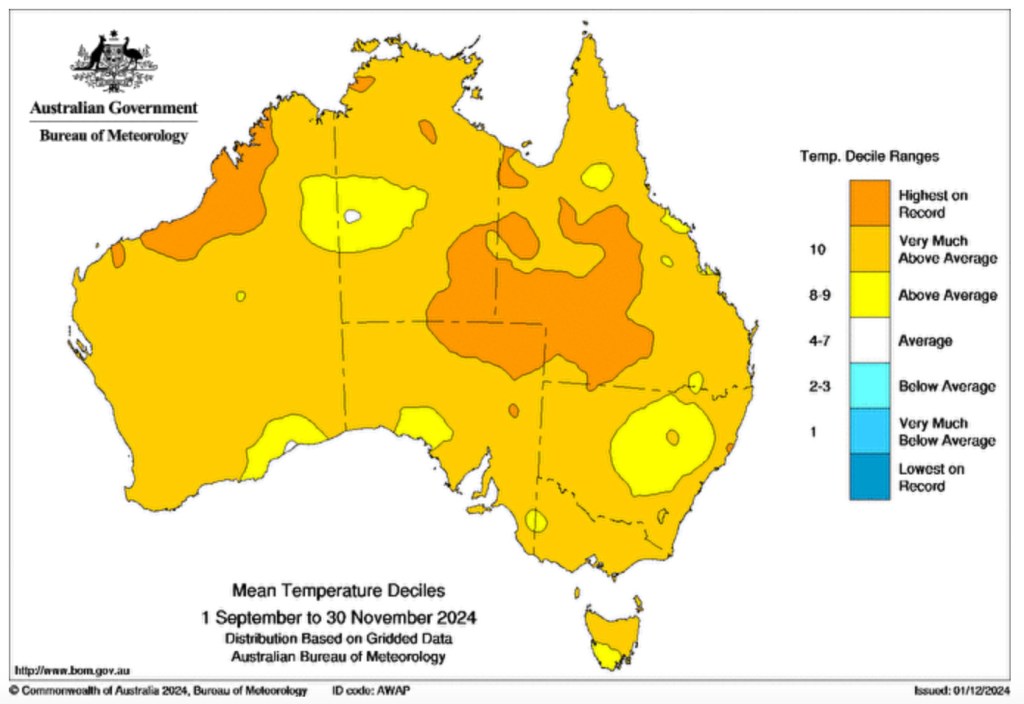
and the time series trend for Australian Spring mean Temperature Anomaly:
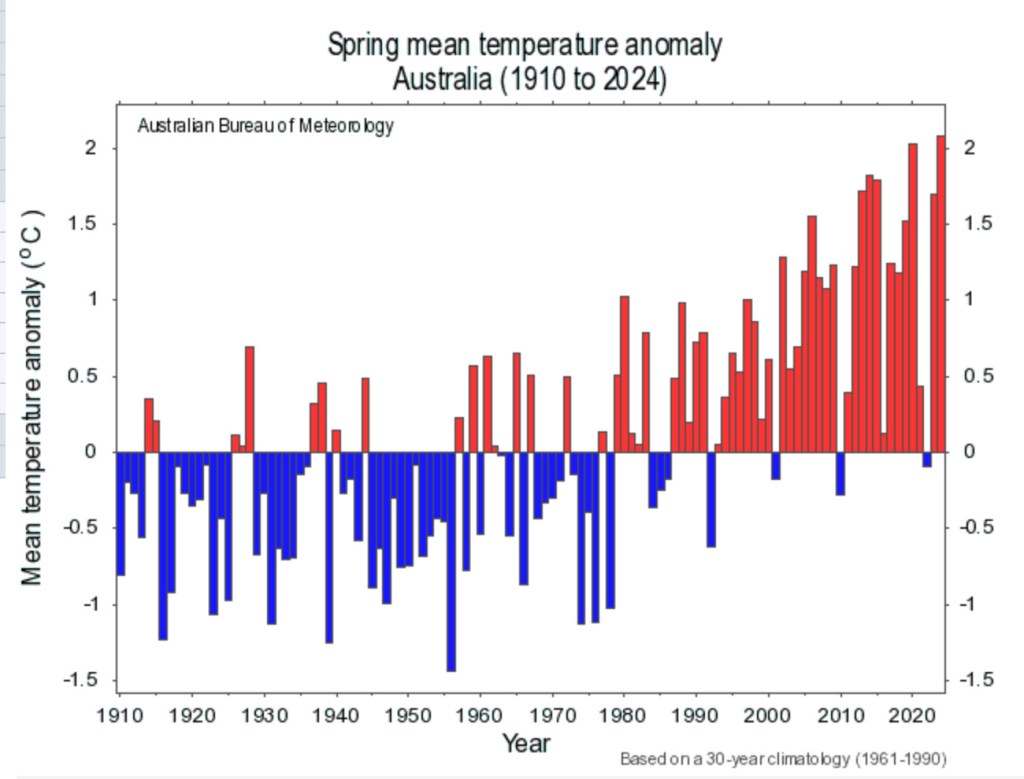
References:
ABC News, 2 December 2024, Australia sweats through hottest spring on record as temperatures soar 2.5C above pre-industrial levels https://www.abc.net.au/news/2024-12-02/australia-weather-hottest-spring-on-record-temperatures-soar/104673886
ABC News, 2 December 2024, Concerns more Australians at risk of heat-related injuries as people do it tough in cost-of-living crisis https://www.abc.net.au/news/2024-12-02/experts-warn-not-to-downplay-heatwave-risks/104669928
 Climate Action Merribek
[…] has been Earth’s hottest year on record. The impacts of climate change are here and have been devastating communities all over the world. […]
LikeLike