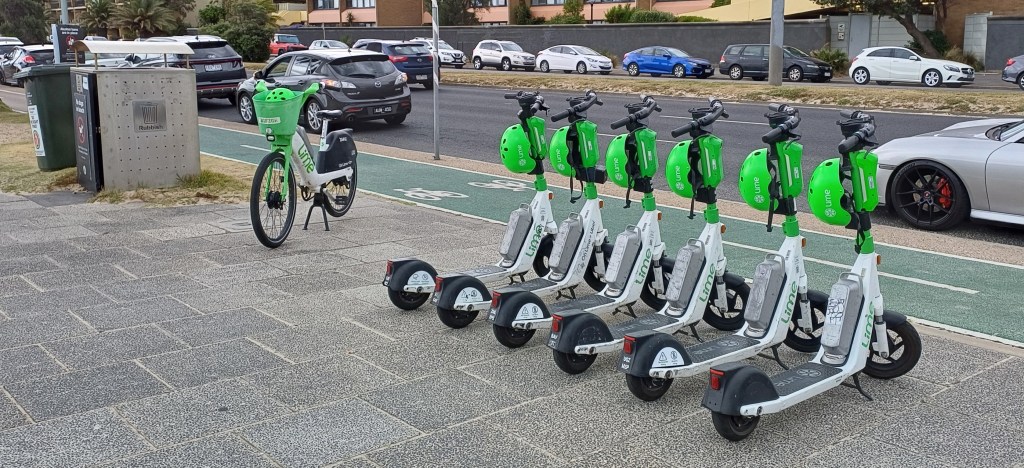
Merri-bek, Darebin and Moonee Valley Councils may soon be introducing shared e-scooter schemes, whereby e-scooters (and/or e-bikes) are available for hire from a for-profit private operator, stored on public land and managed with an app. To run these shared micromobility schemes, the private operator must have an agreement with the local Council. Councils specify where e-scooters can be ridden and parked, and the maximum speed in particular locations. Geofencing technology based on GPS is used to control location.
Our car-dependent transport system is a disaster in terms of sustainability, safety, cost and efficient use of space. Will shared e-scooters help?
Shared e-scooter trials have been controversial
Victoria’s shared e-scooter trials, organised by the state government, began in early 2022. Four council areas were chosen to participate: Melbourne, Port Phillip, Yarra and Ballarat. In April 2023, the Victorian government legalised private e-scooters, and in October 2024 legalised shared e-scooter schemes.
E-scooter (but not e-bike) trials have been very controversial. The City of Melbourne recently banned shared e-scooters, and Yarra Council voted to prevent them parking on footpaths narrower than two metres. Clearly some opposition is a backlash, and no doubt many e-scooter critics are “selectively blind to the widely accepted dangers of cars”. But e-scooters do pose some safety and accessibility problems.
Supporters say e-scooters are a cheap and compact mode of transport, reducing car usage and air pollution. Critics say they are hazardous for pedestrians if ridden on footpaths and for e-scooter riders themselves as too many are crashing. Parked e-scooters obstruct footpaths for pedestrians, especially impacting people with disabilities. Critics also claim that too many e-scooter riders flout the law, and police are not sufficiently enforcing the law, while supporters point out that motor vehicles already dominate our cities, and drivers frequently flout the law with far more hazardous consequences. Private e-scooters have already been legalised, so why not have e-scooters for hire as well?
E-scooters and Merri-bek’s Transport Strategy
Merri-bek’s transport strategy is guided by six values. Our transport systems should be safe, accessible, sustainable, healthy, liveable and inclusive. (Liveability is about destinations being nearby and reducing transport costs.) How do e-scooters stack up in this context?
Being compact, e-scooters are far more sustainable than cars. They are cheap to run and convenient for nearby destinations. But they have disadvantages.
In terms of accessibility, e-scooters are mostly ridden by able-bodied people, although as with cycling this may be partly due to the lack of safe infrastructure. Though some people with mobility difficulties find them useful. But the big concern for accessibility is e-scooters parked on footpaths obstructing people with disabilities. One disability activist has taken Yarra Council to VCAT over this. (You can read details of the claim currently before VCAT here.) Parking can be addressed with designated parking places (preferably off the footpath) but penalties for non-compliance are essential. Of course, e-scooters are not the only objects obstructing footpaths; cars, motorbikes, bins, hard rubbish, signs and construction works regularly do.

E-scooters are not active transport
E-scooters score negatively on health. It is concerning that Merri-bek regards them as “active transport”. The physical activity benefits of e-scooters are marginally better than driving, but worse than walking and much worse than cycling. (Would anyone regard standing at one’s desk as physical activity?) If e-scooter trips replace walking, the health impact is negative. We want them to replace car trips, meaning e-scooters may be more suitable in suburbs and regional towns rather than densely populated city centres. If e-scooters are ridden on the footpath, they can discourage older people from walking, negatively impacting their health.
Safety is a key concern
Then there is safety. Regarding personal safety, survey data has found that some women feel safer riding an e-scooter at night compared with walking. However, designated parking could mean they can’t be ridden to the door of a destination. With respect to road safety, e-scooters like all vehicles can pose a threat to other road users, particularly pedestrians. Road rules are meant to stop this, but they depend on compliance and enforcement.
The biggest safety concern is the risk to the e-scooter rider themselves. Indeed, a Royal Melbourne Hospital emergency physician has said that e-scooter injuries now comprise almost 5% of the hospital’s major trauma cases and are in addition to other road trauma cases.
It is problematic to compare e-scooter safety with bike riding. Data on the e-scooter injury rate is still emerging but there are estimates that it is 2 to 4.6 times greater than for bike riders. For cyclists, the health benefits clearly outweigh the injury risk. E-bikes, which provide motor assistance only when pedalled also have health benefits. For e-scooters, a recent study from Portugal found that the social cost of e-scooter crashes swamped any benefits by a huge margin.
The cause of road injuries differs. About 90% of serious cycling injuries are due to motor vehicle collisions. We can make cycling much safer with protected cycling lanes. However, 74% of e-scooter injuries are due to a fall from loss of balance. When e-scooter riders fall, they tend to face-plant, resulting in head injuries, whereas cyclists tend to fall on their sides. Experts have recommended full-face helmets.
Why are e-scooter riders more likely to lose control?
E-scooters are less stable than bikes due to their small wheel size, and how the body is positioned. With their large wheels, bikes can better handle uneven surfaces. The e-scooter rider has a higher centre of gravity, which reduces stability.
E-scooters are relatively new, so riders tend to be less experienced. This is particularly so for shared e-scooters – one study found 30% of riders injured on shared e-scooters were on their first ride!
E-scooter riders have been found to engage in more risky behaviour than cyclists. E-scooters are considered fun to ride, which can contribute to poor behaviour. Compared with private e-scooters, those riding shared e-scooters are less likely to wear a helmet, more likely to be affected by alcohol and more likely to be carrying a passenger. Note that alcohol is also significant contributor to road trauma for other road users.
The Victorian Government wants to improve rider behaviour, and has recently introduced bigger fines. The Transport Accident Commission is focusing on education and has released a series of advertisements: “If you think E-scooters are a toy, think again” also here, and here. The government is also planning legislation to include new requirements for e-scooter share hire operators. The process will include trialing technologies to detect footpath riding, being drug or alcohol affected, and not using a helmet. Given that police capacity is limited, the government will also allow Protective Services Officers (PSOs) to enforce the e-scooter road rules.
Improving e-scooter safety for riders and pedestrians
Our roads would be much safer for e-scooter riders, cyclists and pedestrians if there was physical separation for different modes. Safe bike (or micromobility) lanes address many safety problems but to date road authorities have been reluctant to reallocate road space from motor vehicles to allow for safe cycling. Clearly this must change.
Councils can only influence shared e-scooter schemes. Shared e-scooters can be made safer than private e-scooters because the technology can be controlled. Their speed can be restricted, whereas private e-scooter owners can illegally tamper with them to override the legal speed limit of 25 km/h. Councils could require shared e-scooters to include a seat, which lowers the rider’s centre of gravity making them safer, and perhaps less appealing to joyriders. Bigger front wheels could be required to reduce the risk of falls. Shared e-scooters can incorporate AI-powered cameras, which detect footpath riding, and warn the rider or slow the speed (though it is not clear how well this technology works in practice). Shared e-scooters can be geofenced to prevent inappropriate parking and riding, but the GPS technology is not accurate, and has not prevented inappropriate use in the current trials. More accurate locational technology will be required for designated parking areas. Shared e-scooters can control who uses them and new riders can be prevented from riding at high-risk times or have reduced speed limits, while alcohol-affected riders can be detected with cognitive testing. Shared e-scooters could be designed to address the silent nature of such devices, a major concern for people with low vision. Overall, Council needs to ensure the terms of the contract with the e-scooter companies are strong enough to effectively deter inappropriate use.
Currently, published data on pedestrian injuries from e-scooters is poor. The Royal Melbourne Hospital recorded 9 such injuries in 2022, when e-scooters where not in wide use. (Data from other hospitals or GPs was not published.) For many older people, the fear of falling even from being startled by an e-scooter can deter them from walking. Each year over 5000 Victorians require hospital treatment due to falls in the street. Older people who fall can lose their confidence in walking. This can reduce their physical activity and increase dependence on driving, with consequent financial, health and environmental impacts. It is vital that older people feel safe on footpaths.
Footpath riding for e-scooters is illegal. But it is not well enforced, and some e-scooter riders ride on the footpath because they don’t feel safe riding on the roads. Separated micromobility lanes are vital for everyone’s safety.
Solving the e-scooter parking problem
It is essential that parked e-scooters do not obstruct footpaths. Storage of e-scooters and e-bikes should have been addressed at the outset.
Melbourne’s original “shared micromobility” scheme of 2010-2019 (the government-owned blue bikes) had docking stations in the CBD and nearby. Then dockless or “free-floating” yellow oBikes were introduced by a private company in 2017. Users could find a bike using an app. But bikes were left everywhere, including obstructing footpaths, and it was quickly abandoned.
In the latest shared e-scooter trials, the Victorian government left Councils and the e-scooter operators to sort out where to park them. The arrangements made were clearly unsatisfactory, leading to many concerns about parked e-scooters blocking footpaths. Councils need to respond to complaints about obstructions. The Yarra Mayor recently said that that the cost of responding to complaints exceeded the $180,000 annual revenue from the e-scooter companies.
In March 2023, Ballarat introduced designated parking stations. To ensure compliance, the rider would continue to be charged until tracking technology detected e-scooters were parked in a designated parking area.
Yarra Council is now painting designated e-scooter parking bays on the footpath with one in Gertrude Street, Fitzroy shown below. This method degrades pedestrian infrastructure and creates another footpath hazard, with the space left on the footpath being only 3 cm more than that required for wheelchair access. Where possible, designated e-scooter parking bays should be put on the road by repurposing car parking spaces.
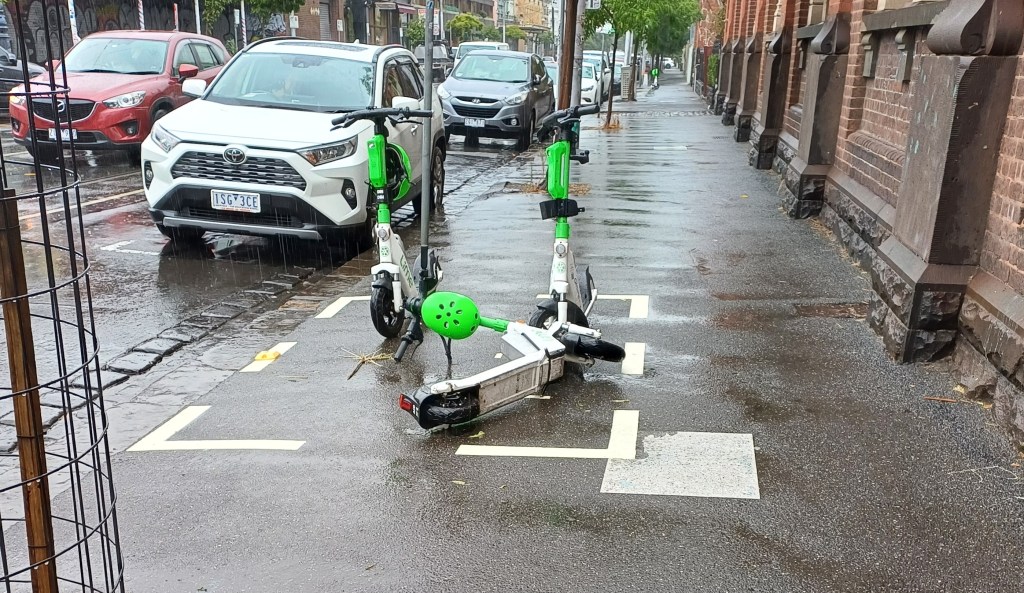
Merri-bek Council officers have recommended “shared mobility parking only in areas identified as being appropriate, enforced by geo-fencing, line marking and, when on-street, with additional protective bollards”.
The convenience of e-scooters depends on having enough parking bays. A study from the USA suggested they should be not more than 200 metres apart. If Merri-bek starts rolling out e-scooters in the Brunswick suburbs, perhaps 250 parking areas would be required – with multiple bays in activity streets.
Will shared e-scooters significantly reduce car travel?
For e-scooters to be a sustainable transport option, e-scooter trips need to replace car trips. This seems to be the case for private e-scooters. But if shared e-scooters are mostly replacing short walking trips or being ridden for fun, their sustainability benefits are questionable. If they replace public transport trips, they also replace the associated walking. Clearly which trips are replaced depends on the location. Cities differ enormously in terms of sprawl and public transport options. Studies from other countries show significant variability.
In Ballarat, where public transport is relatively poor, 63% of shared e-scooter trips are said to be replacing car trips. In the City of Melbourne, a survey of people who used shared e-scooters found that only 3% of e-scooter trips replaced private car trips, with a further 8% replacing taxis and rideshare. 80% of e-scooter trips replaced walking or public transport.
In terms of walkability, and access to public transport, Merri-bek is obviously in between the City of Melbourne and Ballarat. Arguably, Merri-bek has fewer “fun” destinations compared with the original trial areas of Melbourne, Port Phillip and Yarra. So perhaps in Merri-bek, they are more likely to be used by residents just wanting to get around.
 Climate Action Merribek
mmm … e-scooter use is complicated. Thanks for the detailed article on the many issues.
I think there is an important role for private e-scooters with public transport, both trains and buses. They can provide greater range mobility than walking to catch public transport and for last mile after public transport to final destinations.
I noticed this at the Super Tuesday bike count at Upfield Station in March 2024. There was a resonable cohort of people using bikes or -e-scooters with the train service.
https://upfieldbikepath.wordpress.com/2024/03/05/cycling-count-insights-from-upfield-station/
LikeLike
I’d like to see Ario put in a bid/be considered as an operator. They’ve got a more stable three wheeler e-scooter with the ability to be re-parked remotely by operators with a 360 degree camera when it’s detected the rider has parked incorrectly. Potentially solves a couple of issues and has been quite a popular feature in Auckland, but of course road space reallocation, protected riding lanes and safe speeds should be council’s and DoT’s priority.
LikeLike
[…] Shared E-Scooters coming to the Inner North? Climate Action Merri-bek, 10 January 2025 […]
LikeLike
Great article – thanks Andrea. YAs you say, Yarra is grappling wth this issue, and this provides very useful info and ideas
LikeLike