Stay tuned, we’ll be updating this page with news throughout January….
Action
Action: Send an email to Federal Labor to Urgently apply the water trigger to Beetaloo fracking. See our background information post on the contaminated water spill and the Independent Expert Scientific Committee report into exploratory fracking.
Timeline
31 January 2025 – With an incoming heatwave the like of which we haven’t seen in Melbourne since 2014 we decided to prepare an Essential Heatwave Preparedness Tips for Merribek Households. Stay cool, look after your heat Health. Remember Fossil Fuels are worsening Extreme Heat. (CAMerribek)
31 January 2025 – Make a noise or work with the system? New research reveals 4 ways to create real change for nature. (The Conversation) The article elucidates on the 4 ways: Be prepared for a long haul; Know the system; Be strategic; Seize the moment.
31 January 2025 – The Greens have proposed a nationwide scheme for 50 cent public transport fares across Australia, likely to cost $8 billion over four years, after Queensland Government made permanent 50 cent fares. It could save a Melbourne commuter up to $2400 per year. (The Age)
29 January 2025 – Australian households could save more than $3000 a year on power bills by making simple energy-efficiency upgrades including insulation, solar panels and home batteries. (The Age)
29 January 2025 – A marine heatwave in northwest Australia is killing huge numbers of fish. It’s heading south (The Conversation)
29 January 2025 – Australians who get most of their news from commercial media more likely to believe in climate conspiracy, study finds (Guardian) Exclusive: Monash University study suggests those who rely more on newspapers and public broadcasters more likely to score highly on ‘civic values’. But as you are here reading this we know you are media savvy.
29 January 2025 – Economics editor Ross Gittins fears voters will get it wrong in the 2025 Federal Election. Thoughtful piece discussing cost of living and climate, advocating for minority government. (The Age)
Ross Gittins quote (Click to open)
“We face a choice between a weak leader in Anthony Albanese (someone who knows what needs to be done, but lacks the courage to do much of it) and Peter Dutton (someone who doesn’t care what needs to be done, but thinks he can use division to snaffle the top job).
“By far the most important problem we face – the one that does most to threaten our future – is climate change. We’re reminded frequently of that truth – the terrible Los Angeles fires; last year being the world’s hottest on record – but the problem’s been with us for so long and is so hard to fix that we’re always tempted to put it aside while we focus on some lesser but newer irritant.”
….”From the perspective of our children and grandchildren, the best election outcome would be a minority government dependent on the support of the pollies who do get the urgency of climate action: the Greens and teal independents.”
28 January 2025 – Dangerous temperatures could kill 50% more Europeans by 2100, study finds (Guardian) Net increase of 80,000 deaths a year projected in hottest scenario, with milder winters failing to redress balance. See : Estimating future heat-related and cold-related mortality under climate change, demographic and adaptation scenarios in 854 European cities (Nature Medicine)
28 January 2025 – Hepburn Energy announce 5MWh battery ordered to add to their 2 wind turbines and solar farm (Email). They are 100% community owned. They have also released a 100 page free handbook by Taryn Lane: Hopeful Action – A Handbook for Community-led Climate Transitions. While its focus is on country and regional areas, it is a useful resource for empowering everyone involved in the energy transition, city and country. (HepburnZNet)
28 January 2025 – Biofuelwatch have published a global report on the issue of Biofuels for aviation, or ‘Sustainable Aviation Fuels’ (SAF), which is far from sustainable. :A Global Fat Grab: examining the push for aviation biofuels (Biofuelwatch)
25 January 2025. The Australian Electric Vehicle Association (AEVA) will be campaigning on transport issues in the 2025 Federal Election. And not just on Electric Vehicle uptake. They are also advocating investment in electric heavy haulage, including electric rail and intermodal facilities. AEVA has also explicitly endorsed the Avoid-Shift-Improve hierarchy and has stated that “a simple one-to-one replacement of ICE cars to electric is not a satisfactory strategy; broader solutions [encompassing public transport and active travel] are required”. (AEVA)
24 January 2025 – Knitting Nannas Good news summary (Knitting Nannas): Ed Husic the federal Minister for Industry and Science announced on 16 January 2025, “the Commonwealth-New South Wales Offshore Petroleum Joint Authority (Joint Authority) made the decision to refuse both the PEP-11 [offshore gas] applications”. (Minister’s media release)
21 January 2025 – President Trump initiates executive orders on immigration, climate and environment. Revocation of 78 Biden Era orders. (Whitehouse.gov) Including withdrawal from Paris Agreement and the 50% EV target by 2030. See Union of Concerned Scientists statements: Pres. Trump Brings His Anti-Science, Destructive Agenda to White House on Day One (Union of Concerned Scientists)
Executive orders on Climate and Environment (Click to Open):
- Withdraw the United States from the Paris Agreement, the pact among almost all nations to fight climate change. (Guardian)
- Declare a national energy emergency, a first in U.S. history, which could unlock new powers to suspend certain environmental rules or expedite permitting of certain mining projects.
- Attempt to reverse Mr. Biden’s ban on offshore drilling for 625 million acres of federal waters.
- Begin the repeal of Biden-era regulations on tailpipe pollution from cars and light trucks, which have encouraged automakers to manufacture more electric vehicles.
- Roll back energy-efficiency regulations for dishwashers, shower heads and gas stoves.
- Open the Alaska wilderness to more oil and gas drilling.
- Restart reviews of new export terminals for liquefied natural gas, something the Biden administration had paused.
- Halt the leasing of federal waters for offshore wind farms.
- Eliminate environmental justice programs across the government, which are aimed at protecting poor communities from excess pollution.
- Review all federal regulations that impose an “undue burden” on the development or use of a variety of energy sources, particularly coal, oil, natural gas, nuclear power, hydropower and biofuels.
- Source: Trump’s Executive Orders: Reversing Biden’s Policies and Attacking the ‘Deep State’ (New York Times)
20 January 2025 – Federal Labor offer two billions dollars in production credits to support a new “green aluminium” sector, in a new election pitch. Aluminium production is energy intensive and uses in Australia 10% of electricity produced. The production credits encourage use of renewable energy. Aluminium is produced in Queensland at Gladstone, NSW at Tomago, Victoria at Portland and Tasmania at Bells Bay. Export Demand for green aluminium is likely to rise. (ABC News | Read the media release | The Guardian)
20 January 2025 – New transformers arrive at Melton for the 600MW Melbourne Renewable Energy Hub, to connect the 1.6 gigawatt-hour (GWh) battery to the grid. This is the first project from the State Electricity Commission (SEC). SEC plans to develop 4.5 GW of new renewable energy and storage projects including reinvestment of profits back into Victorian projects that deliver cheaper renewable energy. Meanwhile, the newly installed leader of the Victorian opposition, Brad Battin, has pedged to scrap the SEC if his party wins the next state election. (Renew Economy)
18 January 2025 – The home front: Could the Los Angeles fires happen in Australia? Experts say yes. Indeed, house to house ignition has already happened: the 2003 Canberra fires destroying at least 470 houses (Wikipedia), Victoria’s Black Saturday fires in 2009, which killed 173 people – mostly in the Kinglake area and Marysville – which destroyed more than 2000 homes; the Sydney fires of 1994, when more than a hundred homes were lost around the city from Como in the south to the Lane Cover River Valley in the north; and the 1983 Ash Wednesday fires that swept through South Australia and Victoria. Just not yet on the scale of LA. (The Age) Back to LA: How the Los Angeles wildfires expose climate risks and solutions is a thoughtful piece by Penn State distinguished professor of geography Erica Smithwick, with expertise in landscape and ecosystem ecology and wildfires. (Penn State U)
17 January 2025 – Worth reading this Factcheck by Andrew Gunner on Peter Dutton’s statements on electricity pricing and Coalition Policy: “The Coalition’s presentation of current Australian electricity costs and their cost comparisons are flawed to a remarkable extent. Not one aspect of their analysis is valid.” (FeedbackReigns) He has also done a Factcheck on the Coalition Nuclear Power Folly (FeedbackReigns)
17 January – Comedian Dan Ilic launches It’s not a Race to raise donations for a climate campaign in the 2025 Federal election to factcheck, and do a digital media strategy. “So we’re going to do what we know how: make subversive content and spread it around the internet. We need to hire writers, producers and editors to make more of this between now and the election. We will then buy strategic ads to put it where it will make a difference: on billboards, in display ads, in people’s social media feeds” (Its Not a Race Raisely)
16 January 2025 – New Climate Council report explores how Australians are under-estimating the rapid growth of renewables and grid batteries. Electric Shock! Australia’s light-bulb moment. (Climate Council)
16 January 2025 – Some words of wisdom from Greg Jericho at the Australia Institute about vote climate in the 2025 election: Australians should be angry about another year of climate inaction. But don’t let your anger turn into despair. (Guardian) Also listen to the Dollars and Sense Podcast: The Election at the End of the World talking about the major Parties on climate policy in the wake of the catastrophic LA Fires (Australia Institute)
16 January 2025 – A thought-provoking article on the LA Fires, the fires in Canada and Siberria and what it portends for our future in the Pyrocene. Entering the ‘Pyrocene’: Devastation in California is the harbinger of the apocalypse (Pearls and Irritations)
15 January 2025 – David Spratt on the Labor Government failure to articulate the climate threat. Climate and security risks? Shhh, says the Albanese Government. “the Albanese Government, which has blithely set about its climate policy agenda — renewables, batteries, EVs and the grid, all well-mixed with a large expansion of Australia’s coal and gas industries — without ever understanding, or explaining to Australians, the basic question: what is the nature of the threat to be mitigated, and how does their policy contain that threat?” (Pearls and Irritations)
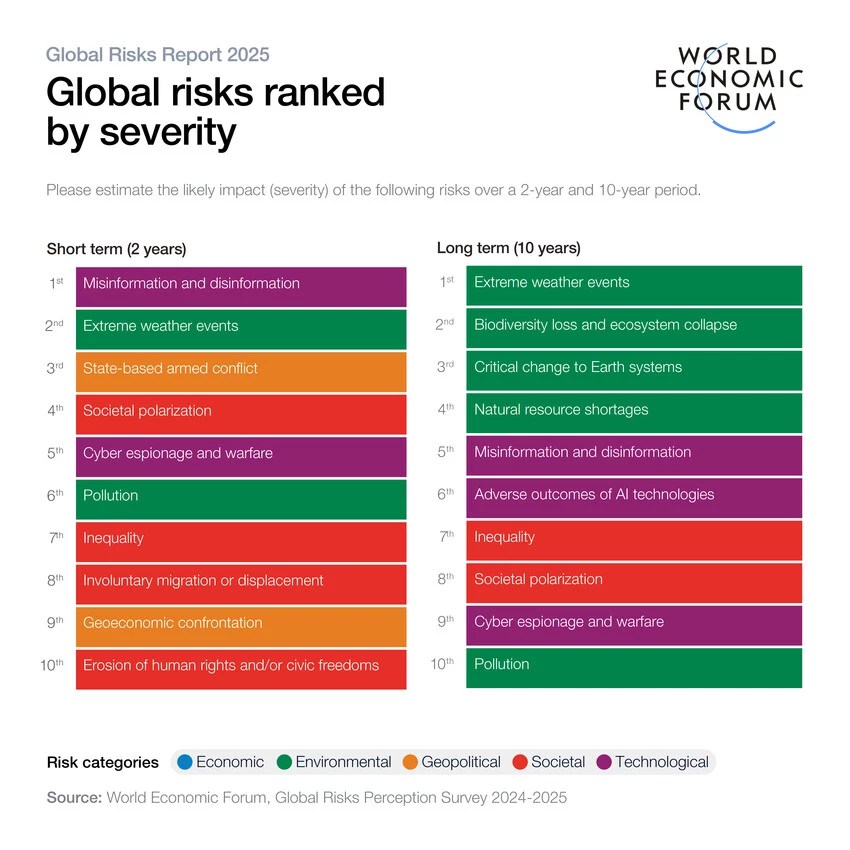
15 January 2025 – WEF Global Risks report for 2025. Environmental risks – from longterm concern to urgent reality. (WEF) “The impacts of environmental risks have worsened in intensity and frequency since the Global Risks Report was launched in 2006, as discussed in depth in Section 2.6: Looking back: 20 years of the Global Risks Report. Moreover, the outlook for environmental risks over the next decade is alarming – while all 33 risks in the GRPS are expected to worsen in severity (Figure E) from the two-year to the 10-year time horizon, environmental risks present the most significant deterioration. Extreme weather events are anticipated to become even more of a concern than they already are, with this risk being top ranked in the 10-year risk list for the second year running. Biodiversity loss and ecosystem collapse ranks #2 over the 10-year horizon, with a significant deterioration compared to its two-year ranking.”
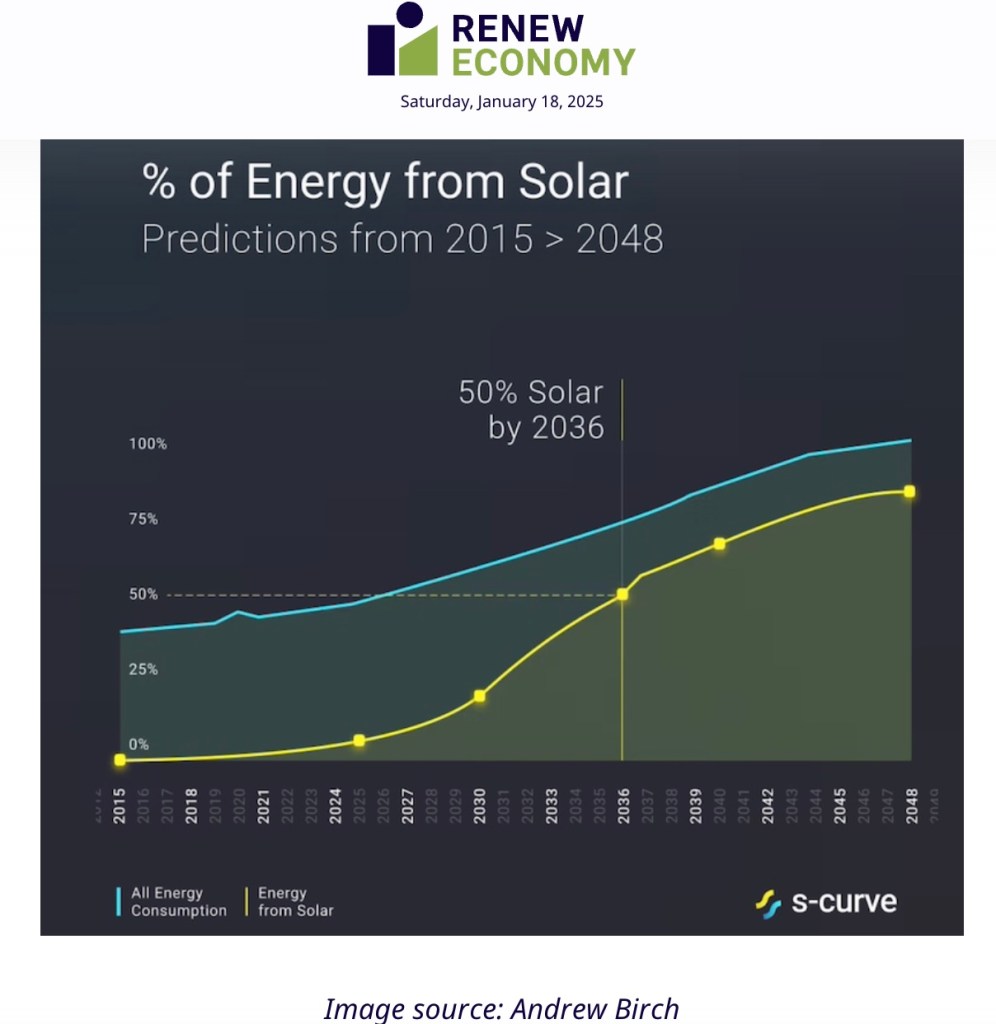
15 January 2025 – It’s the S-Curve, stupid: New model predicts half of world’s energy will come from solar by 2035. (Renew Economy) Electrification will also produce energy savings.
14 January 2025 – LA fires add to climate insurance crisis. Yes, even to insurance premiums here in Australia. Insurance premiums are rising more rapidly adding to inflation, driven by local and international climate disasters. This is adding to the Costs of Living and why we need rapid Emissions reduction not new coal and gas approvals, and a national climate adaptation risk assessment (the Australia Institute)
14 January 2025 – ‘Have some guts’: Sarah Hanson-Young challenges Labor to keep its environmental promises (Guardian)
14 January 2025 – Matt Kean, former Liberal Party NSW Treasurer and Energy Minister, now chair of the Climate Change Authority: Why the LA fires should spark economic alarm in Australia. (The Age)
13 January 2025 – Breese Street residents in Brunswick are working on greening their high density residential precinct, with a study by Melbourne University researchers helping them for ideas to build climate resilience and climate adaptation (Brunswick Voice)
10 January 2025 – Slash to Victorian solar Feed-in Tariff in 2025. A glut of energy during the day and rapid uptake of rooftop solar has prompted the state’s Essential Services Commission to propose cutting the minimum flat feed-in tariff to 0.04¢ per kilowatt-hour in the next financial year – drastically lower than the current 3.3¢. Rooftop solar in Victoria has increased by 76 per cent since 2019. “The huge uptake of solar in Victoria has helped push daytime wholesale prices to historic lows – meaning lower power bills for everyone,” said Victorian Climate Minister Lily D’Ambrosio (The Age)
10 January 2025 – David Spratt, a former member of Climate Action Merribek, calls for : Mobilise as if our lives depend on it (Climate Code Red)
10 January 2025. Copernicus, the European Space Agency, has confirmed that last year 2024, was the hottest year so far on record. It was 1.60°C warmer than the pre-industrial level making it the first calendar year to exceed 1.5 above that level. (Copernicus | Coment at The Conversation)
Key messages (Click to open)
- 2024 was the warmest year in multi-dataset record of global temperature going back to 1850.
- 2024 had a global average temperature of 15.10°C; 0.12°C higher than the previous highest annual value in 2023.
- 2024 was 0.72°C warmer than the 1991–2020 average, and 1.60°C warmer than the pre-industrial level making it the first calendar year to exceed 1.5 above that level[1].
- The last ten years have been the warmest ten years on record.
- Each month from January to June 2024 was warmer than the corresponding month in any previous year. August 2024 equalled the record warmth of August 2023 and the remaining months from July to December were each the second warmest for the time of year, after the corresponding months in 2023.
- There were three record seasons for the corresponding time of the year: boreal winter (December 2023–February 2024), boreal spring (March–May 2024), and boreal summer (June–August), at 0.78°C, 0.68°C and 0.69°C respectively above the 1991–2020 average.
- On 22 July 2024, the daily global average temperature reached a new record high of 17.16°C.
- Heat Stress: During 2024, much of the globe experienced more days than average with at least ‘strong heat stress’.
- Several regions of the globe also saw more days than average with ‘extreme heat stress’.
- The area affected by at least ‘strong heat stress’ reached a new record maximum on 10 July, when around 44% of the globe was affected by ‘strong’ to ‘extreme heat stress’. This is 5% more than the average annual maximum.
9 January 2025 – Los Angeles surrounded by fierce intense wildfires, over 10,000 buildings destroyed, several deaths, 180,000 subject to mandatory evacuation. Apocalypse or Armageddon, Wildfire Emergency, Climate Emergency (Live pages: NYT | LA Times | ABC News)
It’s an example of a “cascading disaster,” a situation involving “an initial shock” — in this case, a fire — that leads to a secondary shock: the strain on water systems, Aldrich says. See Palisades wildfires are ‘cascading disaster.’ Is California running out of water to fight fires? See also See Deep Sky Research Report: Extreme Wildfire Risk, for the increase in extreme fire weather risk in the US. See ABC News: How Santa Ana ‘devil winds’ and climate change are fuelling fire conditions in California.
David Bowman, Professor of Pyrogeography and Fire Science, University of Tasmania, identifies some lessons for Urban Australia: LA is on fire. How will Australia cope when bushfires hit Sydney, Melbourne or another major city? (The Conversation)
9 January 2025 – Hydroclimate volatility on a warming Earth. An important academic research paper to help understand global heating driving wild swings from dought to floods that we are seeing globally, and at present a factor in the LA fires. (Nature)
8 January 2025 – Santos gets a $10,000 slap on the wrist for 25,000 litre Pilbara oil spill… meanwhile it is greenwashing itself as principal sponsor of the UCI Tour Down Under Pro cycling event in South Australia… (Australia Institute)
7 January 2025 – In Global car manufacturing China is playing a long game and the future is electric. It poses issues for US and European vehicle manufacturers and even Trump’s proposed tariffs on China will be only a temporary band-aid (SMH)
6 January 2025 – Another $50 million in low interest loans offered to SMEs to buy EVs and renewables. These new loans are targeted towards farmers, freight companies and other small and medium businesses (SMEs) to get cheaper finance for EVs (the Driven)
6 January 2025 – Global warming surged last year, but there is also good news. Article outlines 6 areas of progress in Australia: (SMH)
- Electric buses are making cities cleaner and quieter
- Electric car sales remain strong
- Solar uptake keeps climbing
- Big batteries and wind farms are surging, too
- Transmission to move all this new power is on the way
- Heavy industry is catching up. NeoSmelt project in WA aims to make low emissions steel
6 January 2025 – Biden bans new offshore drilling in US coastal waters weeks before Trump handover. Ban includes entire Atlantic coast, eastern Gulf of Mexico, Pacific coast off California, Oregon and Washington, and part of Bering Sea. Some question whether this can be easily wound back unilaterally by Trump, or require Congress approval to reverse. (Guardian)
6 January 2025 – Rising temperatures with global warming causing Global water Cycle to be more energised with more torrential rain, floods, and flash droughts. Climate extremes in 2024 ‘wreaking havoc’ on the global water cycle (ANU | The Conversation) Here in Merribek last year we heard over 12,000 properties in our municipality are at potential flood risk.
4 January 2025 – ‘Ironic’: climate-driven sea level rise will overwhelm major oil ports, study shows. Ports including in Saudi Arabia and the US projected to be seriously damaged by a metre of sea level rise. (Guardian)
Sea Level Rise inevitable and 1 metre rise could come as early as 2070 (Click to see)
“The latest science published by the International Cryosphere Climate Initiative (ICCI) shows 1 metre of sea level rise is now inevitable within a century or so and could come as early as 2070 if ice sheets collapse and emissions are not curbed. An even more catastrophic rise of 3 metres is probably inevitable in the next millennium or two and could arrive as soon as the early 2100s.”
3 January 2025 – Faifax journalist Malcolm Knox proposes a national unity Government focused on climate action in the climate emergency after the next election. Is he dreaming? Well, if more Teal Independents are elected, it would make some sense. “After the federal election, whoever wins government must form a national, multi-party emergency cabinet on climate change, its purpose being to achieve net zero carbon emissions not by 2030 or 2040 but AS-frigging-AP.” (The Age)
2 January 2025 – Upfield Transport Alliance: Upfield and Craigieburn lines shafted in Metro tunnel budget cuts (Upfield Transport Alliance)
1 January 2025 – Changes starting on 1 January 2025 include Mandatory climate reporting for Large companies and the New Vehicle Emissions Scheme. (Guardian)
Large companies will be required to provide climate-related information in their annual financial reports from the financial year starting 1 January. Vehicle efficiency standards introduced so that the emissions of new cars will be capped to incentivise companies to supply low- and zero-emissions vehicles.
1 January 2025 – Cabinet documents from 20 years ago in 2004 reveal the conservative Howard Government failing to act on climate change, in failure to pursue an emissions Trading Scheme in 2003, failing to strengthen the Mandatory Renewable Energy Target introduced in 2001, and an Energy paper which recommended technology funding mostly focussed on carbon capture and storage. (The Conversation)
The Conversation on 2004 climate in cabinet documents (Click to Open)
“In 2003, Howard had vetoed a submission from his ministers to set up an emissions trading scheme. But in 2001, the government had adopted a Mandatory Renewable Energy Target. It aimed to reduce greenhouse gas emissions by encouraging additional renewable electricity generation.
“In 2004, Cabinet rejected recommendations to strengthen the target and released an energy White Paper.
“The paper shifted policy away from any consideration of emissions trading and toward technology. About A$1.5 billion of spending was mainly directed at the fossil fuel sector, primarily carbon capture and storage for coal or gas-fired generation.
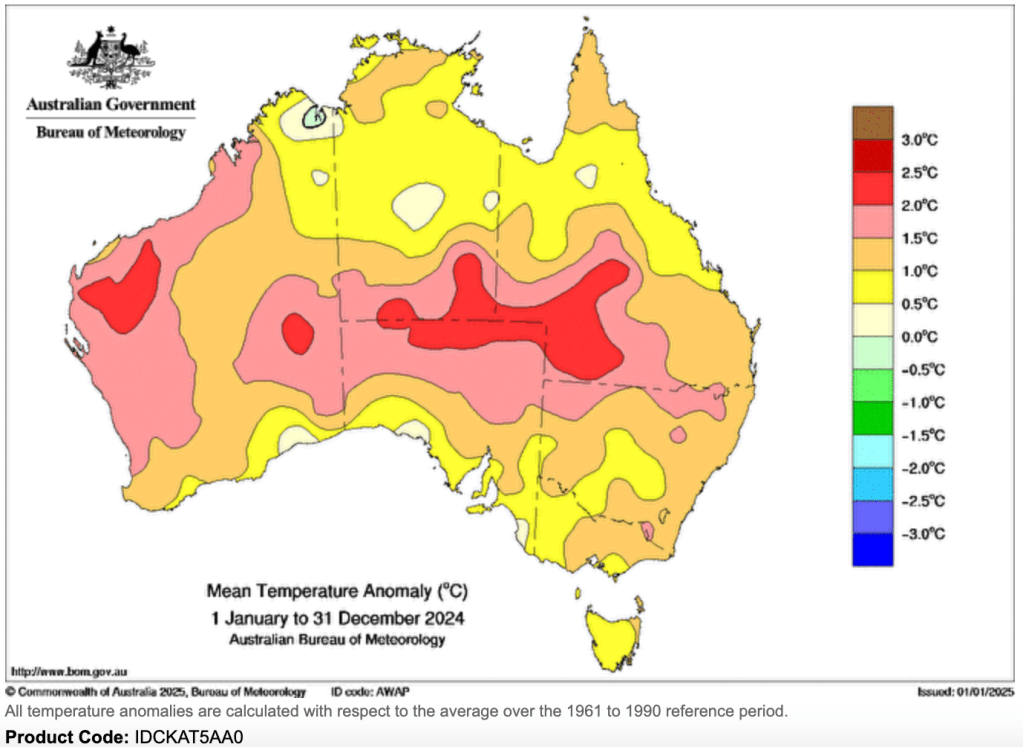
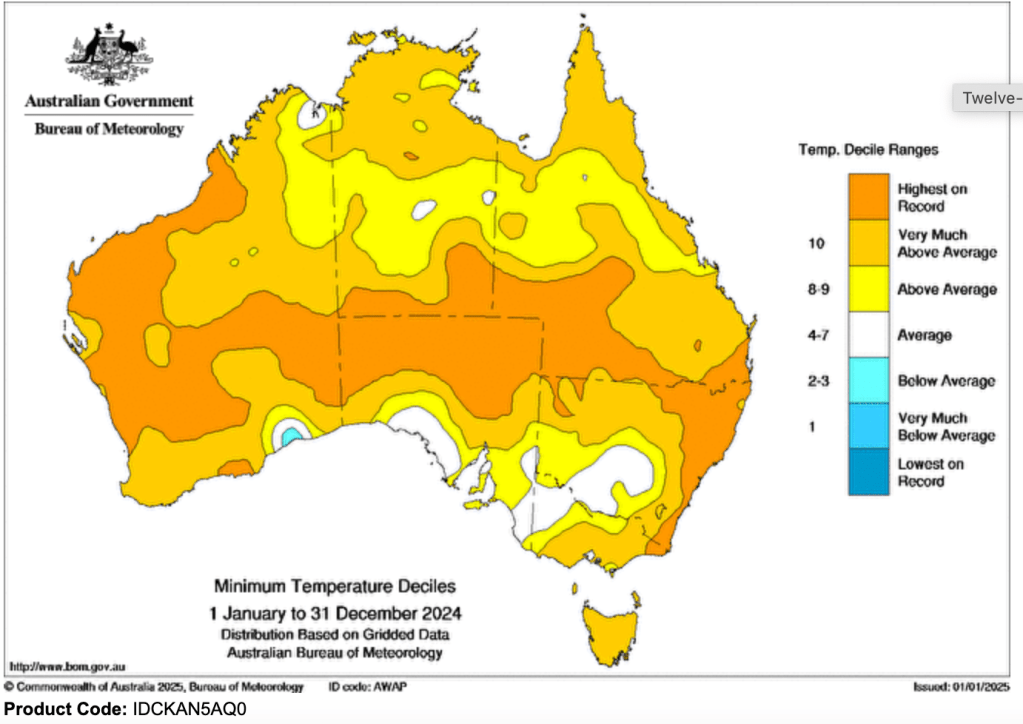
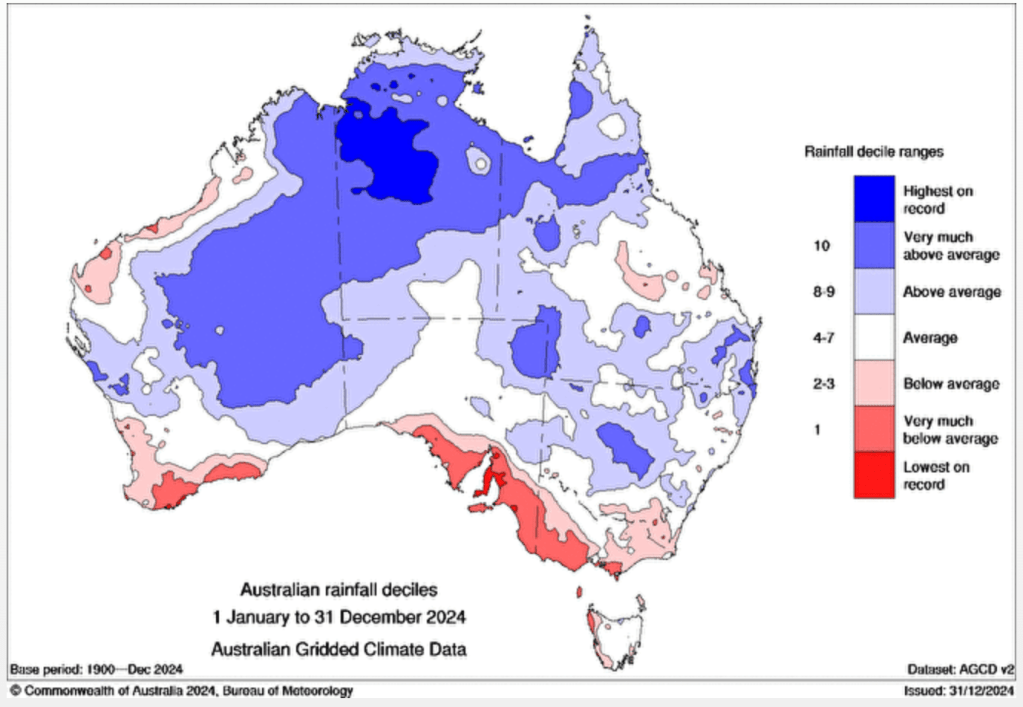
1 January 2025 – BOM climate maps show the Mean temperature anomaly for 2024, the Maximum and Minimum temperature deciles for Australia, and rainfall decile map showing a very dry Western Victoria, where the Grampians National Park BushFire burned 76,000 hectares.
See also: Australia just had its second-hottest year on record – and temperatures will rise again (The Age) BoM data finds 2024 was Australia’s second-hottest year on record (Guardian)
Australia’s climate in 2024 (BOM 2024 Annual Summary)
Temperature
- Australia’s second-warmest year since national records began in 1910, with the national mean temperature 1.46 °C warmer than the 1961–1990 average.
- The national mean maximum temperature was 1.48 °C above average, the fourth-warmest since national records began in 1910. The national mean minimum temperature was 1.43 °C above average, and the warmest since national records began in 1910.
- Warmth was persistent throughout the year. Nationally, summer 2023–24 was the third-warmest on record, winter was the second-warmest on record and spring was the warmest on record.
- Low-intensity to severe heatwave conditions affected large parts of Australia during early 2024 and from September to December.
Rainfall
- Nationally-averaged rainfall was 28% above the 1961–1990 average at 594.0 mm, making it the eighth-wettest year since national records began in 1900.
- Rainfall was above average for the Northern Territory, northern and inland areas of Western Australia, large parts of Queensland, northern and inland areas of New South Wales and western and north-eastern parts of South Australia.
- Rainfall across northern Australia as a whole (north of 26° S) was 42% above the 1961–1990 average, making it the fifth-wettest year since national records began in 1900 and the wettest since 2011.
- Rainfall was below average for parts of north-west and south-west Western Australia, southern areas of South Australia, most of Victoria, western and southern areas of Tasmania, south-eastern New South Wales and parts of Queensland’s central interior and central coast.

 Climate Action Merribek