This submission could have been very brief: We oppose lifting the emissions cap for a sector with so many environmental and health risks involved. Further, we call for re-assessment of the Waste to Energy Framework. That Waste to Energy is basically fossil fuel power and does not belong as part of a circular economy.
We see in Europe toxic contamination around waste to energy plants affecting agriculture and environment and warnings on human health. There are initiatives to wind back use of Waste To Energy and implement recycling schemes and advanced management of residual waste in landfill.
We call for the design of a novel waste management system for Victoria, consistent with the DCCEEW Framework and free of waste incineration.
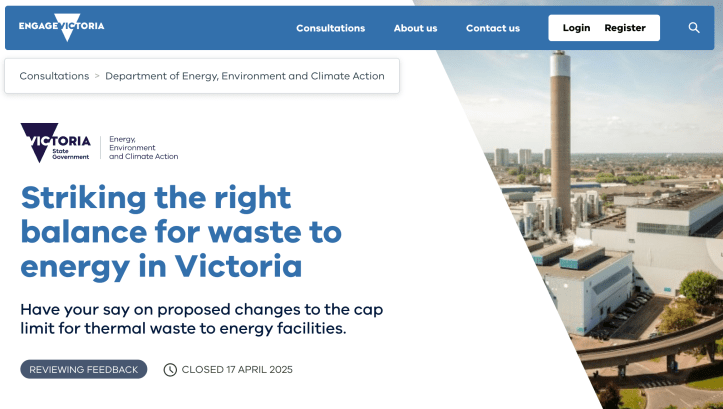
Find below our submission to the Victorian Department of Energy, Environment and Climate Action. See the Enagage Victoria page for details.
Executive Summary and recommendations
We have had limited time to read the Regulatory Impact Statement, but even so we think the benefits do not outweigh the risks and long term costs. We don’t think the health and environmental risks have been adequately factored into the cost benefit analysis.
- We Oppose lifting the cap.
- We Call for a Reassessment of Waste to Energy Framework.
- We support pursuing recycling solutions and waste minimisation
- Repeal the Circular Economy (Waste Reduction and Recycling) (Waste to Energy Scheme) Regulations and all attendant Laws and Regulations.
- Revoke all licences and Planning Permits for waste incineration projects.
- Repeal all the current laws and regulations relating to the calculation of greenhouse gas emissions, and start again. Current practice is based on the obsolete assumption that THE alternative to incineration of waste is landfill, with largely unrestrained emissions to atmosphere of methane from buried putrescible matter. Modern practice is now very different and evolving rapidly.
- EVERY proposal for a waste management facility should be required to have an INDEPENDENT Environmental Effects Statement (EES). Same for Health Impact Assessments.
- Ensure that EVERY proposal for a waste management facility is accompanied by a Business Case consistent with the guidelines specified by the Department of Treasury and Finance. Each Business Case to be made public.
- Where there is a requirement for a “Fit and Proper Person” to be responsible for an EPA licence, ensure that the “Fit and Proper Person” is actually a specific named human being who can be prosecuted (an Australian citizen and resident), and not just a corporation with limited liability.
- Ensure that the EPA actually evaluates each development proposal submitted to it rather than accepting its claims, assurances and vague assertions untested.
- Forbid the practice of issuing a licence for a project that has an incomplete design. (Due to advances in technology, it may be found that design improvements are possible/desirable AFTER the licence has been issued, in which case the proponent must apply for an amendment to the licence.)
- EPA and/or DEECA to immediately reject proposals that are written in “weasel words”, that is, lacking in detail, commitment and accountability.
- Empower the EPA to impose deadlines for the submission of documentation, in breach of which the project is automatically REJECTED.
- Forbid the EPA’s practice of issuing “licences with conditions”. Forbid the EPA from issuing licences IN ADVANCE of meeting the requirements. These practices are MALFEASANCE. The proposal either meets the requirements, or it is REJECTED by the authorities. “Licences with conditions” is open to abuse and corruption, and certainly undermines the EPA’s authority and social licence.
- Forbid the EPA from issuing a licence for a project, in the absence of a comprehensive suite of emergency procedures which are to apply during construction, commissioning and normal operations. Emergency procedures must include plans for evacuation of the site and environs.
- Forbid the EPA from issuing licences in the absence of social licence for the project, or in defiance of community expectations.
- Forbid the practice of publicly announcing a project approval in the absence of the proponents. Both the Applicants and the Decision Makers must face the public together. (If the guys who want to do this don’t turn up, we all go home.)
- Study the new policy from DCCEEW “Australia’s Circular Economy Framework” and design a novel waste management system for Victoria, consistent with the DCCEEW Framework and free of waste incineration.
- Implementation of DCCEEW’s “Australia’s Circular Economy Framework” will involve invention of entirely new waste management industries. The Victorian government to ensure that the Chief Health Officer is directed to report on the public health implications of every type of new waste management industry.
- Collect “baseline data” regarding key health and environmental parameters BEFORE construction of any waste management project, then periodically after construction, with analysis of the data to find statistically significant differences. This can be considered a “permanent epidemiological study”.
- Empower the EPA to impose a BOND of substantial proportions on each project which has significant potential for harm to public health and/or environment. EPA to stipulate rules for drawing on the BOND for “emergency actions”, “cleanup expenses”, and compensation.
- Enshrine in EPA standard practice a requirement that new waste management facilities must provide a continuous stream of data to the public via the internet regarding key process parameters that may have an effect on public health or the environment.
We also put forward our Submission to the EPA on: Wollert Waste to Energy Incinerator. We ask that this fully detailed submission also be considered in our argument opposing lifting the cap and calling for reassessment of the Waste to Energy Framework.
 Climate Action Merribek
[…] more information refer to the submission to EPA Victoria that John Englart and Pauline Galvin wrote on behalf of Climate Action Merri-bek in April last […]
LikeLike